
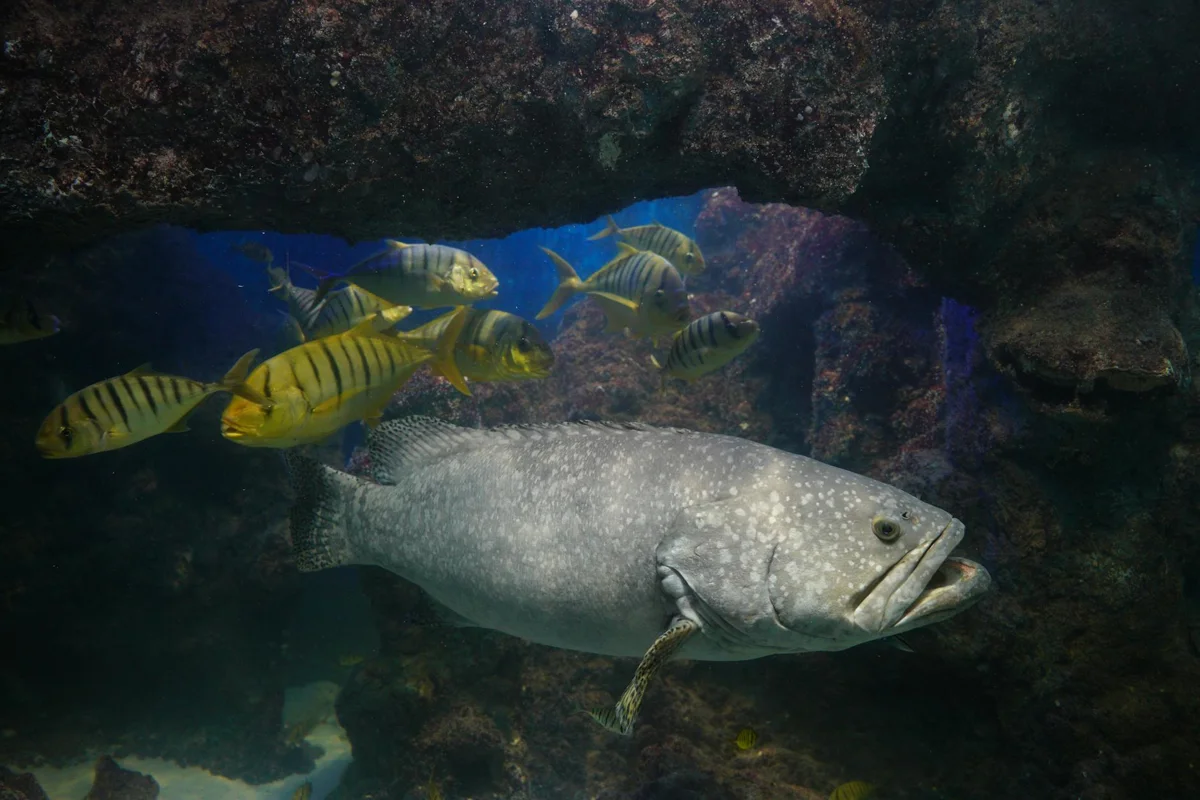
The goliath grouper is among the largest bony fish in the Caribbean and one of the few genuine recovery stories in marine conservation. Adults can reach 400 kg, with jaws wide enough to engulf a diver whole. Florida holds the world's densest spawning aggregations each August–September. For serious underwater photographers, it ranks among the defining encounters of the tropical Atlantic.
The goliath grouper (*Epinephelus itajara*) dominated the reefs of the Caribbean and tropical Atlantic for millennia. Typical adults measure 1.5–2.5 m and weigh 100–300 kg; documented maximums reach 3 m and 400 kg. The cavernous mouth closes by suction, swallowing prey whole rather than biting. With a lifespan exceeding 50 years and sexual maturity delayed to 5–8 years, the species had no defence against industrial and recreational harvest. Its historic range stretched from Florida and Carolina south through the Bahamas, the wider Caribbean, coastal Brazil, and pockets of West Africa.
The collapse played out slowly, then all at once. Between 1950 and 1990, spearfishing and hook-and-line pressure reduced Florida populations by 80–90 %. The IUCN listed the species as Critically Endangered. By 1990 Florida banned all take completely — a moratorium that would eventually prove one of the Atlantic's most consequential fishery decisions.
Recovery has been steady since the moratorium took effect. Florida's summer reefs and wrecks now host seasonal spawning aggregations from July through October at depths of 25–50 m. Fifty to two hundred adults gathering on a single wreck structure is not unusual. The Castor off Boynton Beach, the USS Spiegel Grove in the Florida Keys, and several artificial reefs have become fixtures on the aggregation circuit, drawing divers from across the Atlantic.
The aggregation unfolds in predictable stages. Males arrive at the wreck in July and establish loose territories. Females move in during August. Actual spawning happens at night around the August and September full moons. During daylight dives, goliath groupers are remarkably indifferent to divers — they hover in mid-water, manoeuvre slowly around camera rigs, and occasionally approach to investigate. Florida operators run dedicated wreck dive trips throughout the season.
The acoustic dimension of an aggregation surprises first-time visitors. Goliath groupers produce a deep boom sound — a resonant drum-like pulse felt as much as heard — used for territorial signalling between competing males. Experienced divers learn to recognise the calls and track individual fish by sound before spotting them. Encountering a 250–300 kg female hanging motionless at arm's length, studying the diver with one enormous amber eye, requires no annotation.
Outside Florida, options thin out. The Bahamas holds goliath groupers in warmer shallows but at lower densities. Cuba's Jardines de la Reina hosts recovering populations under strict protection. Brazil's northeast coast carries the largest genetically distinct stock, still rebuilding since its 2002 moratorium. West African waters — Senegal, Mauritania — remain poorly documented. For consistent, high-density encounters, Florida has no rival.
Getting there from Europe is straightforward. Transatlantic flights land at Miami or Fort Lauderdale; the aggregation sites are within 30–60 minutes by dive boat. Operators based in Boynton Beach, Jupiter, and the Florida Keys — including Pura Vida Divers, Florida Underwater Sports, and Loggerhead Outfitters — run guided wreck dives for 100–150 USD per dive. Packages covering four to six dives during aggregation season typically run 600–800 USD.
The goliath grouper stands as one of the clearest conservation wins the western Caribbean has produced. Florida in August and September delivers encounters that are consistently large in scale and relatively easy to access. A week can include the aggregation wrecks alongside less-visited sites like the USS Vandenberg or USS Oriskany for a wreck dive programme with real variety. As a subject for underwater photography — or simply as evidence that population recovery is achievable — it repays the trip.