
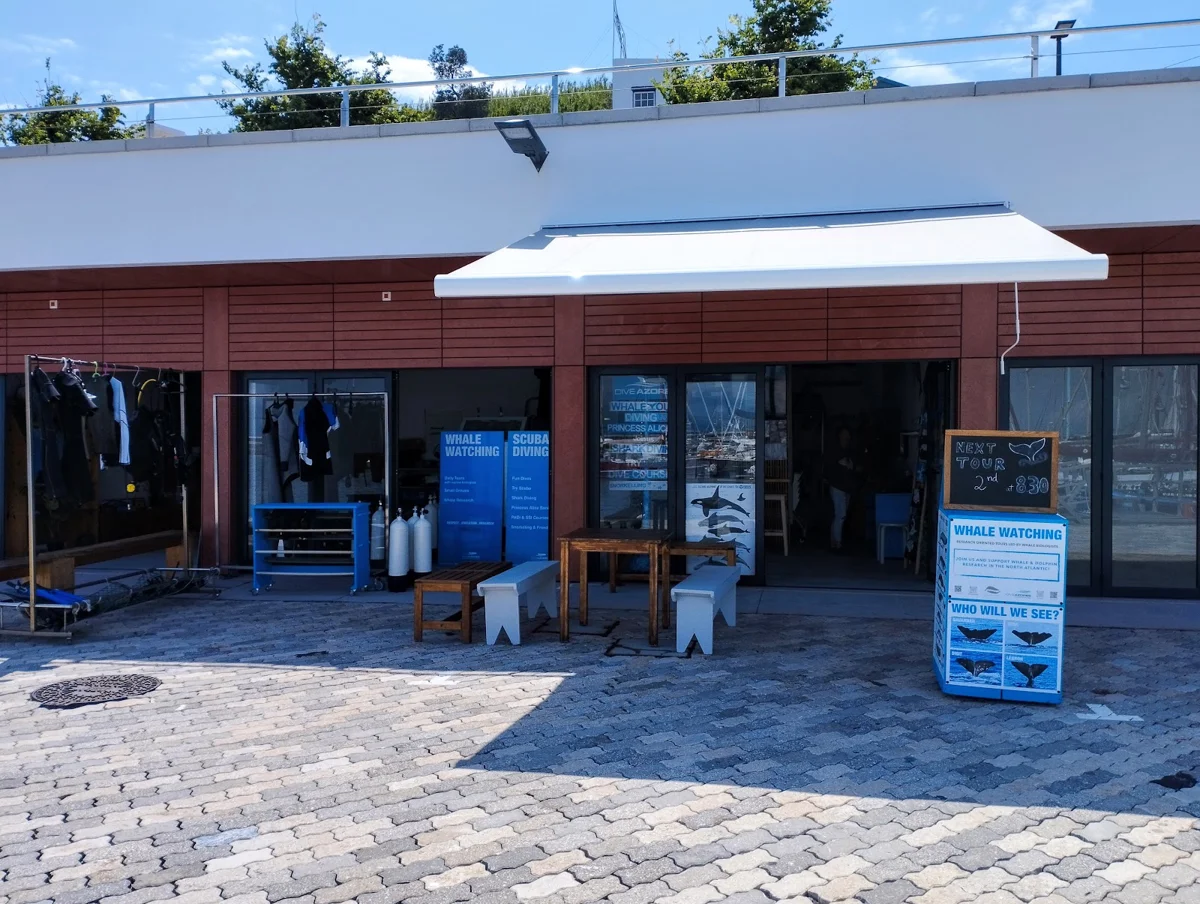


Dive Azores . Whale Project Azores
Marina da Horta, Cais de Santa Cruz, Shop, A-2, 9900-026 Horta, Portugal, Horta, Horta, PRT
Sobre el Centre
Dive Azores, amb seu a Horta, Portugal, és un centre de busseig i operador d'observació de balenes dirigit per biòlegs marins des del 2002. Situat a l'illa de Faial, a les Açores, és conegut per la seva vida marina verge i la seva ubicació remota i fora dels circuits turístics habituals.
El centre ofereix una experiència immersiva en el món marí de les Açores, combinant visites respectuoses i educatives d'observació de balenes i dofins amb oportunitats de busseig autònom i apnea. Les seves instal·lacions inclouen allotjament, lloguer d'equips, armariets i omplert d'aire amb nitrox, a més d'opcions de busseig nocturn. La seva dedicació a la conservació i la recerca marina és un pilar fonamental de les seves operacions.
Dive Azores ofereix cursos PADI i SSI, incloent especialitats com Advanced Open Water i Apnea, així com immersions úniques a llocs com el banc Princess Alice i experiències de busseig amb taurons oceànics amb tintoreres. El centre també participa activament en programes de recerca i conservació, oferint oportunitats de pràctiques i assistència per a estudiants i voluntaris interessats en biologia marina i protecció oceànica.
Cursos Disponibles
4 cursosDolphin School
The Dolphin School was developed specifically by Joana and Tiago — both marine biologists and diving instructors — based on their years of working with dolphin populations in the Azores. It is not a generic snorkelling holiday bolted onto a whale watch tour. The program is structured around building skills and understanding that let participants interact respectfully with wild pods, and the curriculum reflects the scientific background of the people running it. The program spans 4 days of activities over 7 nights, running in July, August and September when sea conditions are most favourable. Included are three tours to snorkel with wild dolphins, one whale watching tour aboard the centre's RIB vessel, training sessions, and an educational lecture on species identification and dolphin behaviour. A certificate of participation is issued on completion. All snorkelling equipment is provided. Accommodation is in a shared apartment or house with a kitchen, located 15 minutes on foot from the Dive Azores base at Horta's marina. Airport transfers are included. Couples, friends or families who prefer private accommodation can arrange it in advance at an additional cost. Flights, food and daily living expenses, travel insurance and any additional activities are not included in the base price. Participants must be 18 years of age or older, have good swimming skills, and come with prior snorkelling experience — this is a firm requirement, not a suggestion. The dolphin swims depend on sea conditions and animal behaviour; if a session is cancelled due to rough seas or because the dolphins are not behaving in a way that permits the activity safely, it is rescheduled rather than skipped. Faial's waters are known for several dolphin species that are present throughout the summer: common dolphins, bottlenose dolphins and Risso's dolphins are resident year-round, while Atlantic spotted and striped dolphins appear in greater numbers in summer. The briefings and in-water approach are designed around the specific behaviour of these animals in this location — something that comes from two decades of research rather than a generic responsible-watching protocol.
Introductory Scuba Dive (Try-Dive)
The try-dive at Dive Azores is the entry point for non-divers who want to get underwater around Faial without committing to a full certification course. It is led by the same team of licensed dive guides and marine biologists who handle all the centre's guided dives — there is no separate track for beginners that gets handed to a junior member of staff. Faial has beginner-friendly sites close to Horta, with Entre Montes being the most accessible: a gentle volcanic slope from 5 to 20m, sand patches, stingrays, parrotfish cleaning stations. For a first-time diver this is a good introduction to what the Azores actually looks like underwater — subtropical species, clear water, volcanic terrain — without the exposure to current or depth that characterises the advanced sites. All rental equipment is MARES, annually serviced. The 7mm one-piece wetsuits are appropriate for Faial's water temperatures, which sit around 21–23ºC in summer. Tanks are 12L or 15L steel with DIN and Yoke fittings. A detailed briefing is run before every dive, and the crew helps participants gear up on board when the boat reaches the site. For anyone who wants to go further, Dive Azores runs the complete PADI and SSI lines from this same base. The SSI e-learning option allows the theory portion to be completed at home before arriving, so the in-water time in Faial is used entirely for practical training.
PADI / SSI Dive Courses (Beginner to Professional)
Dive Azores offers the complete PADI and SSI course lines from beginner through to professional level, taught by a team of experienced instructors in English, Portuguese, Spanish and French. The SSI e-learning system is highlighted as the flexible option for people with busy schedules: complete the theory online at home, then arrive in Faial ready for the in-water portion of the certification. The centre's stated teaching philosophy is performance-based rather than quota-based. Students progress at their own pace, and the instructors describe the approach as rigorous — no shortcuts in skill assessment, no pushing people through before they are confident. Recreational diving takes time to manage properly underwater, and the emphasis here is on producing divers who can dive safely anywhere in the world, not just in the controlled conditions of the certification dives. For beginner courses, Faial's sheltered sites close to Horta provide the right conditions for skill development. Entre Montes — a gentle volcanic slope from 5 to 20m with good visibility — is the kind of site where a new diver can work through buoyancy and equipment skills without the current or depth exposure that characterises the advanced sites. The marine life is genuine: stingrays, groupers, parrotfish, barracudas even at the shallower end. Advanced and specialty courses open up the rest of what Faial offers. Boca das Caldeirinhas (to 40m), Radares (drift, moderate to strong current, eagle rays), and Furnas (volcanic caverns) are all within the reach of certified divers working through their advanced qualifications. Princess Alice Bank, requiring Advanced Open Water certification and 30 logged dives minimum, is the end goal for many visiting divers who want to experience the mobula rays and pelagic life of the seamount. Professional-level courses are also available for those pursuing dive instructor or divemaster qualifications.
Freediving Courses
Freediving at Dive Azores is available both as structured courses and as guided fun dives for already-certified freedivers. The same team that runs the scuba operation handles the freediving, and the same marine biology background applies: briefings are detailed, the sites are matched to the participants' level, and the surrounding marine environment is the actual draw. Faial's underwater terrain — steep walls, volcanic arches, seamounts and caves — works well for freediving as well as scuba. The variety of depths and topographies within a short boat ride from Horta means that training sessions can be adapted to different stages of the certification progression. The blue water shark diving and Princess Alice Bank expeditions also have a freediving component: advanced freedivers holding AIDA 3, SSI 2 or Apnea Academy 2 certification can join both of those offshore expeditions. For the shark diving, freedivers enter blue open ocean water alongside the scuba divers, with blue sharks typically encountered at 1.5 to 3m length circling in open water. For Princess Alice Bank, the mobula rays — often found between the surface and 30m — are accessible to freedivers throughout the surface interval and during the structured in-water time. Both expeditions require the relevant advanced freediving certification and a check-out evaluation beforehand. Water temperatures for freediving on Faial peak at 23ºC in August–September, dropping to 16ºC in February–March. The best months are July through September, coinciding with the peak visibility windows and the offshore expedition seasons.
Servicios
Instalaciones
Especialidades
Marcas con las que trabajan
Destinos & viajes
Puntos de buceo recomendados
Los spots que ofrece este centro a sus alumnos
Galeria(12)
Clima
Promedio anual
Datos históricos por mes para planificar tus inmersiones
Ressenyes d'usuaris
Deixa la teva opinió
Inicia sessió al teu compte de bussejador per valorar aquest centre o curs.
Iniciar SessióPreguntas frecuentes
Las dudas más habituales de quienes están a punto de reservar
Advanced Open Water certification (or equivalent) and a minimum of 30 logged dives. A mandatory check-out dive to assess skills and equipment is required before the trip. The site involves strong currents and no bottom references for much of the dive, so it is not suitable for inexperienced divers. Inexperienced scuba divers can join as snorkelers.
Courses are conducted in English, Portuguese, Spanish and French by Dive Azores instructors.
All rental gear is MARES: BCDs, regulators, 7mm one-piece neoprene wetsuits with hoods, 3mm booties and gloves, adjustable fins, and 12L and 15L steel tanks with both DIN and Yoke fittings. Dive computers, torches and SMBs are also available for rent. Air is filled with a Bauer compressor.
A 25% refund is issued if no sharks appear. The quoted success rate for blue shark sightings is above 90%, but Dive Azores acknowledges that sightings cannot be guaranteed as blue sharks are highly migratory. The best season is July to September.
Yes — Horta's hospital has a hyperbaric chamber. For offshore dives such as Princess Alice Bank, the nearest recompression facility is 2 to 2h30 away, which is why Dive Azores enforces conservative, non-decompression-limit dive profiles on those trips.
Groups are normally limited to a maximum of 5–6 divers per dive guide. The centre aims to match divers of similar experience levels within each group.
The Dolphin School is a 4-day/7-night residential program running in July, August and September, developed by Joana and Tiago based on their work with dolphins in the Azores. It includes 3 snorkelling sessions with wild dolphin pods, 1 whale watching tour, training sessions, educational lectures, snorkelling equipment, airport transfers, 7 nights in shared accommodation 15 minutes from the base, and a certificate of participation. Participants must be 18 or older, have good swimming skills and prior snorkelling experience. The price starts from 795 EUR per person.
July, August and September are the best diving months. Water temperatures reach 21–23ºC, visibility at Princess Alice Bank runs 25–30m, and this is also the peak season for blue shark encounters and mobula ray sightings at Princess Alice. Whale watching runs from March to November, with spring bringing blue, humpback and sei whales and summer peaking for sperm whales.
Cómo llegar
Marina da Horta, Cais de Santa Cruz, Shop, A-2, 9900-026 Horta, Portugal, Horta, Horta, PRT


