Discover how to start apnea and freediving safely. Learn about AIDA disciplines, the best spots on the Spanish coast to practice, and how to find courses and training partners.
Freediving and apnea have gone from being disciplines reserved for a few to becoming one of the fastest-growing underwater activities in Spain. More and more people are seeking to explore the sea in its purest form, without a tank, relying solely on lung capacity and the connection between body and mind. If you feel the call of the ocean and want to know how to get started safely, this article gives you everything you need to begin properly.
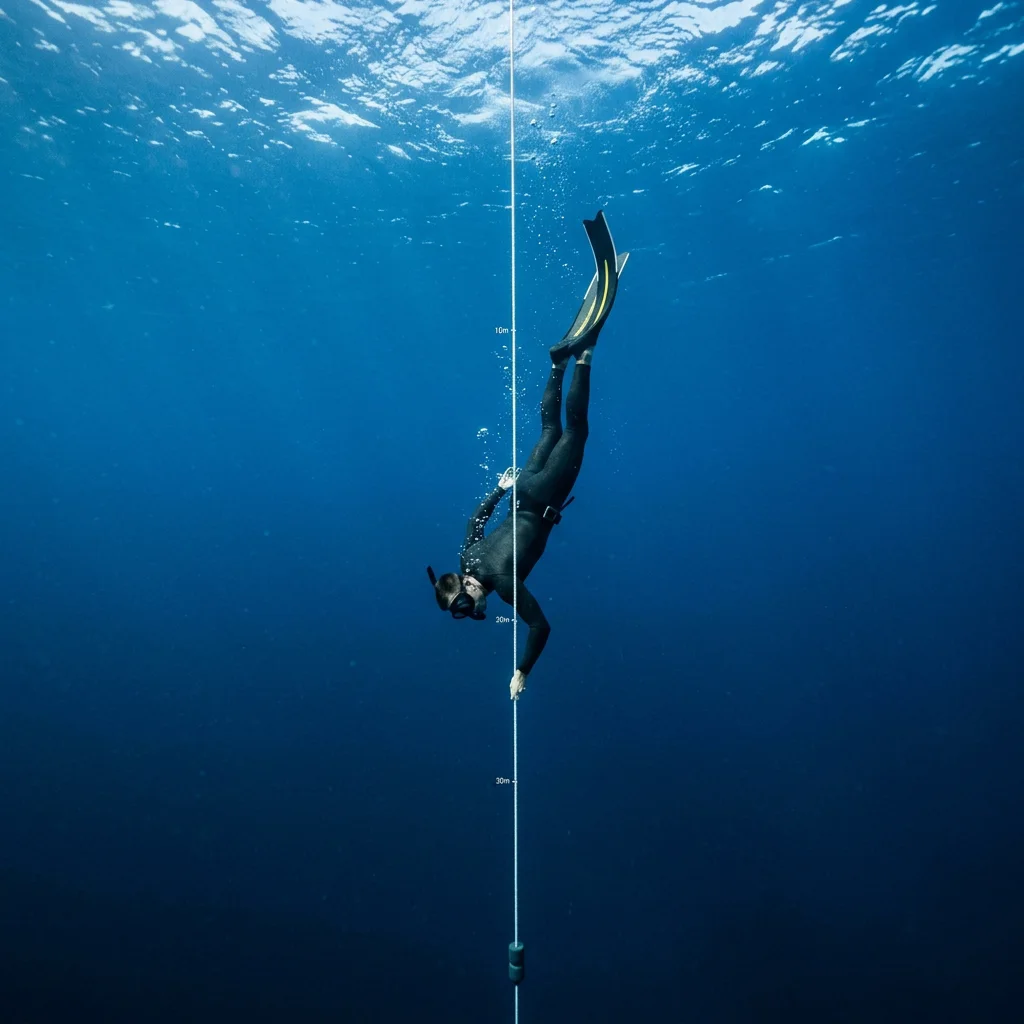
AIDA International is the world reference for freediving and recognizes more than eight competitive disciplines, from static apnea in a pool to depth dives using different types of propulsion. The best known to the general public is CWT (constant weight), which involves descending and ascending using only fins. It was precisely in this discipline that Alexey Molchanov set a new world record in 2025 by reaching 125 meters.
One of the most fascinating aspects of freediving is the physiological response it generates in the body. During a prolonged dive, elite freedivers experience what is known as the mammalian dive reflex, which dramatically slows the heart rate: in the world's best freedivers, the heart can beat at fewer than ten beats per minute. This mechanism, inherited from our aquatic ancestors, redistributes blood to the vital organs and allows much longer time underwater.
Safety is the absolute cornerstone of responsible freediving. Unlike scuba diving, freediving is never practiced alone: the golden rule is to always work with a buddy who supervises every dive. Blackout — loss of consciousness due to hypoxia — can occur without warning and is the leading cause of serious accidents in the sport. Finding reliable training partners is just as important as the training itself.
If you want to build solid foundations, the most recommended approach is to complete a course accredited by AIDA or SSI. These courses teach breathing techniques, equalization, buddy safety, and the fundamentals of freediving physiology. Along the Spanish coast there are excellent options: the Costa Brava and the Catalan coastline, Cádiz with its mild temperatures, and Málaga and Sevilla with very active freediving communities.
Once the first steps are behind you, progression comes through consistent training and diversification of disciplines. Many freedivers discover underwater rugby as a perfect complement — a team sport in a pool that develops spatial orientation underwater, apnea endurance, and the ability to make decisions under low-oxygen conditions.
A symptom that worries those starting out in apnea is a cough after diving. This response is completely normal and is usually caused by irritation of the airways from salt water. However, if the cough is persistent or accompanied by pink sputum, it may indicate dive-induced pulmonary edema, a condition that requires medical evaluation.
Freediving is much more than a sport: it is a philosophy of connection with the aquatic environment and with oneself. Progression is not measured only in meters of depth or seconds of static apnea, but in the quality of presence underwater and in the bond created with the community of people who share this passion.