
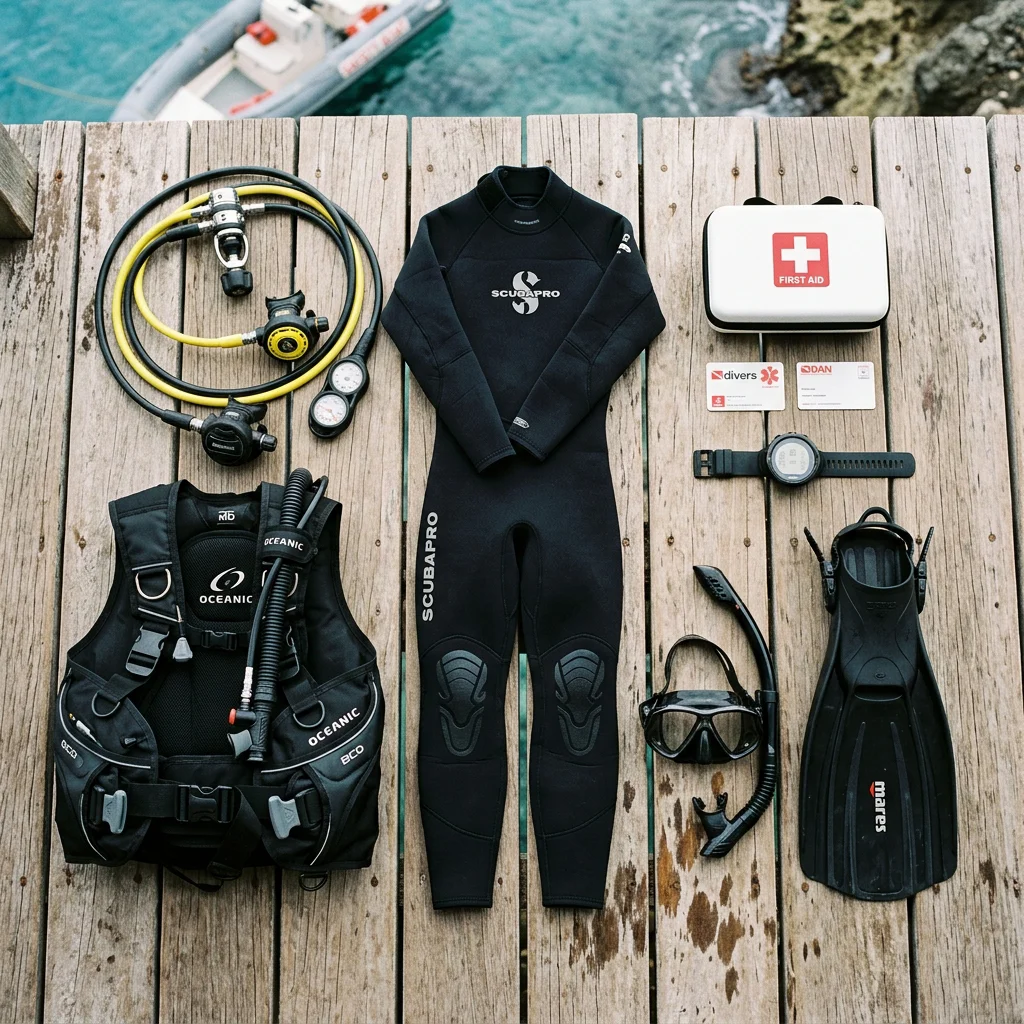
A hyperbaric chamber treatment costs $800-2000/hour. DAN offers plans from $40/year. Conventional travel insurance does NOT cover diving.
There is an important gap between what most divers believe their insurance covers and what it actually covers when an accident occurs. That gap has a concrete and often devastating cost: a hyperbaric chamber session can cost between 800 and 2,000 dollars depending on the country and the facility, and a complete decompression treatment typically requires multiple sessions. A medical air evacuation from a remote diving destination, such as the Maldives, the Galápagos, or Indonesia, can range from 25,000 to 40,000 euros depending on the distance and the type of aircraft required. These are not theoretical scenarios: they happen several times a year, and the divers who face them without adequate coverage find themselves in a financial crisis as serious as the medical one.
The most widespread first mistake is trusting that the travel insurance taken out with a plane ticket or through a bank covers diving accidents. In the vast majority of cases, it does not. Standard travel policies include clauses that explicitly exclude high-risk activities, and autonomous scuba diving is categorized as such in almost all contracts. Even travel policies that do not generically exclude diving typically limit coverage to recreational shallow diving or diving with an instructor, excluding autonomous dives beyond a certain depth. Reading the fine print before assuming you are covered is an exercise that can save tens of thousands of euros.
DAN, Divers Alert Network, is the world reference organization for diver-specific insurance. Its membership plans start from approximately 40 dollars per year for US residents, with coverage that can reach 500,000 dollars for diving-related medical expenses, including hyperbaric chamber treatment, emergency evacuation, and repatriation. DAN has agreements with hyperbaric chambers and medical centers at the main diving destinations around the world, which means that in many cases coverage is arranged directly between DAN and the medical center without the diver having to advance funds. This characteristic is especially relevant when the accident occurs in a country where the diver does not have access to sufficient local funds.
The federated insurance that accompanies a diving license from national federations, such as FEDAS in Spain, offers basic coverage that should be understood in detail. It generally includes third-party civil liability, accidents during federated practice, and medical assistance in certain circumstances. However, federated coverages are designed for sports practice on national territory and under normal recreational diving conditions. Their indemnification limits are typically significantly lower than those of a specific policy such as DAN, and their coverage abroad may be limited or non-existent. The federated license and a specific diving insurance policy are not mutually exclusive: they are complementary, and having both is the optimal situation.
When a diving accident occurs abroad, the administrative complexity multiplies. You must simultaneously manage immediate medical care in an unfamiliar healthcare system, communication with the insurer from a country with possible language barriers, coordination of the evacuation if the local facility cannot adequately treat the accident, and the logistics of the return. DAN has a medical emergency hotline operating 24 hours a day, 365 days a year, staffed by physicians specializing in hyperbaric medicine who advise both the casualty and local medical teams. This medical advisory service is free even for non-members, although financial coverage is reserved for those who have a membership.
Technical diving and diving in higher-risk specialties, such as caves, deep wrecks, or diving in intense currents, generally require insurance with specific coverage or policy extensions that are not included in standard plans. A technical diver who practices dives with gas mixes, exceeds 40 meters in depth, or enters overhead environments should explicitly review with their insurer whether these activities are covered. DAN offers specific plans for technical diving with adapted coverage. Assuming that the standard policy covers all variants of the activity without verifying it is one of the most costly mistakes an advanced diver can make.
There are aspects related to diving that no insurance covers, and the diver must know these to avoid unpleasant surprises. Diving equipment damaged or stolen during a trip is generally not covered by a health or accident policy: it requires specific equipment insurance or an extension to a home policy. Pre-existing conditions that worsen during a dive can generate disputes with the insurer over whether the claim is related to diving or to the prior condition. And dives carried out without the appropriate certification for the type of dive being performed, such as a basic diver entering a cave, can lead to coverage being voided on grounds of gross negligence.
Taking out a specific diving insurance policy before each season or before each trip to a diving destination is not an expression of pessimism or insecurity: it is simply the rational decision of someone who has done the math. Compared to the cost of a hyperbaric treatment, an air evacuation, or a repatriation, the annual cost of a DAN membership is negligible. The question is not whether it is worth having specific coverage. The question is why someone who has invested in equipment, training, and travel to dive would choose not to protect all of that with the right policy.