
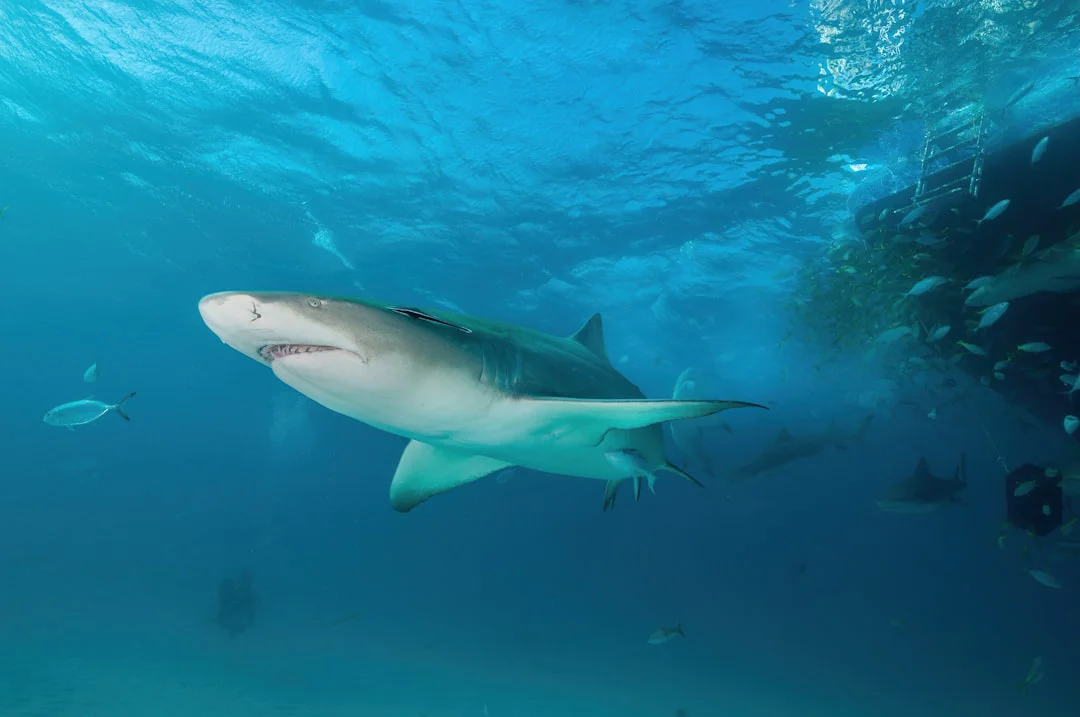
Tiger Beach is a sandflat off the northwest tip of Grand Bahama, in shallow water (8–12 m), hosting one of the world's most reliable tiger shark aggregations for recreational diving. No cage, no hook, in crystal-clear warm water. A specialist destination for shark photographers and divers after an intimate encounter with an apex predator.
Tiger Beach sits 32 km northwest of West End, Grand Bahama — a shallow sandflat (8–12 m) reachable by fast boat in an hour from West End, or by liveaboard from Florida. Conditions are consistently good: 30–40 m visibility in the clear Bahamas water, warm temperatures (24–28 °C), minimal current, and a white-sand bottom that bounces natural light upward.
The headline species is the tiger shark (*Galeocerdo cuvier*), resident here through the winter months (October to March). Large females, typically 3.5–4.5 m, dominate the encounters. Lemon sharks (*Negaprion brevirostris*) are a constant companion, joined by Caribbean reef sharks and occasional nurse sharks. Numbers aren't overwhelming — what sets Tiger Beach apart is the proximity: individual tigers gliding past at arm's length over bare white sand.
Every dive here is a baited dive. Operators anchor over the site, lower a chum box packed with fish scraps, and divers take up positions at 8–10 m around it. Sharks typically arrive within minutes. A single dive runs 60–90 minutes with 3–8 different tigers cycling through, always surrounded by a loose constellation of lemon sharks. No cage, no hook.
The ethical dimension: baited diving divides opinion. Critics argue it disrupts natural behaviour, conditions sharks to associate humans with food, and may raise risk for swimmers elsewhere. Supporters counter that without the shark-diving economy these animals would be fished out, and that population studies show no meaningful shift in migration patterns. Whether to participate is a personal ethical call.
Getting there: fly to Freeport (Grand Bahama) from the US (Miami, Fort Lauderdale) on regional carriers. From Europe, connect through Miami. A popular alternative is a 5–7-day liveaboard out of Florida — West Palm Beach or Riviera Beach — pairing Tiger Beach with other Bahamian sites. Operators include Aqua Cat, Tiburon Safari, and Carbiribbean Explorer II. Liveaboard cost: €3,500–5,500 for five to seven days; flights from Europe add roughly €1,000–1,500.
What catches divers off guard is the calm. You're on a shallow sandflat in clear water, a 4 m tiger shark passing within arm's reach, and the overriding sensation is stillness. Tigers on a controlled bait aren't aggressive — they circle, approach, move on. Experienced divers report more adrenaline on a heavy-current drift dive than across an entire session at Tiger Beach. The answer is training and professional conduct.
The main drawback is bait dependency. Divers uncomfortable with the method won't find a clean alternative here. Cage-free, baitless shark encounters exist — Aliwal Shoal (South Africa) during ragged-tooth season, or the Galápagos — but the intimacy and photographic quality rarely match Tiger Beach. For underwater photographers wanting tigers, this is the best venue in the world, bait and all.
Tiger Beach is a specialist destination. For those who accept baited diving, it offers the finest tiger shark encounter on the planet. For those who don't, it's a site to skip. That line is ethical, not technical. Paired with Caribbean reef diving and a stop in Nassau, it makes a strong case for a week in the Bahamas. There aren't many chances to look a 4 m tiger in the eye with nothing between you.