
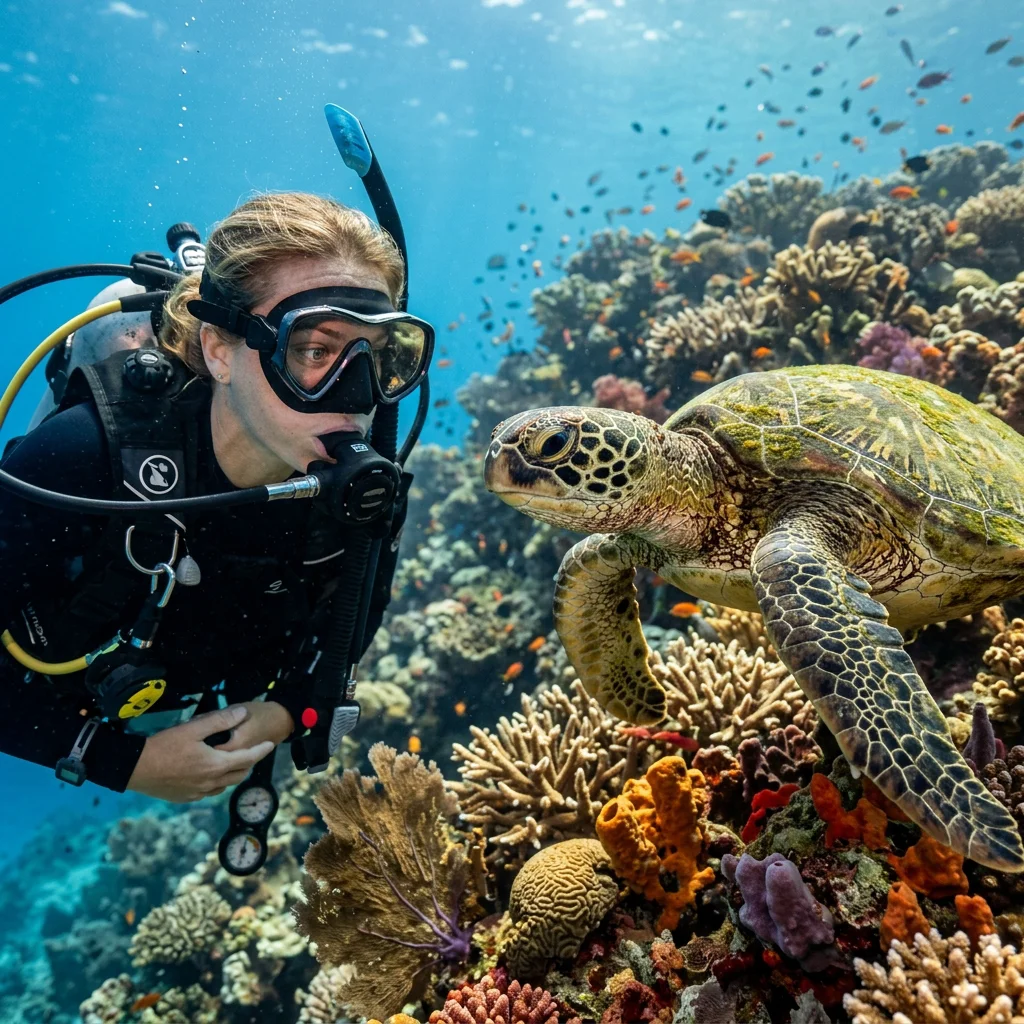
Divers can be key agents in marine conservation. Learn about the invasive alga Rugulopteryx okamurae, sharks and groupers in Spanish waters, and citizen science with iNaturalist.
A diver who descends into the sea is not merely a spectator. Every dive is an opportunity to observe, record, and act in favor of the ecosystems visited. In recent decades, the diving community in Spain has become increasingly aware of its role as conservation agents, complementing the work of marine biologists and public authorities with a presence in the water that no laboratory can replicate.
One of the greatest threats currently facing the Spanish Mediterranean coastline is the spread of the invasive alga Rugulopteryx okamurae. Native to the northwestern Pacific, this brown macroalga was first detected in the Strait of Gibraltar in 2015 and has since colonized rocky seabeds along the coasts of Málaga, Granada, Almería, and Cádiz at a worrying pace. It displaces native algae and posidonia oceánica, reducing biodiversity and altering the structure of the benthic ecosystem.
Posidonia oceánica is the most emblematic species of the Mediterranean and also the one most in need of effective legal protection. Royal Decree 191/2026 has come to reinforce the existing regulatory framework, establishing stricter obligations on the mooring of vessels in posidonia meadows, expanding exclusion zones, and requiring the installation of ecological buoy fields in areas of highest tourist pressure.
Sharks in Spanish waters generate a mixture of fascination and misunderstanding. In the Mediterranean it is possible to encounter blue sharks, shortfin mako, catsharks, or tope sharks, although large pelagic species are increasingly scarce. In the Atlantic and the Canaries, sightings of angel sharks — a critically endangered species — are somewhat more frequent.
The grouper is perhaps the most visible example of a species recovering thanks to marine protection. In the Cabo de Gata–Níjar Natural Park, specimens weighing more than twenty kilograms approach divers with curiosity, making Cabo de Gata one of the most impressive diving destinations in the Spanish Mediterranean.
Spain has taken a significant step with the declaration of seven new marine protected areas, covering deep-sea habitats such as submarine canyons, seamounts, and maerl beds. For divers, these declarations have a direct impact: some zones now have specific regulations, but in return it is guaranteed that marine life will be preserved for future generations.
The iNaturalist platform has become an essential tool for marine citizen science in Spain. Any diver with an underwater camera can upload their photographs, identify observed species, and contribute to global databases that scientists use to study distributions and population trends.
The organization Oceánidas, with more than two thousand five hundred active volunteers in Spain, is the most established example of how recreational diving can become organized environmental activism. Their seabed cleanup campaigns and transects monitoring indicator species have demonstrated that citizen-scale efforts can generate data and changes that no government agency could achieve alone.