
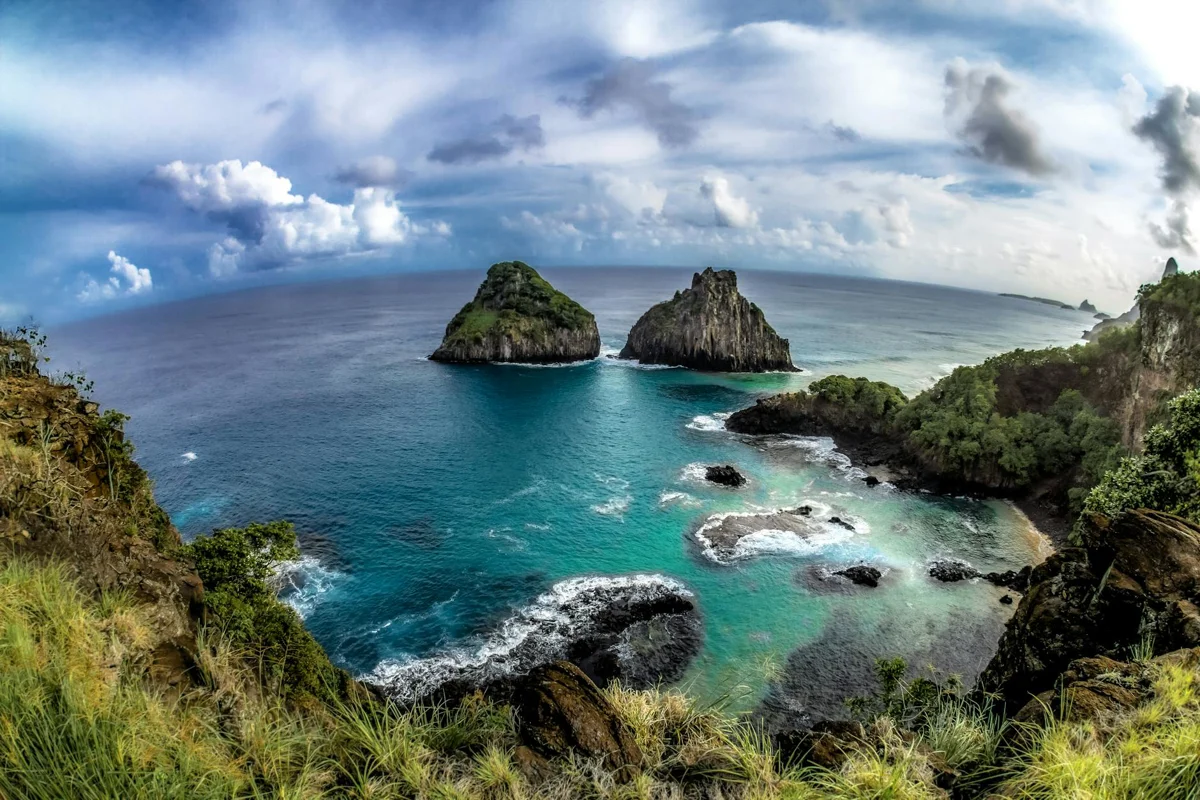
Fernando de Noronha is a Brazilian volcanic archipelago 350 km off the northeast coast, in the tropical Atlantic. A UNESCO World Heritage Site and national park with strict visitor quotas, it holds one of the few consistent resident populations of spinner dolphins in the eastern Atlantic. For European divers who have already done the Caribbean, Noronha is the next stop in the South Atlantic.
Fernando de Noronha is an archipelago of 21 volcanic islets in the South Atlantic Ocean, 350 km from Recife, capital of Pernambuco. The archipelago has been a UNESCO World Heritage Site since 2001, and most of it is a regulated marine national park: daily visitor limits, a mandatory environmental fee, and strictly enforced no-fishing zones. The main island, where all accommodation is concentrated, has 4,000 inhabitants and lives almost entirely from tourism and diving.
The headline fauna is the spinner dolphin (*Stenella longirostris*), with a resident population of 800–1,000 animals. Every morning at dawn they pour into the Bahía dos Golfinhos to rest after a night of hunting, and visitors can snorkel near them from designated observation points. Groups of 100–200 individuals spin and leap at the surface in a display that gives the species its name. For wildlife photography, few spectacles anywhere rival it.
SCUBA diving has its own merits. The main sites: Pedras Secas (coral garden thick with turtles), Cabeço Submarino (drift dive over reef fish), Cordilheiras (volcanic formations with swim-throughs and caves), Naufrágio do Porto (wreck dive on a cargo ship sunk in the 1980s), Sapata (vertical walls draped in coral). Depths run 12–30 m, water temperature 26–29 °C year-round, visibility 25–40 m. Green and hawksbill turtles are permanent residents and approach divers without prompting.
Other encounters: Caribbean reef sharks, manta rays (especially September–November), Napoleon wrasse, migrating tuna, and the occasional juvenile lemon shark. Biodiversity is solid for the tropical Atlantic, though it does not challenge destinations like the Coral Triangle. The distinction from the Caribbean is that Noronha sits on the open Atlantic, flushed by the South Equatorial Current, which keeps the water unusually clean and clear.
Logistics: fly to Recife or Fortaleza from Europe with a connection (Lisboa, París, Frankfurt), then a 1.5-hour domestic flight to Noronha. Mandatory environmental levy: 200 reais per person (~€37). National park fee: 180 reais (~€33). Accommodation is scarce: pousadas run €60–120 per double, resorts €300–500. Dive operators: Atlantis Divers, Águas Claras, Noronha Divers. Guided dives cost €70–90 each; a six-dive package runs around €350.
The pleasant surprise is how well it works as a mixed destination. Noronha is Brazil's premium honeymoon and ecotourism address, equally popular for surf and hiking. The beaches — Praia do Sancho and Praia do Leão — are routinely ranked among the world's best. Dolphin sightings require no diving kit at all; the animals are visible from clifftop viewpoints. For couples or families where only one person dives, the island holds its own completely.
The frustrations are real: quota rigidity means booking 6–12 months ahead in high season. Prices are steep compared with mainland Brazilian diving in Bahía or Espírito Santo. And the window of clear water is narrow — August to November; outside that period visibility drops to 10–20 m as weather turns. For serious underwater photography, September and October are the only months worth targeting.
Fernando de Noronha stands as Brazil's top diving address and a genuine option for European divers who want exotic South Atlantic without the Asia flight. Spinner dolphins at the surface, turtles on every dive, volcanic scenery, and Brazilian beaches — the combination holds up. A week in September or October covering both above and below water makes for a trip that stays with you. As a pure elite diving destination there are stronger alternatives; as a mixed beach–diving–wildlife destination in the Atlantic, nothing comes close.