
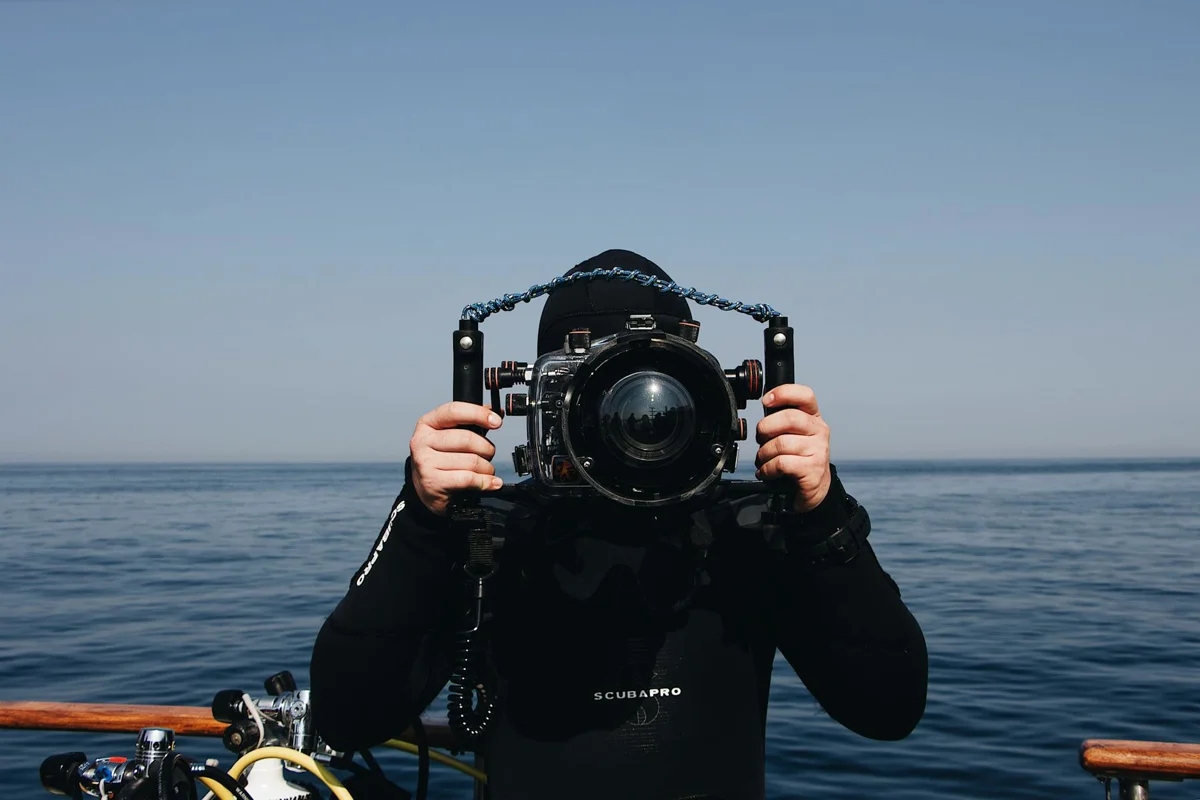
The gap between a waterproof compact (200–500 €) and a professional camera in an underwater housing (3,000–8,000 €) is staggering in price — and in results. The real question for diving photographers: when does the jump actually pay off? This guide compares all three tiers honestly: compact, mirrorless with a basic housing, and full-frame with a premium housing.
Tier 1: waterproof compact cameras — Olympus TG-7, Nikon W300, GoPro Hero. Price range: 200–500 €. Rated to 15–30 m depending on the model, no underwater housing needed. Small, simple, affordable, decent video. The downsides are real: limited manual control, modest image quality in low light, fixed lens angle. For social media and dive memories, they work well. For serious underwater photography, they fall short.
Tier 2: mirrorless with a basic underwater housing — Sony ZV-E10, Canon R7, Olympus OM-5 paired with an Ikelite or Aquatica housing. Total outlay: 1,500–2,500 €. Professional image quality, full manual control, interchangeable lenses (wide-angle, macro). The step up from a compact is dramatic. The limits: not in the same league as a professional full-frame, and a basic housing restricts access to some controls.
Tier 3: full-frame with a premium housing — Sony A7R V, Nikon Z9, Canon R5 in a Nauticam or Subal. Total cost: 6,000–12,000 €. No compromises: maximum image quality, every control accessible underwater, professional-grade durability, full support for strobes and video lights. For serious underwater photography, this is the benchmark.
When upgrading from compact to mirrorless makes sense: if you log 50+ dives a year, want large prints rather than just social posts, travel to bucket-list destinations where you refuse to have gear limitations, or genuinely care about developing as a photographer. For five to ten annual dives at popular tourist spots, a compact handles the job.
When going full-frame professional is justified: if you publish in magazines, books, or stock libraries. If you enter serious competitions. If underwater photography is a side profession or your main income. For a committed amateur without commercial goals, mirrorless in a basic housing delivers 80 % of the quality at 25 % of the price.
Lenses and accessories: the camera body is only half the story. You need a macro lens (60–105 mm) for nudibranchs and seahorses, and a fisheye wide-angle (8–15 mm) for reefs and pelagic subjects. Add a dome port for wide-angle work (300–600 € extra), one or two strobes — Inon Z330 at 800 € a pair, or Sea&Sea YS-D3 at 600 € a pair — plus sync cables, articulating arms, and diffusers. A complete Tier 3 kit easily clears 10,000 € in total.
What most people leave out: the quality of an underwater image comes 30 % from the camera, 30 % from lighting (strobes and video lights), 30 % from the photographer's technique, and 10 % from water conditions. Spending on the most expensive body while skipping strobes and proper technique rarely produces better photos. Many serious shooters consistently outperform full-frame rigs using a mirrorless with quality strobes.
Bottom line: beginners should start with a GoPro Hero or a waterproof compact — it's the sensible choice. A committed amateur with a real budget hits the sweet spot at mirrorless + basic housing + two strobes (3,000–4,500 € total). Professionals or serious shooters can justify full-frame + premium housing + two professional strobes (10,000+ €). The one combination worth avoiding: buying the latest full-frame body and relying on its built-in flash. Lighting is what transforms underwater images.