
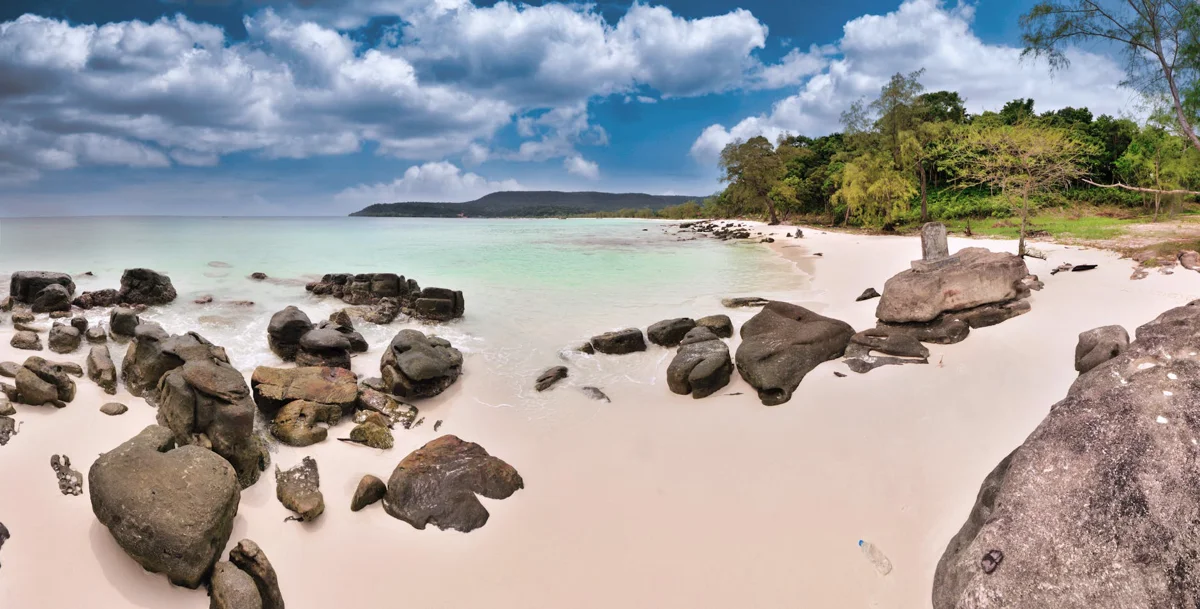
Cambodia has 443 km of coastline on the Gulf of Thailand, with two main diving islands: Koh Rong and Koh Rong Samloem (Sihanoukville Province). It's the least explored diving destination in Southeast Asia: limited infrastructure, low prices (15-22 € per dive), reefs in intermediate condition. Easily combined with Angkor Wat cultural tourism. Best suited for divers seeking low budget and off-the-beaten-track adventure.
Cambodia (officially the Kingdom of Cambodia) is a Southeast Asian country with 16 million inhabitants and 443 km of coastline on the Gulf of Thailand. The coast was a conflict zone during the Khmer Rouge dictatorship (1975-1979) and its aftermath, which delayed tourist development until the 2000s. The capital is Phnom Penh; the coastal diving hub is Sihanoukville (also called Kampong Som). E-visa available online (30 USD for 30 days) or on arrival. Currency: riel (KHR), but USD is accepted everywhere — in practice it's the dominant tourist currency.
The islands: Koh Rong and Koh Rong Samloem are the two main diving islands, located 25 km from Sihanoukville (45-90 minutes by boat). Koh Rong (78 km², the larger) has been subject to massive Chinese tourist development on its eastern side (Royal Group), while the west remains rural. Koh Rong Samloem (9 km², the smaller) is more pristine and ecotourism-oriented. Other reachable islands: Koh Tang (south), Koh Prins (south, best corals), Condor Islands (virgin, liveaboard required).
Underwater geography: the waters belong to the Gulf of Thailand, shallow tropics (average depth 50 m, maximum 80 m). Water temperature ranges from 27 °C in January to 30 °C in July. Average visibility is 8-20 m (best in dry season, November-May). Coral diversity is low (around 70 species, compared to 600 in Indonesia). Main sites: 1) Koh Rong (coral gardens at 5-15 m). 2) Koh Tang (walls and bommies, 10-25 m). 3) Koh Prins (best corals, 12-25 m). 4) Condor Reef (remote area with reef sharks, 18-30 m).
Marine life: the Gulf of Thailand is heavily overexploited by industrial fishing. Large sharks are rare (occasional grey reef or nurse shark sightings). Typical species: angelfish, triggerfish, occasional green and hawksbill turtles, rare reef mantas, scorpionfish, seahorses (specific sites around Koh Rong Samloem), octopus, cuttlefish. This is macro and landscape diving, not big-animal territory. Remote sites like Condor offer better wildlife but require a liveaboard.
Logistics and costs: flights to Sihanoukville (KOS) direct from Phnom Penh, Kuala Lumpur, Singapore, Bangkok. More common: fly to Phnom Penh (PNH) then bus or domestic flight to Sihanoukville (4-5 hours by bus, 30 minutes by plane). Dive centres: The Dive Shop Cambodia (Sihanoukville, Koh Rong), Scuba Nation (Koh Rong Samloem), Koh Rong Dive Center. Cost per dive: 15-22 € (among the cheapest in the world). 6-dive package: 80-120 €. PADI Open Water course: 250-300 €.
The pleasant surprise: the Angkor Wat combination. Cambodia allows you to pair diving with a visit to the Angkor temple complex (UNESCO, one of the world's great archaeological treasures, in Siem Reap). The classic itinerary is Phnom Penh — Siem Reap (Angkor, 3 days) — Sihanoukville (Koh Rong, 4-5 days). For a mixed diving + Khmer archaeology + low-budget destination, Cambodia is an excellent option. Overall costs in the country are low (accommodation 15-30 € per night, meals 3-5 € per dish).
The disappointment: unchecked development in Sihanoukville. Since 2017, massive Chinese investment (casinos, hotels) has turned the coastal city into a zone of chaotic construction. The main beach has deteriorated. Projects on Koh Rong have split the island between a Chinese luxury zone (east) and a rural area (west). Coral condition at accessible sites is mediocre — overfishing and cruise ship pollution. For pristine reefs, the Philippines or Indonesia are better choices. For a low-budget Southeast Asian destination, Cambodia still delivers.
Conclusion: Cambodia's Koh Rong is a budget diving destination that pairs well with Angkor Wat. Reefs in intermediate condition, prices among the world's lowest, basic but adequate infrastructure. For a dedicated quality diving trip, better options exist in Asia (Philippines, Indonesia, southern Thailand). For a mixed Khmer culture + diving + low budget + Indochina route, Cambodia is a functional choice. Recommended November to May (dry season). Combinable with Vietnam (Phu Quoc border to the south) and Thailand (Trat border to the northwest) for a complete Indochina circuit.