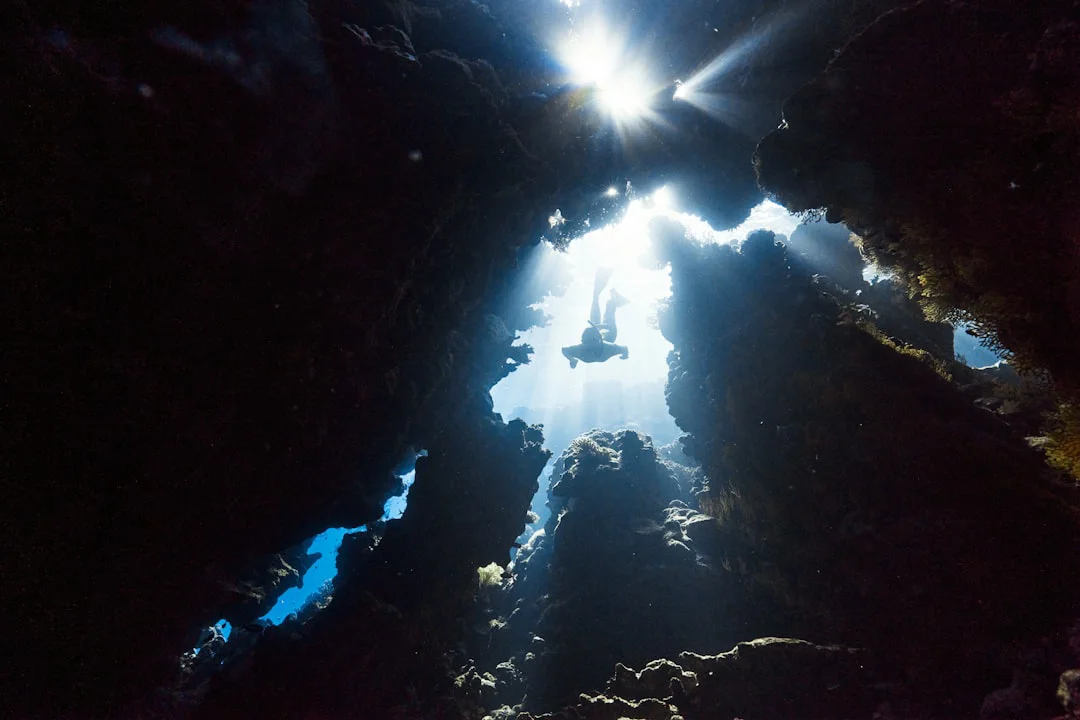
Cave diving is the most demanding discipline in recreational diving, and the one that tolerates mistakes least. It breaks down into three levels: cavern (natural light always visible), intro to cave (no natural light, permanent guideline, no junctions), and full cave (independent navigation, jumps, gaps, multiple junctions). Each level demands specific training, redundant equipment, and strict mental discipline.
Cavern is the most accessible entry point. The diver stays within the zone where natural light remains visible at all times. Depths run 5-30 m, no decompression, and the route involves no junctions — a single guideline in, the same guideline out. Gear: one primary torch plus a backup, a line reel, standard recreational equipment. Course: 2-3 days, 4-6 training dives. Cost: 350-550 €. With certification, you can dive well-known caverns like Dos Ojos in Mexico, Devil's Cave in Florida, or accessible Mediterranean sites.
Intro to Cave is the first genuine step into cave diving. Divers enter zones with no natural light but follow a permanent guideline and make no independent navigation decisions — junctions are off-limits. Depths 8-35 m. Gear: 2 torches, 2 reels, doubles (twin cylinders with manifold), redundant regulators. Course: 5-7 days, 12-15 training dives. Cost: 1.200-1.800 €. Prerequisites: Cavern + Advanced + Nitrox.
Full Cave opens independent navigation in complex systems. Divers execute jumps (crossing from one guideline to another), gaps (sections with no line), and navigate multi-junction networks. Depths up to 60 m depending on the system. Gear: 3 torches, 3 reels, multiple gas mixes, fully redundant breathing configuration. Course: 7-10 days, 18-25 training dives. Cost: 1.800-2.800 €. Prerequisites: Intro to Cave plus 50 logged cave dives.
Top training destinations: 1) Yucatán, Mexico (Tulum, Playa del Carmen) — cenotes suit every level, long systems, crystal-clear fresh water, stable 24-25 °C. The world capital of cave training. 2) Florida, USA (High Springs, Live Oak) — freshwater caves, well-mapped systems, a tradition of legendary instructors including Tom Mount and Jarrod Jablonski. 3) France (Dordogne, Lot) — colder, darker caves, suited to advanced-level work. 4) Sardinia, Italy — sea caves for cavern and intro.
Equipment and configuration: cave diving enforces strict standards. The Hogarthian or DIR (Doing It Right) configuration means minimalism with every item accessible and redundant. Long-hose primary regulator, independent doubles, backup regulators, clear communication line. Cutting corners on cave gear is not a viable option; the environment does not absorb mistakes.
Risk profile: cave diving carries a higher fatality rate than any other recreational diving discipline. The leading causes: 1) Untrained divers — recreational divers without a cave course entering caverns and losing orientation. 2) Inadequate equipment — no redundant torches, no guideline. 3) Poor gas management — ignoring the rule of thirds. 4) Navigation errors. The cave diver's universal rule: do not enter without training; do not advance if you cannot return on twice the air you have used.
Mindset: cave diving is not for impulsive personalities. It demands patience, discipline, meticulous planning, and the honest acceptance that certain sites are inaccessible without years of preparation. The cave punishes ego: many advanced divers with 500+ recreational dives remain at cavern level for years before progressing to intro. Those who convince themselves that a recreational certification is sufficient are the ones who die.
The full picture: cave diving is the deepest, most demanding discipline in the recreational diving world. For experienced divers with the right mentality, it opens genuinely unique exploration. For the vast majority, cavern level is both sufficient and rewarding — Mexican cenotes, Mediterranean caves. Intro and full cave belong to a small group with a specific calling. The correct progression: cavern first, 50+ cave dives, then intro; 100+ cave dives, then full cave. No shortcuts.