
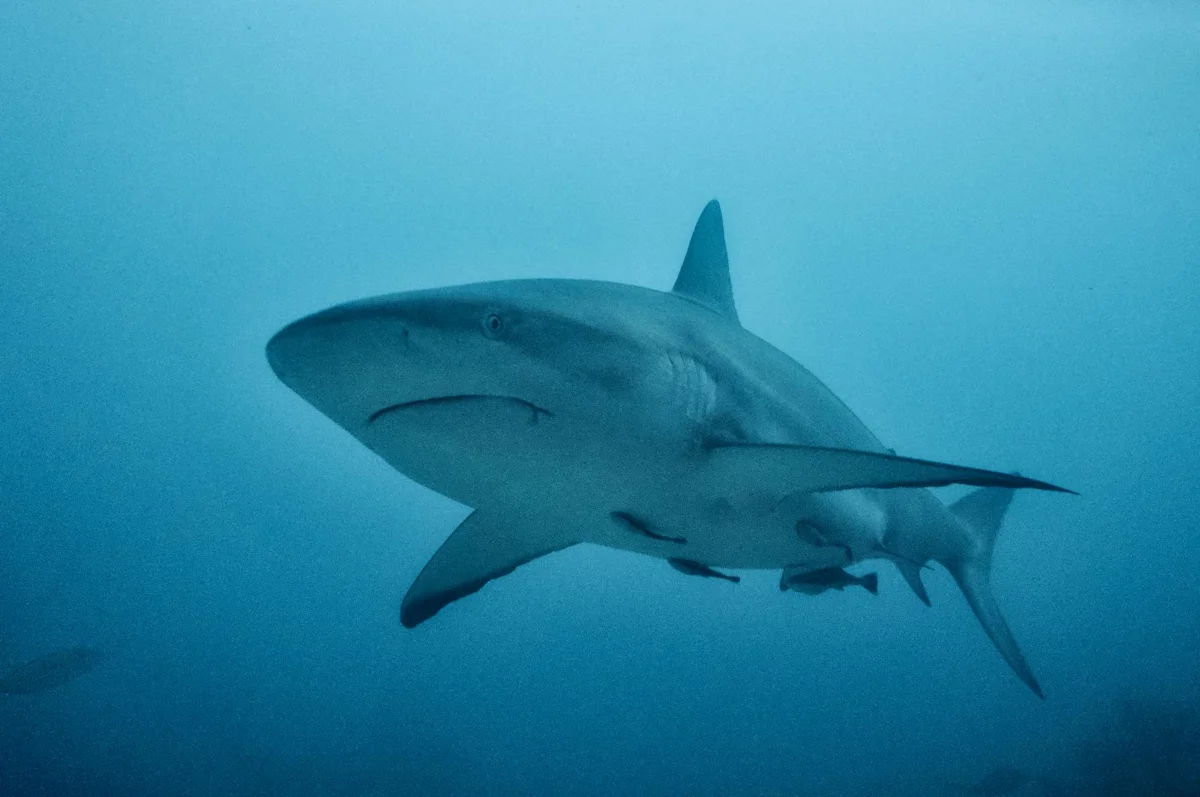
Galápagos gets all the headlines, but two less-crowded alternatives in the eastern Pacific match it for sheer spectacle. Cocos Island off Costa Rica is raw, remote, and built for hammerhead obsessives; Socorro in the Revillagigedo archipelago delivers intimate manta ray encounters that no other destination on earth replicates. Both attract experienced divers chasing megafauna without the Galápagos crowds.
Cocos Island sits 550 km southwest of Costa Rica in the tropical eastern Pacific. A UNESCO World Heritage Site and strictly enforced national park, it is accessible only by liveaboard — a 36-hour crossing from Puntarenas. Standard itineraries run 10 days aboard. The headline fauna is schooling scalloped hammerheads (*Sphyrna lewini*), Galápagos sharks, silky sharks, occasional tiger sharks, oceanic manta rays, yellowfin tuna, and sailfish. No destination in the eastern Pacific concentrates more shark species in a single dive.
Socorro anchors the Revillagigedo archipelago 400 km southwest of Cabo San Lucas, México — also in the eastern Pacific. It has held UNESCO World Heritage status since 2016. Liveaboards depart Cabo San Lucas on a 24-hour crossing; typical itineraries run 8–10 days. The draw is oceanic manta rays (*Mobula birostris*): Socorro mantas are famously curious, approaching divers unprompted and hovering above the group for 5–10 minutes. For underwater manta photography, nothing on the planet comes close.
The key differences come down to sharks versus mantas. At Bajo Alcyone, hammerhead schools of 200–500 individuals are routine; currents run 3–5 knots and divers clip in with reef hooks to hold position. Cocos is a shark destination. Socorro has fewer sharks — silky sharks are omnipresent, whale sharks appear occasionally — but the quality of manta encounters at Roca Partida and Cabo Pearce is unmatched. Humpback whales visit in February and March, with females known to give birth in these waters.
Conditions at both sites are similar: water temperature 24–27 °C at Cocos, 22–26 °C at Socorro; moderate to strong currents; visibility 15–30 m. Cocos runs greener water with more suspended sediment; Socorro tends bluer and clearer. A 5–7 mm wetsuit is advisable at both. A reef hook is essential kit for Cocos.
Costs: a 10-day Cocos liveaboard runs €5,500–7,500 all-inclusive. An 8–10-day Socorro liveaboard costs €4,500–6,500. Flights from Europe to Costa Rica add €1,000–1,400; to México via Mexico City then Cabo San Lucas add €1,000–1,500. All-in totals: Cocos €7,000–9,000, Socorro €5,500–8,000. Socorro is modestly cheaper and the logistics are simpler.
Operators at Cocos: Okeanos Aggressor I and II, Sea Hunter, Argo. At Socorro: Solmar V, Belle Amie, Quino el Guardián, Nautilus Belle Amie. All run high-spec vessels with well-designed itineraries. Book 9–12 months in advance — cabins sell fast.
The frustrations are real: both destinations are rigid by nature. Once aboard, you follow the boat's schedule. Open-ocean crossings can be cancelled or truncated — Cocos especially during the rainy season, May through November. Neither place is appropriate for beginners; Advanced certification plus 100 logged dives is the practical minimum, with Rescue and 200 dives the realistic comfort level.
The bottom line: Cocos if you want to be surrounded by hundreds of hammerheads in a single dive; Socorro if an intimate hover session with a giant manta ray or a humpback whale sighting is the goal. European divers who have already done Galápagos will find both are the logical next step. With enough budget and the right years, doing both is worthwhile — each operates in a category of its own.