
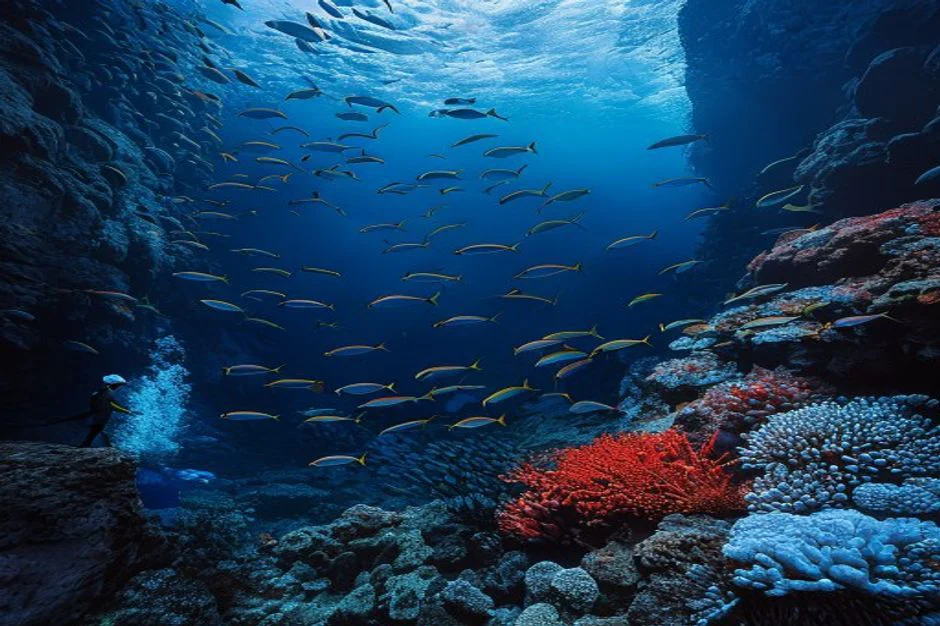
The Columbretes Islands hold the strictest marine reserve quota in the Spanish Mediterranean — which is exactly why the underwater world there looks the way Cousteau filmed it in the 1950s. Only 30 divers per day receive a permit, bookings fill months ahead, and the boat crossing takes three hours each way. That combination is what has kept the place wild.
The Columbretes are four volcanic islets sitting alone in open water, 50 km off the Castellón coast. They are what remains of a submarine volcano that erupted roughly 1 million years ago, and the crater outline of the main island, Columbrete Grande, is still legible from the air. Getting there is the first filter: departures from Castellón harbour at 7:30, arrival at 10:30, two dives, return by 17:00. A full day, no shortcuts.
The islands have held marine reserve status since 1990 under one of the tightest regimes in the Mediterranean. The daily quota is 30 divers — 15 morning slots, 15 afternoon slots, divided among the licensed dive centres. Fishing is entirely banned, anchoring is regulated, and boat traffic runs on quotas. That is why the groupers here weigh 30 kg when the same species averages 8 kg in unprotected areas.
The standout sites number four or five, all around the perimeter of Columbrete Grande and the adjacent islets — la Foradada, el Bergantín, la Mancolibre. Depths run 18–30 m: walls, caverns, red gorgonians reaching 1 m across, sponges, and an abundance of nudibranchs that catches experienced divers off guard. The headline species is the brown meagre (*Sciaena umbra*) in schools of hundreds — one of the few genuinely dense populations left in the Mediterranean.
What sets Columbretes apart from Medas or Cabo de Palos is the category of trip. This is not a dive day out; it is an expedition. The five centres holding permits — based in Castellón and Peñíscola — run trips from May through October only, and a swell forecast cancels the departure without warning. The all-in cost per diver for a full day (three-hour boat crossing each way, two dives, lunch on board) sits around 180–220 €. Plan it as a mini-trip, not a spontaneous weekend filler.
Permit allocation: the Generalitat Valenciana assigns quotas to each licensed centre, and the centres sell those slots. In July and August the calendar fills within days of opening. Book two to three months ahead. May and October sometimes have openings a week out, but cancellation risk from swell is higher in May and lower in October when settled weather arrives.
What most trip reports leave out: three hours at sea in open water is a serious crossing. If you are prone to seasickness, take medication before leaving the dock and accept that part of the day involves staring at the horizon. A choppy day is genuinely punishing. A flat August morning with crystal visibility and a pod of common dolphins pacing the bow at 30 knots is the opposite experience entirely. Luck and weather are part of the kit.
An honest comparison: Columbretes delivers more pristine conditions and more pelagic life than Medas or Cabo de Palos, but the logistics are heavier, the dives run deeper (not suited to first-timers), and the variety of sites is narrower. The right profile for this reserve is an experienced diver who wants to see what the Mediterranean looked like half a century ago — not a beginner, not a family outing.
After four trips the assessment is consistent: Columbretes is not the most visually spectacular dive in the Mediterranean, but it is the most honest thing left in Spanish waters. The density of life, the absence of engine noise, the concrete sense that strict rules have preserved something real — all of it outweighs the six hours of daily boat time. If the window opens, take it.