
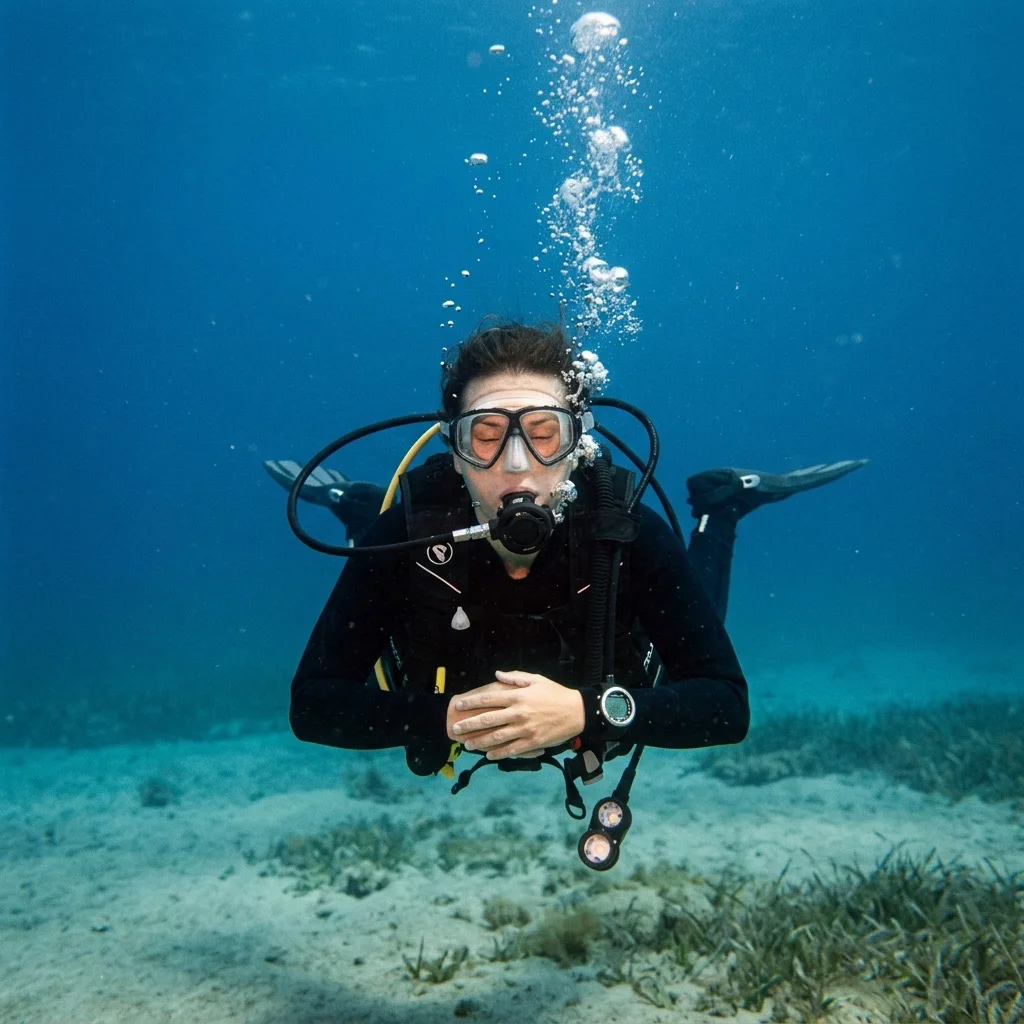
Air consumption is the metric that changes most with experience. A novice diver empties a 12 L tank in 30 minutes at 18 m; someone with 200 dives stretches it to 60. The difference isn't lung capacity — it's mindset. And it can be learned, even though almost nobody teaches it explicitly in the open water course.
Start with the maths. A 12 L tank filled to 200 bar holds 2,400 L of air at surface pressure. At 18 m (absolute pressure 2.8 bar), every breath consumes 2.8 times its actual lung volume. A relaxed diver moves around 12–15 litres per minute at the surface, so at 18 m that becomes 35–42 litres per minute. Run the numbers and a 12 L tank gives you somewhere between 55 and 70 minutes. Stress, exertion, or a cigarette habit push that surface rate up to 25–30 lpm easily — and at 18 m you're looking at 25–30 minutes total.
Your personal baseline is called your SAC rate — surface air consumption. It's a number worth measuring now and then. Modern dive computers calculate it for you, or you can do it manually: bars consumed × tank volume ÷ time ÷ mean absolute pressure. Knowing your SAC under different conditions — cold water, effort, shooting photos, navigating — lets you plan dives properly rather than guessing.
The first technique for cutting consumption is the most obvious and the most widely ignored: breathe long, not deep. There's a real difference. A hard, deep inhale uses more air than a normal inhale followed by a slow exhale. The phase worth extending is the exhalation — on dry land it roughly matches inhalation duration. Underwater, it should be twice as long.
Second technique: active muscle relaxation. Every movement burns air. Waving your hands, checking your computer every 30 seconds, constant small kicks just to hold position. If your buoyancy is dialled in and you're horizontal without touching anything, you can go five minutes without moving a fin. That alone drops consumption dramatically.
Third, and less obvious: cold. A diver with mild hypothermia burns 30–40 % more air than the same diver warm. The body spends energy maintaining core temperature, which drives up metabolism and breathing rate. No breathing trick will compensate for an inadequate wetsuit in cold water. Thermal protection is part of the consumption equation whether it looks like it or not.
Fourth: trim and fins. A vertical diver flailing with huge kicks uses twice the air of the same diver horizontal with gentle hip-driven fin strokes. Hydrodynamic efficiency matters far more than most people realise. Split fins are inefficient at low speed; stiff blades like Jet fins or Apollo Bio-Fins are considerably better for relaxed SCUBA diving.
One drill that genuinely works: a dedicated consumption control session. Drop to 15 m over sand, nail your buoyancy, cross your arms, no camera, no distractions, stay for 40 minutes. Start at 200 bar and check what you surface with. The first time the result is surprising. By the fourth or fifth session, the improvement becomes visible. Think of it as zen mode for diving — and like any skill, it responds to practice.
My personal best: 73 minutes at an average of 14 m on a 12 L aluminium tank off Mallorca. I surfaced with 30 bar. Not heroics — it was a 25 m visibility day, 24 °C water, no current, no camera, just being there. The takeaway is that breathing well is not one trick: it's the sum of gear, conditions, technique, mental calm, and time in the water. When everything lines up, a tank gives you twice the dive.