Currents of 1.5 knots exceed recreational swimming capacity. Learn to assess conditions, consult tide tables and use apps to plan safe dives.
The water of the ocean is never still, and understanding that movement is one of the most valuable skills a diver can develop. Marine currents are not simply an inconvenience: they are physical forces with concrete magnitudes that determine whether a dive will be safe, demanding, or outright dangerous. A current of 1.5 knots, equivalent to about 2.8 kilometers per hour, already exceeds the sustained displacement capacity of most recreational divers without specific training. At 3 knots, the water moves at 6 kilometers per hour, a speed at which it is practically impossible to swim against it in full dive gear. Knowing these magnitudes before entering the water is not alarmism: it is applying technical judgment to a safety decision.
Rip currents, a specific type of current that forms when water pushed toward the shore by waves seeks an outlet channel toward open sea, cause more than one hundred deaths per year in the United States according to NOAA data. They are not exclusive to surfing beaches: they can form on any coast with surf and an irregular seabed. For a diver returning to the surface near the shore, a rip current can drag them rapidly toward deeper water within seconds. The correct protocol if a rip current is detected is not to swim directly toward shore, but to move parallel to the coastline to exit the current channel before attempting to return. This knowledge, basic in any open-water swimming course, should also be part of every coastal diver's training.
Evaluating conditions before a dive requires combining at least three sources of information: tide tables, weather forecasts with particular attention to wind, and direct observation of the water at the moment of entry. Tide tables indicate the moments of highest and lowest water level, which generally correspond to periods of greatest current flow (high tide and low tide). However, tidal prediction is astronomical, not meteorological: a sustained wind in the direction of flow can significantly intensify a forecast moderate current, while headwinds can attenuate it. This is why wind forecasts are an independent variable that cannot be ignored.
The NOAA (National Oceanic and Atmospheric Administration) and PADI, the world's largest dive training organization, offer complementary perspectives but with different emphases on current assessment. NOAA provides high-precision oceanographic data, including real-time measurement buoys, current prediction models, and current atlases for US coastal areas. PADI, for its part, integrates this knowledge into a decision-making framework oriented toward the recreational diver, placing emphasis on practical observation, communication with local guides, and the fundamental rule of never entering the water when conditions exceed the diver's experience level. Both sources are necessary and complementary: the objective data from NOAA and the applied judgment promoted by PADI.
Direct observation remains irreplaceable, regardless of the volume of available data. Before entering the water, observe the surface movement looking for foam lines, eddies, or color changes that indicate current convergence zones. Throwing a floating object and observing its trajectory for one minute allows you to estimate both the speed and direction of the surface current. Speaking with local guides or with divers who have been in the water that same day provides contextual information that no numerical model can supply. The combination of technical data and empirical observation on the spot is the standard of a prudent diver.
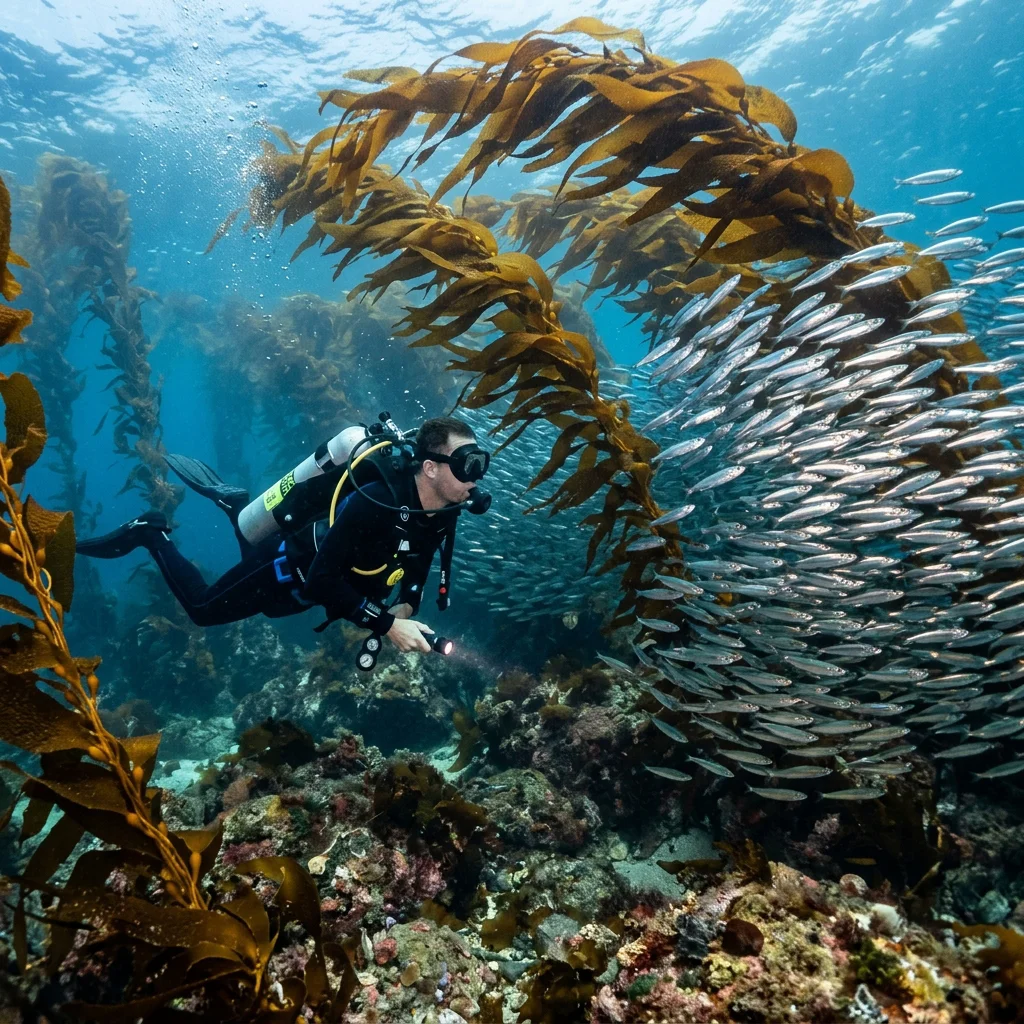
Diving with a moderate current, rather than trying to swim against it, is one of the most satisfying experiences in diving. Currents carry plankton, which attracts fish of all sizes, and allow large areas of the seabed to be covered with minimal effort. Destinations such as the Maldives, the Galápagos, or the Coral Sea are famous precisely for their currents, which concentrate marine life at passages and channels. The technique for using them involves descending quickly to the bottom or the wall where the current is weaker, staying close to the substrate to reduce resistance, and going with the flow while monitoring gas consumption. The most common and dangerous mistake is fighting the current until exhausted.
When an unexpected current carries a diver beyond the planned exit point, the correct response depends on whether they are underwater or at the surface. Underwater, if gas allows, the best option is to descend to a depth where the current is less intense and seek shelter behind a rock formation while assessing the situation. At the surface, the priority is to inflate the BCD, deploy the SMB (surface marker buoy) to be visible from the vessel, and conserve energy by avoiding swimming against the current. Signaling is critical: a diver at the surface without a visible marker can be extremely difficult to spot from a vessel at a distance.
Currents are a reality of the ocean that cannot be eliminated, only managed. Divers who develop the ability to read them, assess them with sound judgment, and adapt their planning accordingly enjoy richer dives and return to the surface more reliably than those who ignore or underestimate them. Seeking specific training in current diving techniques, available as a specialty at most certification agencies, is a direct investment in safety and in the quality of the experiences the ocean has to offer.