
Jacques Cousteau (1910–1997) probably changed public perception of the ocean more than any other human being. French naval officer, co-inventor of the Aqua-Lung, documentarian who brought the sea into living rooms worldwide. The Calypso served as his floating laboratory for 40 years. His legacy reaches beyond diving: he made marine conservation a mainstream concern.
Jacques-Yves Cousteau was born in 1910 in Saint-André-de-Cubzac, France. His father was a lawyer; his childhood shaped by the Atlantic. In 1930 he entered the École Navale. He was learning to fly in 1936 when a car accident ended those plans and redirected him toward the sea. During the Second World War he served in the French Navy, taking an active role in the Resistance, and began experimenting with free diving.
The Aqua-Lung (1943): wartime scarcity pushed Cousteau and French engineer Émile Gagnan to develop the first practical demand regulator. Until then, professional diving relied on surface-supplied hoses — the Mark V and its variants. Their invention made truly autonomous scuba possible for the first time. They patented the Aqua-Lung in 1943 and licensed it to Hookah for commercial distribution in 1946. Cousteau collected royalties until his death. He is the father of modern scuba.
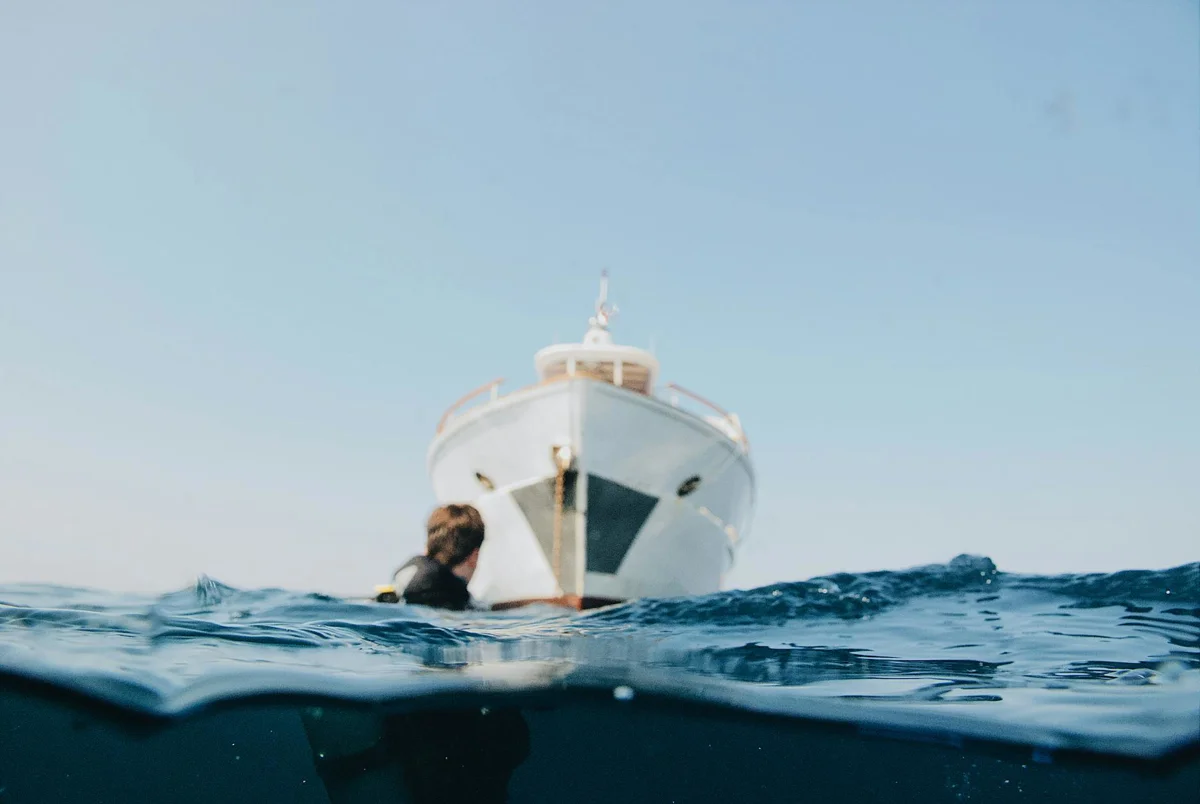
The Calypso (1950): in 1950, Cousteau acquired the RAS-1, a former British Royal Navy minesweeper, and converted it into a research vessel. He renamed it Calypso after the Greek nymph. Over the next 40 years, the ship crossed every ocean: the Red Sea, the Caribbean, Antarctica, the Pacific, the Indo-Pacific. It served as a platform for marine research, filmmaking, exploration, and conservation projects. The Calypso sank in an accident in Singapur in 1996; restoration remains incomplete.
The films: Cousteau produced more than 100 underwater documentaries. The best known are 'Le Monde du Silence' — 'El Mundo del Silencio' (1956, Palme d'Or at Cannes and Academy Award for Best Documentary Feature) and 'Mundo sin Sol' (1964, Academy Award). His greatest cultural impact, though, came from the television series 'El Mundo Submarino de Jacques Cousteau' (1968–1976), broadcast worldwide. For the first time, millions of people in their living rooms watched coral reefs, whales, and sharks — and understood the ocean as a living ecosystem, not an infinite resource.
Inventions and advances: beyond the Aqua-Lung, Cousteau's team developed a submersible underwater camera — forerunner of today's systems — experimental underwater habitats (Conshelf I, II, and III, where aquanauts lived submerged for days), diver propulsion vehicles (DPVs), controlled-lighting underwater filming techniques, and methods for preserving waterlogged film stock.
Marine conservation: Cousteau moved from explorer to conservationist. In the 1970s he founded the Cousteau Society, dedicated to ocean protection. He lobbied for international treaties banning underwater nuclear testing and chemical dumping, and campaigned for the Antarctic moratorium. His media campaigns reframed the ocean in public consciousness — from 'inexhaustible resource' to 'vulnerable ecosystem'.
Controversies: Cousteau's public image is that of an environmental hero, but the record is more complicated. Species were captured for his films; some died in the process. Certain filming methods — baiting sharks, disturbing whale behaviour — are considered ethically problematic today. His relationship with his son Philippe (killed in a seaplane accident in 1979) and later the public dispute with Jean-Michel over the direction of the Cousteau Society left a difficult chapter. History is as layered as any life.
The legacy: Cousteau died in 1997, two months past his 87th birthday. The ledger: he created modern scuba (every diver owes him the demand regulator); he brought the sea into global popular culture; he turned marine conservation into a mainstream concern; he inspired generations of marine scientists, photographers, and divers. Any diver who clips a regulator to a tank, any person who can name a coral species, any activist who defends the ocean — all are in debt to Jacques Cousteau. The red knit cap on the deck of the Calypso is one of the most recognisable images of the twentieth century.