Jardines de la Reina is an archipelago of 250 islands off southern Cuba, declared a National Park in 1996 under one of the Caribbean's strictest protection regimes. Access is tightly capped — liveaboard only, 1,500 divers per year. The outcome is a Caribbean reef in better shape than almost anywhere else: sharks, goliath groupers, and healthy corals across 360 km of protected sea.
Jardines de la Reina — Gardens of the Queen, the name Colón gave the archipelago — lies off south-central Cuba, facing Camagüey across the Caribbean Sea. Two hundred and fifty islands and reef systems stretch over 360 km. National Park status since 1996 came with hard diver quotas and a virtual monopoly granted to Avalon Cuban Diving Centers. All access is by liveaboard. Fishing is banned throughout, and that ban is enforced.
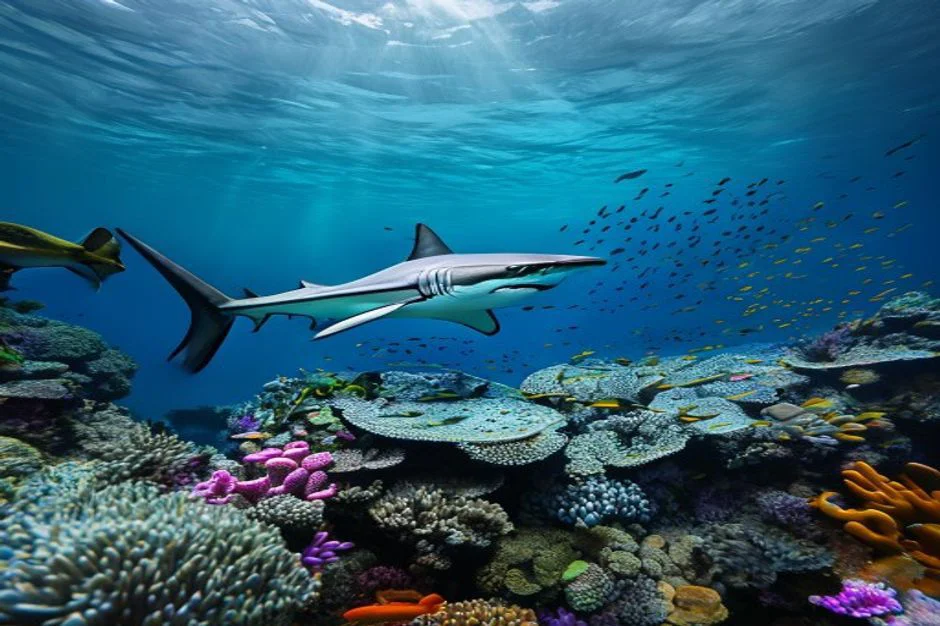
The sharks are the reason people book a year in advance. The Caribbean has lost more than 90 % of its shark populations to overfishing and bycatch. Jardines de la Reina still holds the numbers that existed in the 1950s: Caribbean reef sharks (*Carcharhinus perezii*) patrolling in genuine abundance, silky sharks (*Carcharhinus falciformis*) in the blue water, the occasional lemon shark, and rare but documented tiger shark encounters. There is nowhere else in the Caribbean where this picture survives.
Goliath groupers complete the picture. *Epinephelus itajara* — up to 200 kg and almost tame — occupy coral caves at 15–25 m. Mediterranean divers used to large groupers are still caught off guard: these animals approach, hover, and hold their ground. For underwater photographers who want consistent, close encounters with the species, Jardines is one of the handful of places on the planet where it actually happens.
The dive sites number more than 50 across the archipelago. Boca Anclita delivers drift dives with sharks on every pass. Pipín is the canonical goliath grouper cave. Five Seas runs along walls covered in living hard and soft coral. Black Coral drops to depth where the eponymous black coral grows undisturbed. Cocodrilo adds a Cuban twist: American crocodiles occasionally appear in the shallower coastal sites. Depths range from 12 to 30 m, water temperature 26–29 °C, visibility 25–40 m, currents mild.
Logistics for European divers are straightforward. Flights reach La Habana or Cienfuegos from Madrid, Paris, Frankfurt, and Toronto. A ground transfer of roughly 10 hours connects to Júcaro, the embarkation port. The liveaboard itself then becomes your hotel for 7 days. All-inclusive pricing from Avalon Cuban Diving Centers runs 4,000–6,000 € per week; add 800–1,300 € for return flights from Europe. US divers face visa restrictions and banking constraints tied to the embargo.
Avalon has operated here for 25 years and has not let standards slip. The boats are comfortable, the Cuban marine-biologist guides know individual animals by sight, and safety protocols are taken seriously. A monopoly operator could easily become complacent; in this case the opposite has happened. Slots fill early — book 6–9 months out.
The friction is real and worth naming. Pricing is fixed; Avalon does not negotiate. Weather cancellations can result in partial refunds, not full ones. The operational season runs November through July, with November–March considered peak; August–October carries genuine hurricane risk and most departures do not run. Cuba's own infrastructure adds layers: currency exchange, limited internet, occasional supply shortages.
Jardines de la Reina stands as one of the few places where a Caribbean reef still looks roughly as it did before industrial fishing stripped everything else. Sharks, goliath groupers, and intact coral in a single itinerary. A 14-day trip pairing the liveaboard with time in La Habana and Trinidad gives both the underwater and the overland Cuba. For serious underwater photographers and marine conservation divers, it belongs on the list.