
Catania's coastline, on Etna's eastern flank, is one of the few Mediterranean areas where recent volcanic lava shapes the seabed. Centuries of eruptions have built a basalt-dominated coast with black lava walls, lava tunnels, and Roman amphorae scattered across volcanic substrate. A geological alternative to the Aeolian Islands for divers drawn to the unusual.
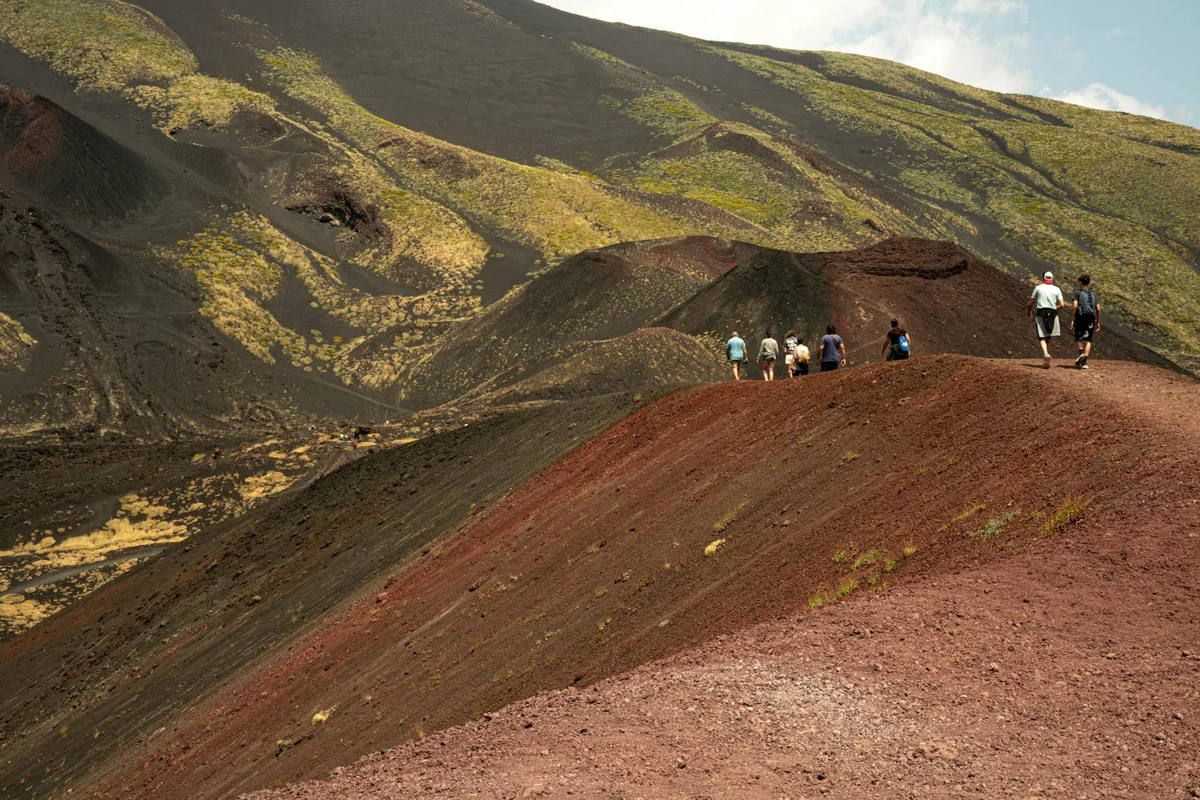
Catania is Sicily's second-largest city, sitting on the island's east coast directly beneath Etna — an active volcano reaching 3,330 m. Etna's eruptions are documented from Roman antiquity to the present day; the most recent major event was in 2021. When lava reaches the sea, as it did spectacularly in 1669, partly destroying the city itself, it solidifies into black basalt formations that have no real equivalent elsewhere in the Mediterranean.
The submarine geology between Acireale and Catania covers roughly 30 km of volcanic seabed. Under water, Etna's legacy takes four distinct forms: basalt columns formed by rapid lava cooling, lava tunnels carved out when flow continued beneath a solidified crust, vertical cliffs split by deep cracks, and black sand produced by centuries of basalt erosion. The visual result is closer to Hawaii or Lanzarote than to any typical Mediterranean dive site.
The main dive sites: Acitrezza in front of the village offers basalt walls from 12 to 25 m; Capo Mulini has caves and lava tunnels between 18 and 30 m; the Riposto Wreck is a 19th-century merchant vessel sitting at 35 m; Calatabiano rewards patient divers with abundant marine life; and the Faraglioni dei Ciclopi — the legendary rocks cited in The Odyssey — rise from the seabed in dramatic fashion. Depths range from 12 to 35 m, water temperature from 16 to 26 °C depending on season, visibility typically 20–35 m on settled days.
Roman archaeology adds a second layer of interest. The Catania–Riposto coast was a busy corridor in antiquity. The site of ancient Naxos, Sicily's first Greek colony founded in the 8th century BC, lies partly underwater near the modern harbour, and Roman amphorae are scattered across sandy patches at several sites. Visiting archaeological dives legally requires a guide holding a permit from the Soprintendente del Mare; Naxos Bay (18 m, Greek and Roman amphorae) and Acireale Roman (a submerged villa structure) are accessible to recreational divers with that arrangement.
Logistics are straightforward. Ryanair and Wizz Air operate direct flights to Catania from most European capitals, with low fares outside peak summer. A hire car is worth the cost: Acireale is 15 minutes away, Riposto 30. Accommodation ranges from guesthouses from 40 € to hotels at 60–150 €. The main local operators are Marevivo Diving, Catania Sub, and Acireale Diving. A guided dive runs 40–55 €; a five-dive package costs around 200 €.
The unexpected bonus is Etna itself. Catania makes a natural base for combining diving with a volcano excursion — the cable car and 4x4 transfer to 2,800 m costs 60–100 €. Cultural side trips are equally rewarding: Catania's Baroque UNESCO centre, the Greek theatre at Taormina framed by Etna, and Siracusa 45 minutes to the south. For those travelling with non-divers, the destination holds its own without kit.
The drawbacks are real. Visibility is unpredictable: Catania sits near the mouth of the river Simeto and an active commercial port, so after rain or strong winds the water can drop to 10–15 m clarity. The dive season runs April to November; most centres operate at reduced capacity in winter. Marine life is decent but not the reason to come — it does not compare to the Aeolian Islands or Capo Carbonara. The draw here is geological and archaeological, not biological.
Catania is a credible alternative to the Aeolian Islands for divers whose interest runs to geology and ancient history rather than large pelagic fauna. The submarine lava landscape is genuinely singular in the continental Mediterranean. Paired with Etna excursions and Sicilian culture, it builds easily into a complete 5–7 day trip at moderate cost with a direct flight from most of Europe.