
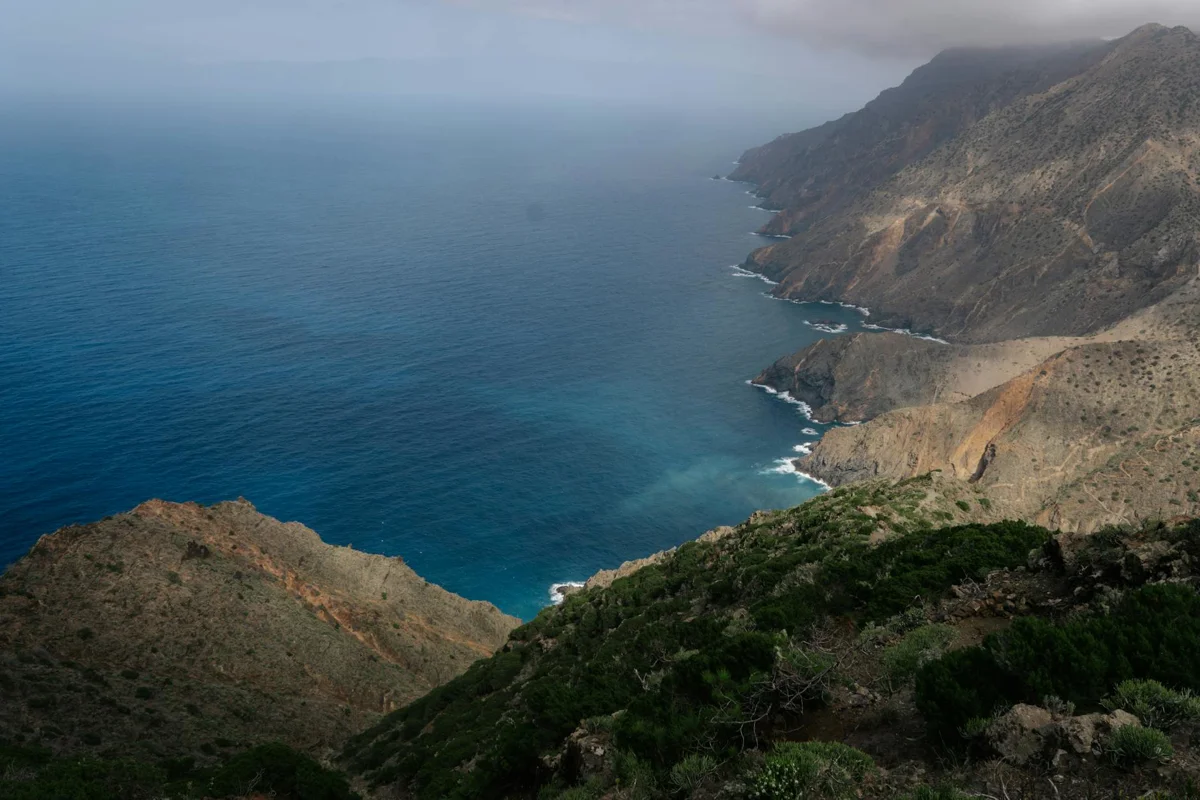
El Hierro is the smallest, youngest and least-touristed of the Canary Islands, and that shows underwater. La Restinga, its only dive village, sits on one of the Atlantic's worst-kept secrets: the Mar de las Calmas, a sheltered bay where visibility holds above 30 m for most of the year and pelagic species pass within metres of the coast.
The Mar de las Calmas is a bay on El Hierro's southern face, shielded from the northeast trade winds by the island's own bulk. That gives it a singular microclimate: flat water 320 days a year, average visibility of 30-40 m, and temperatures ranging from 19 °C in February to 24 °C in September. Divers used to the Mediterranean arrive and find the first impression disorienting — the water here is crystal blue, not blue-green.
The marine life blends Mediterranean and Atlantic species at a density that is rarely seen anywhere now. Schools of great barracuda cap El Bajón, a seamount whose summit sits 8 m below the surface. Giant grouper, comber, parrotfish, cardinal fish. Then the pelagics: whale shark in August-September if luck holds, mantas, migrating bluefin tuna, and occasional visits from a shortfin mako. La Restinga is one of the few Atlantic spots where locals have recorded sightings of sawfish.
Why locals prefer winter. In summer — July and August — El Hierro fills with European divers and prices climb. Spaces at dive centres book out months ahead. But in November, December, January and February, water temperature drops 4 degrees and diver numbers fall by 70 %. Visibility still holds at 30 m, pelagics still come through, and the centres are nearly empty. That is the real season to get to know the island.
The headline dive sites: El Bajón (seamount with barracuda), La Cueva del Diablo (cavern with overhead light shafts), El Salto del Tigre (wall with caves and grouper), Punta Restinga (shallow macro site, good for first dives), Tagomago (gentle drift dive on light current). All reachable by fast RIB in under 15 minutes from La Restinga harbour. The four main centres run two boats daily, leaving at 09:00 and 11:30.
Getting there takes effort. Fly to Tenerife Norte, connect to El Hierro (40 minutes), then an hour by road to the south of the island. Alternatively, ferry from Los Cristianos, Tenerife, to Valverde — three hours — then drive. There are no direct European flights. That alone filters out mass tourism. Diving prices run 50-65 € per dive with kit, with six-dive packages from 280 €. Accommodation in La Restinga starts around 60 € for a double room.
What the tourist brochure skips: the 2011 submarine volcanic eruption, since named Tagoro. A new volcanic cone rose to 90 m depth, ejecting magma for months and killing all fauna in the affected area through sulphur compounds and pH shift. Fourteen years on, marine life has returned — and the site now hosts species of chemosynthetic bacteria found nowhere else on Earth. Tagoro is a scientific site, not a recreational one, but the story is worth knowing.
Against Tenerife or Lanzarote: El Hierro has fewer centres, fewer options, less infrastructure. It also has better average visibility, fewer divers, and wilder fauna. Lanzarote offers the Museo Atlántico sculpture trail and angel sharks; Tenerife has turtles and rays; El Hierro has pelagics and clear water. They do not compete — they complement. If you plan two islands in one trip, El Hierro as the second stop justifies the extra logistics.
El Hierro suits experienced divers who want something beyond the tourist Canaries. It is not the right choice for a first diving trip — the logistics are awkward — but it earns its place on a third or fourth visit to the archipelago. La Restinga runs on diving, the centres know it, and the atmosphere is personal without being overbearing. Dropping down a young volcanic island where the seabed is still raw black basalt is something the Mediterranean cannot replicate.