
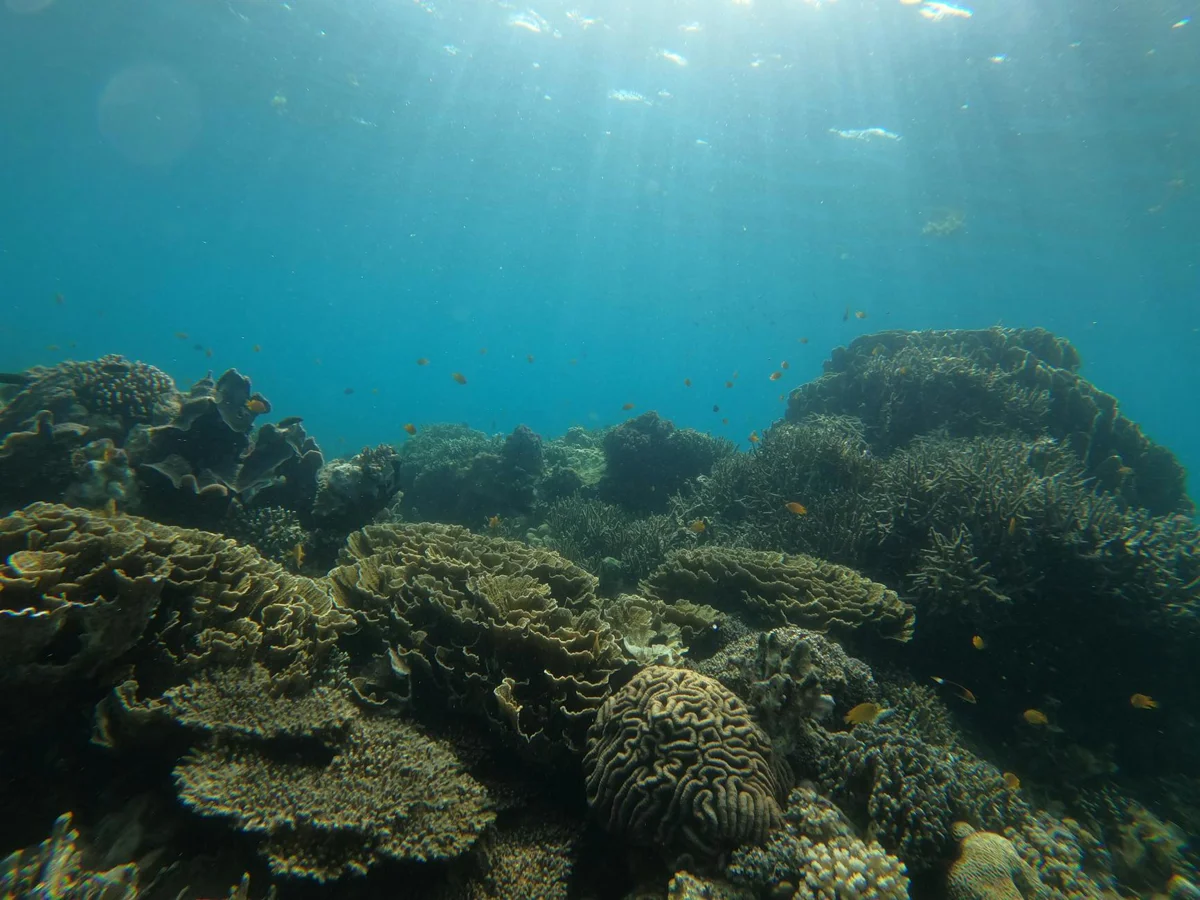
Tubbataha is a double atoll in the middle of the Sulu Sea, UNESCO World Heritage and reachable only between March and June when the monsoon allows it. 100 km southeast of Puerto Princesa, liveaboard access only, with crystal visibility, sheer walls and Coral Triangle biodiversity. It is the most prestigious diving destination in the Philippines and among the finest in Southeast Asia.
Tubbataha lies within the Tubbataha Reefs Natural Park in the Sulu Sea, 100 km southeast of Palawan. The park covers two atolls — North and South — and a small reef outcrop, Jessie Beazley, all uninhabited except for a ranger station that enforces the marine protected area. The site became a Natural Marine Park in 1988 and was listed as UNESCO World Heritage in 1993. Protection is strict: no vessel may anchor, and only motorised navigation is permitted inside the boundaries.
Why only March to June: for the rest of the year, the southwest and northeast monsoons make the open sea between Palawan and Tubbataha either impassable or genuinely dangerous. March to June is the window of flat water, warm temperatures (28–30 °C) and record visibility (40–50 m). Liveaboards from Puerto Princesa or Palawan operate exclusively during those months on typical six- or seven-day itineraries. There are four or five main operators, and berths are limited.
Dives here are drift dives along vertical walls that plunge from 5 m to more than 100 m. The key sites: South Park — drift with reef sharks; Shark Airport — grey shark aggregation point; Black Rock — a pinnacle with extraordinary species density; Amos Rock — drift with sea turtles; Wall Street — a wall thick with hunting jacks. Working depths run 12–30 m, currents 1–3 knots, and visibility is consistently outstanding.
Wildlife varies by day and site, but encounters regularly include whitetip reef sharks, grey reef sharks, oceanic whitetips, oceanic and reef mantas, green and hawksbill turtles, tuna, large jack schools, Napoleon wrasse and bumphead parrotfish. Species density is comparable to Sipadan or Raja Ampat. Both hard and soft corals are in near-pristine condition, with no signs of large-scale bleaching.
Logistics: fly to Manila from Europe with a stopover (Singapore, Doha), then an internal flight to Puerto Princesa (Palawan), and board the liveaboard. Trip cost: €2,500–4,500 for six or seven days, all-inclusive except flights. Flights from Europe run roughly €1,000–1,400. Established operators: M/V Discovery Palawan, M/Y Atlantis Azores, S/Y Philippine Siren. Book six to nine months ahead — berths disappear quickly.
What surprises first-timers: the silence. Tubbataha is genuinely remote. No other vessels in sight, no divers from other groups in the water, no tourist infrastructure whatsoever. Liveaboards arrive after a 10-hour crossing from Puerto Princesa, and for a full week theirs is the only group at each dive site. That solitude changes things: wildlife is unhurried, divers decompress, and the feeling of diving somewhere truly intact is not a marketing line.
What disappoints: the cost and the narrow season. Tubbataha is not a flexible destination. A July calendar blocks it entirely. A tight budget makes other Philippine options — Malapascua, Apo Reef, Anilao — far better value. The investment per diver is on a par with a Maldives trip, but the experience is more exclusive and less packaged. For anyone who can afford the ticket and the right months, there is nothing equivalent.
The bottom line: Tubbataha is a top-tier global destination for experienced divers who have done the classic Southeast Asian sites and want something rawer. The March-to-June window is non-negotiable, prices are premium, berths scarce. The diving quality, however, is beyond argument: untouched walls, intact fauna, record visibility. For a week on the Sulu Sea in May, nothing else comes close. Worth it once — worth it every time the season allows.