
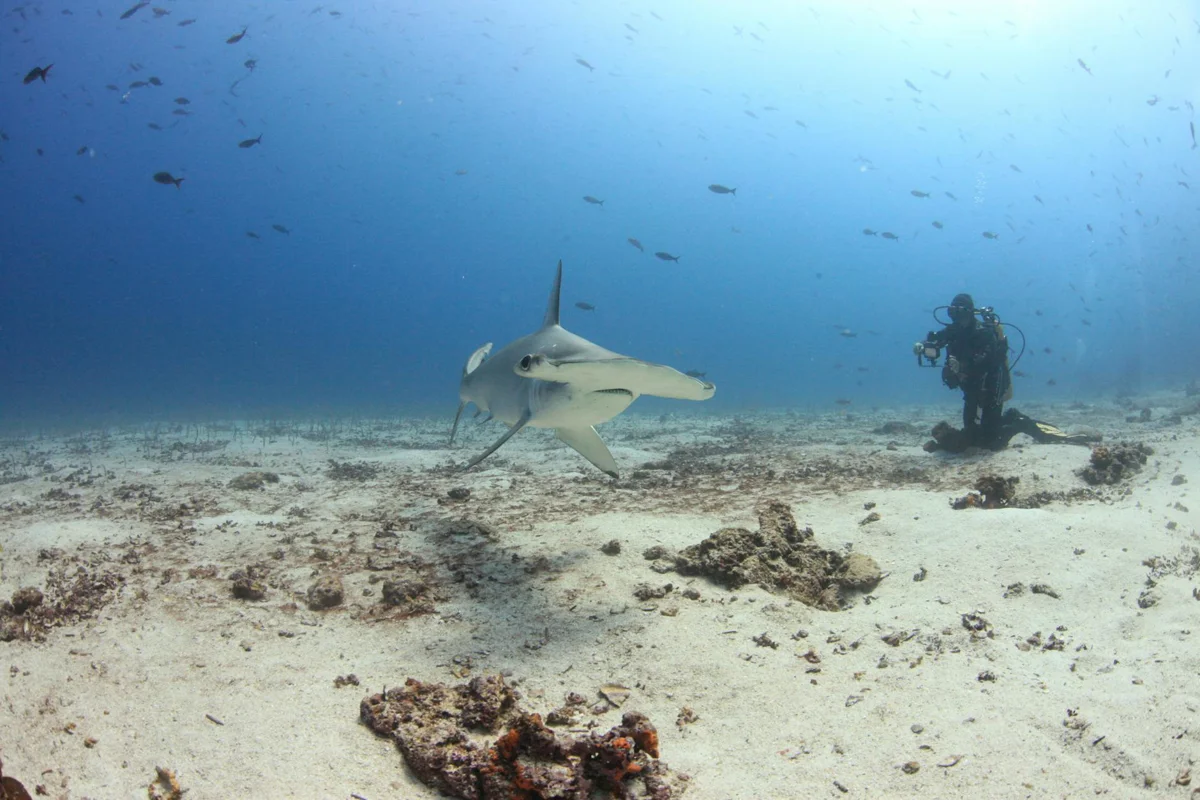
Galápagos is not a typical tropical destination. Water temperatures hover between 17 and 22 °C depending on the month, currents run hard, and the wildlife is relentless: schools of hundreds of hammerheads, oceanic mantas, whale sharks from June to November, endemic Galápagos sharks, sea lions, penguins. This is a destination for committed divers who want world-class pelagic megafauna.
The Galápagos Islands are a volcanic archipelago in Ecuador, roughly 1,000 km west of the South American mainland — the same chain where Charles Darwin refined his theory of evolution in 1835. Serious diving is concentrated at the northern islands: Wolf and Darwin, reachable only by liveaboard. The central islands — Santa Cruz, Isabela, San Cristóbal — offer decent diving but nothing close to the pelagic intensity up north. For the hammerhead encounters the archipelago is famous for, Wolf and Darwin are the only addresses that matter.
Darwin's Arch collapsed in 2021, but the site — now called Pillars of Evolution — remains the most celebrated dive in the Pacific. Wolf's Northeast Side is its equal on certain tidal cycles. Divers clip in with reef hooks at 18–25 m, hold position against the current, and watch columns of scalloped hammerheads (*Sphyrna lewini*) moving past in groups of 50 to 300. Between May and October this happens on almost every dive. Very few places on the planet offer consistent encounters at those numbers.
The species list does not stop at hammerheads. Whale sharks (*Rhincodon typus*) move through from June to November. Endemic Galápagos sharks (*Carcharhinus galapagensis*) patrol the walls year-round. Oceanic mantas appear seasonally. Sea lions turn every shallow site into chaos. And at places like Bartolomé, Galápagos penguins — the only penguins native to the northern hemisphere — torpedo past divers. The cold Humboldt and the deep Cromwell current converge here, stacking cold-water and warm-water species in the same column.
Conditions demand experience. Water temperatures range from 17 °C in July–October to 22 °C in February–April. Currents at Darwin and Wolf can hit 4–5 knots; the thermocline can drop several degrees in a single metre. Visibility swings between 10 and 25 m. A 7 mm wetsuit with hood is not optional in the cold season. Neither is the reef hook. Most operators require a minimum of 100 logged dives, and they check. This is not a place to rack up your first fifty.
Getting there involves commitment. Flights from Europe connect through Madrid, Ámsterdam, or Estambul to Quito or Guayaquil, then a domestic leg to Baltra in Galápagos. Liveaboard itineraries run seven days aboard boats carrying 16 divers. The main operators are Galapagos Aggressor, Galapagos Master, Tip Top, and Humboldt Explorer. A seven-day trip runs 5,500–8,000 € all-inclusive before flights. Flights from Europe add another 1,200–1,800 €. Budget 7,000–10,000 € per person.
First-timers are rarely prepared for the sheer volume. At destinations where spotting one hammerhead counts as a great day, Wolf and Darwin casually produce 100–300 on a single drift dive. The sensation of floating inside that mass, neutrally buoyant, reef hook taut, is difficult to describe to anyone who has not been there. The animals show no particular interest in divers because tourist pressure is capped at strict limits — Galápagos controls liveaboard permits and daily diver numbers with unusual rigour. For pelagic underwater photography, the competition is short.
The drawbacks are real. Flexibility is not part of the package: liveaboards book out 6–9 months ahead, flights to Galápagos are expensive, and the specific kit requirements (7 mm suit, reef hook, camera housing rated for depth) add up. The hammerhead season runs May–October, which is also the cold season — divers who dislike cold water will be miserable. The warm season (February–April) brings better whale shark and manta sightings but fewer hammerheads. Choosing when to go means choosing what you want most.
Galápagos occupies a category by itself for divers who prioritise pelagic megafauna in raw numbers. The budget is significant and the planning is rigid, but the geography, the evolutionary biodiversity, and the strict conservation framework combine to make this a destination that cannot be replicated elsewhere. Cocos in Costa Rica is the closest rival, and Cocos is extraordinary — but Galápagos remains the benchmark.