
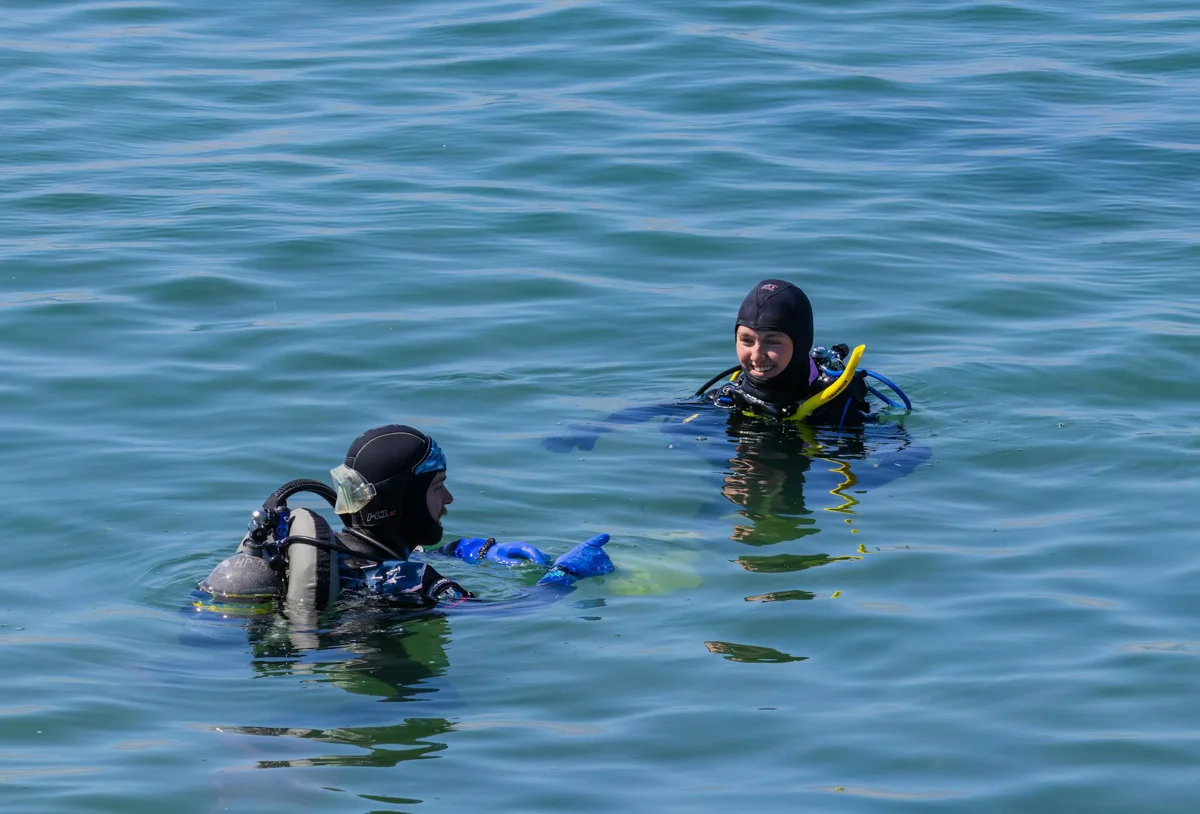
Diving with someone who burns through air twice as fast is awkward and common. The classic rule — whoever hits 100 bar signals first — works, but there's more to it: how to plan the dive knowing that upfront, how to handle it without making your buddy feel bad, and when to accept that the pairing simply doesn't work.
I have a buddy, Javier, with whom I've done over a hundred dives. Solid diver — calm, careful, methodical. And he breathes like a freight train. I surface from a 50-minute dive with 80 bar; he comes up with 30. It's not poor technique, it's pure physiology: 95 kg, 1.92 m, his resting SAC rate is what it is. Learning to plan dives around him took time, and the first rule I actually understood was that the planning is on me, not him.
The most common mistake: planning the dive around the lighter breather. What happens next is predictable — the other diver has to cut the last third short or borrow from the alternate. The right approach is the opposite. You plan for the heaviest breather, and the lighter one simply enjoys the extra gas at the end.
The rule of thirds works well here: one third to descend and explore, one third to return, one third held in reserve. But if your buddy consumes twice as much, their thirds cover half your bottom time. Accept it before the dive, don't negotiate it underwater. Decisions on the surface, execution on the bottom.
Something that actually works: shared air checks every five minutes. You don't wait until someone hits 100 bar to find out. You show each other your gauges whenever your eyes meet. Thirty seconds and you know whether the dive is on track or it's time to start a comfortable ascent. A nasty surprise at 25 m with 50 bar is prevented by a check at 30 m with 100.
The share-air argument gets misused. The octopus is for emergencies, not for squeezing out ten more minutes of bottom time. If your buddy runs out and you hand over the alternate just to keep diving, all you've done is double the risk. If one of you is out of gas, both of you go up. Full stop.
A conversation worth having with a new buddy before the first dive: how much do you typically use, what kind of diving do you prefer, how comfortable are you at that depth. Five minutes on the dock saves a lot of grief below. And sometimes you realise straight away the pairing won't work — far better to split into different groups on the surface than to sort it out at 18 metres with tense hand signals and awkward looks.
A trick that works for me: when I dive with a heavy breather, I plan shorter, deeper dives for him — where the consumption difference is most obvious — and save the long, shallow ones for when I'm with divers whose SAC rate is closer to mine. Matching the dive to the team is basic sense, but most people don't do it.
No-nonsense takeaway: managing air as a buddy team is 80 % planning and 20 % technique. Plan for the worst case and you'll almost never have a problem. Plan for the ideal and a scare is coming, sooner or later. Your own gas is never up for debate, but bottom time is: giving up half an hour of a dive so your buddy surfaces safely is an investment, not a sacrifice.