
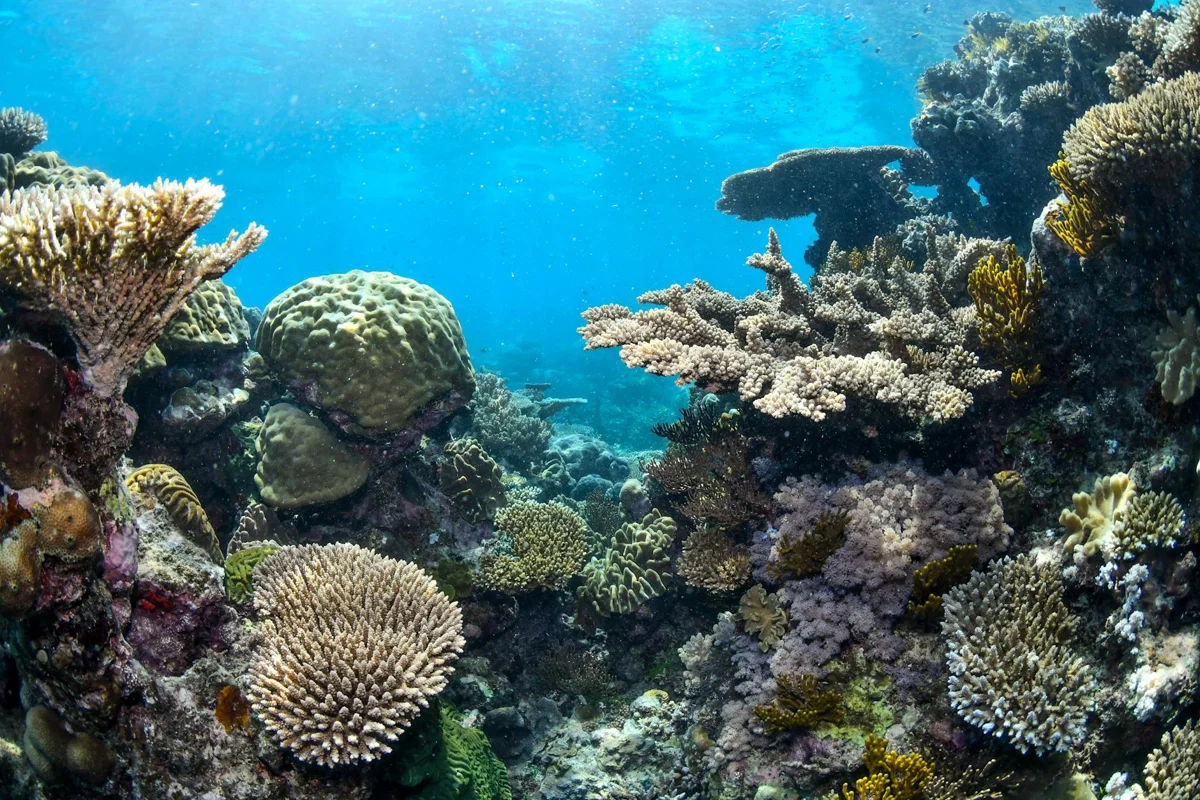
The Great Barrier Reef has endured five mass bleaching events between 1998 and 2024. The question divers keep asking is fair: is the trip still worth it? The short answer is yes, but with caveats that matter. Knowing where to go — and where to avoid — is what separates a disappointing week from diving that rivals the reef's best years.
The Great Barrier Reef stretches 2,300 km along Australia's northeast coast, from Cape York down to Bundaberg. It is the largest living structure on Earth, inscribed as a UNESCO World Heritage Site in 1981. The science, however, is blunt: the Australian Institute of Marine Science found that 50 % of live coral cover was lost between 1995 and 2022. Mass bleaching events in 1998, 2002, 2016, 2017, 2020, 2022, and 2024 have repeatedly hammered coral cover across the system.
The damage is not uniform. Northern sectors — Cape York, Lizard Island — and the outer reefs, including the Ribbon Reefs, Cod Hole, and Osprey Reef in the Coral Sea, have fared noticeably better. The central section around Cairns has taken the worst hits. In the south, around Heron Island and Lady Elliot, cooler water temperatures have helped corals hold on. Where you dive determines everything: a day-trip boat out of Cairns lands on heavily degraded reef; a liveaboard heading north to the Ribbon Reefs puts you on something genuinely healthy.
Liveaboards departing from Cairns or Port Douglas remain the most efficient way to reach the reef in good shape. A 4–7 day itinerary heads north to the Ribbon Reefs, Cod Hole — the legendary potato grouper cleaning station that has drawn divers since the 1970s — Steve's Bommie, and Pixie Pinnacle. Weather permitting, operators push out to Osprey Reef in the Coral Sea: sheer walls, grey reef sharks, and coral cover that holds up far better than anything close to shore.
The southern end around Heron Island and Lady Elliot Island, near Bundaberg, is in stronger shape than its reputation suggests. Lady Elliot is a small resort island built around diving, with reliable manta ray, turtle, and reef shark sightings. Heron Island combines a marine research station with shore diving that starts the moment you step off the jetty. Both sites get less traffic than Cairns, and both punch well above it in terms of live coral.
One consistent surprise: the megafauna has not collapsed with the coral. Schools of trevally, reef sharks, manta rays, sea turtles, and Napoleon wrasse still show up in numbers worth travelling for. For divers whose priority is large marine life, the Great Barrier Reef still delivers. For macro coral photographers, the best sites do exist — they just require targeted planning rather than turning up at whichever platform runs from Cairns harbour.
Getting there: flights from Europe reach Cairns via two stops — typically Doha or Dubai plus Singapore or Kuala Lumpur — or route through Brisbane for domestic connections. Main liveaboard operators for the north: Mike Ball Dive Expeditions, Spirit of Freedom, Spoilsport. Typical costs run from 1,800 to 3,500 EUR for a 4–7 day trip. Day-trips out of Cairns or Port Douglas range from 130 to 250 EUR. A 4-night package at Lady Elliot Island from Brisbane, including flights and diving, starts around 1,200 EUR.
The genuine let-down is the Cairns day-trip industry. Boats carry 30–60 divers at a time to the same overworked nearshore sites. Coral cover is poor, visibility can be average, and the experience is crowded by any standard. If Australia is on the itinerary and the budget can stretch, skipping those trips entirely in favour of a northern liveaboard or a southern island is the call that changes the whole trip.
The Great Barrier Reef remains a tier-one dive destination for anyone willing to choose carefully. A northern liveaboard covering the Ribbon Reefs, Cod Hole, and ideally Osprey Reef, or a stay at Heron Island or Lady Elliot, still justifies the journey from anywhere on the planet. The reef's long-term trajectory under climate change is genuinely uncertain — but the zones where coral is alive and the water full of life still exist. Waiting another five years for conditions to improve is not a strategy that history supports.