
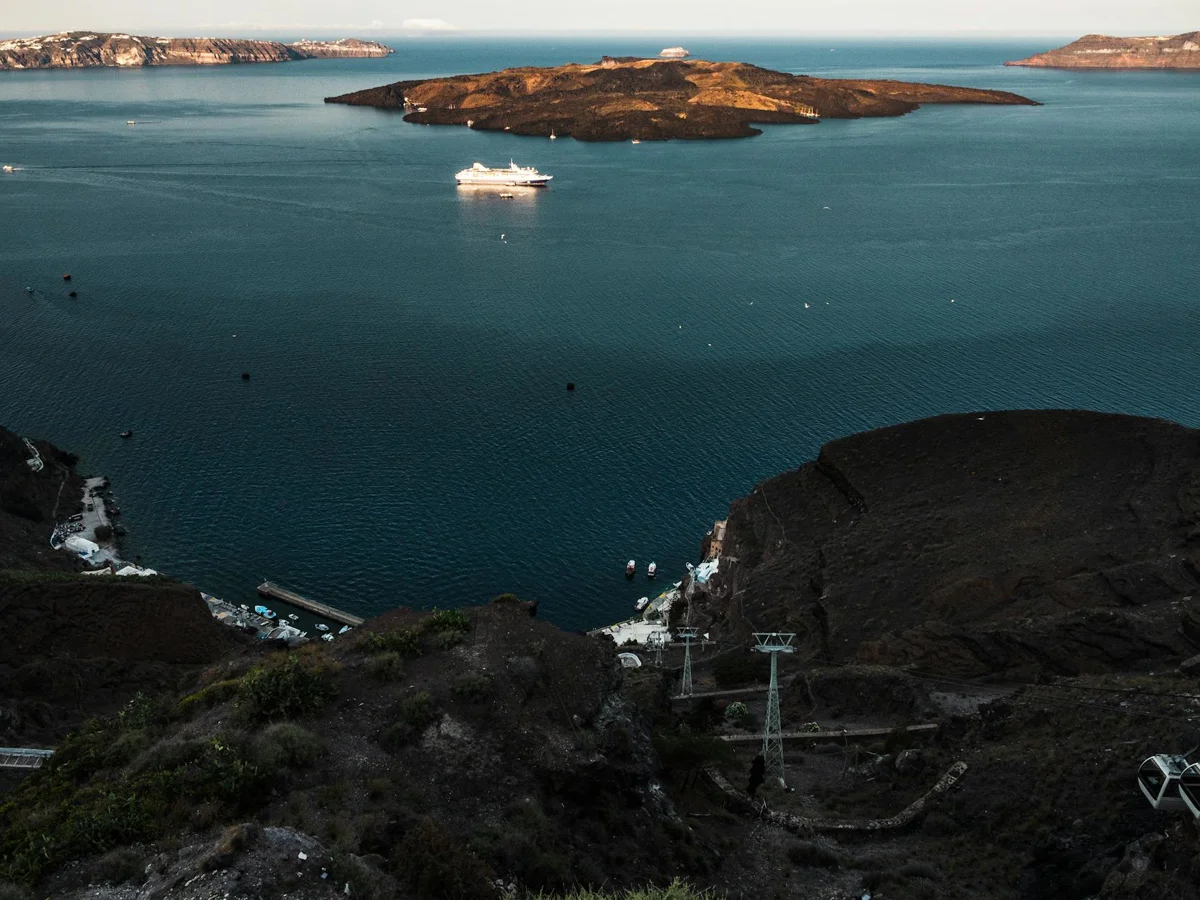
The Santorini caldera is the submerged basin left by the Minoan eruption of 1600 BC, one of the most violent in human history. Today it offers a rare combination: volcanic walls, active hydrothermal vents, lava floors, and the chance to dive above a functioning geothermal system. For divers drawn to geology, Santorini rivals the Aeolian Islands as the Mediterranean's most compelling volcanic dive.
Santorini — officially Thera — is one of the Greek Cyclades in the Aegean Sea. Its crescent shape is the direct legacy of the Minoan eruption of 1600 BC, a VEI 6 event that dwarfed the Krakatoa explosion of 1883. The collapsed crater produced the caldera: a sheltered bay 12 × 7 km wide and up to 380 m deep. The volcano remains active — its last significant episode was in 1950 — with submarine fumaroles and geothermal heat measurable across the caldera floor.
The main dive sites break down as follows. Caldera Wall is a vertical basalt drop from 5 m to beyond 100 m, suited to advanced wall divers. At Hydrothermal Vents off Palia Kameni, active fumaroles at 18–25 m push water temperatures to 35–40 °C against an ambient 23 °C; yellow sulfur deposits coat the rock and chemosynthetic bacteria form visible mats. The Wreck of Taxiarchis, a 20th-century Greek vessel, sits at 22–30 m. Three Caves, a cluster of small caverns on the north wall, works well at 12–20 m. Overall range across all sites: 12–40 m.
The geological case for coming is strong. Diving an active caldera is uncommon anywhere in the world. Micro-tremors register daily, fumarole bubble streams are visible from several metres away, and the substrate is tephra — compressed volcanic ash — rather than the coral sand typical of most Mediterranean sites. This is geological fieldwork as much as recreational diving.
Marine life is constrained by the caldera's chemistry: slightly acidic pH and elevated dissolved sulfides limit species diversity. Rock fish — saddled bream, scorpionfish, conger eels — are present alongside octopus and moray eels, with chemosynthetic bacteria thriving near the vents. For rich biodiversity, dive the island's outer coast to the north and east rather than the caldera itself.
Logistics are straightforward. Direct flights from most European capitals reach Santorini year-round, with cheaper fares outside peak summer. Accommodation spans from studio apartments upward, with caldera-view suites climbing above 300 € per night. The main operators — Santorini Dive Center, Atlantis Dive Center, and Oceanus — charge 60–80 € per guided dive; a five-dive package runs 250–300 €. Fast boats depart from Vlychada or Ammoudi, reaching caldera sites in 10–30 minutes.
The broader appeal of Santorini works in the diver's favour. The island is Greece's leading destination for honeymoons and cultural tourism: the Oia sunset, the Akrotiri archaeological site, Assyrtiko vineyards. A partner who does not dive has no shortage of things to do, which is not something that can be said of every technical diving destination in the region.
The drawbacks are real and worth stating. Santorini receives 2 million tourists annually on an island of 15,000 residents. High season — July and August — is crowded and expensive at every level. The optimal diving window is May–June or September–October, when underwater visibility improves and accommodation prices drop. Winter diving is effectively impossible: northern winds keep operators closed for months.
The honest summary: Santorini is a singular Mediterranean destination for geologically minded divers. The caldera does not compete on biodiversity with sites like Cabrera or the Medas Islands, but it offers volcanic underwater scenery found nowhere else in the sea. It combines naturally with Kefalos for better fauna, a Cyclades liveaboard, or purely cultural island-hopping. A week in May or September works well as a mixed diving-and-travel trip. Traveling to Santorini solely for marine life is a mismatch; you come for geology, landscape, and the wider island experience.