
The Alonissos-Northern Sporades National Marine Park, established in 1992, is the largest marine national park in the Mediterranean at 2,260 km². Its primary purpose is protecting the Mediterranean monk seal (*Monachus monachus*), with 30-50 individuals — the world's highest concentration of this critically endangered species. Regulated diving, recovering wildlife, and a genuine chance of an underwater seal encounter.
Alonissos sits in the northern Sporades, an archipelago scattered across the central Aegean east of mainland Greece. When the marine national park was declared in 1992, it covered 2,260 km² — making it the largest of its kind in the Mediterranean. The protected area takes in Alonissos itself and six uninhabited satellites: Peristera, Kyra Panagia, Gioura, Psathoura, Piperi, and Skantzoura. Of these, only Alonissos and Peristera are open to recreational diving; the rest require special permits.
The Mediterranean monk seal (*Monachus monachus*) is why the park exists. Critically endangered, with a global population of just 700-800 individuals, the Sporades hold 30-50 of them — the densest concentration on Earth. For divers, an in-water sighting is rare: the probability on any given dive in the Peristera-Gioura zone runs at 5-10 %. Descending into water where monk seals live, occasionally picking up their calls through the hydrophone, carries its own weight regardless of whether one appears.
Four sites stand out. The Peristera Wreck is the draw: a 4th-century Byzantine merchant vessel resting at 21-28 m, discovered in 1993, sealed from visitors until 2020. Mavraki Cave offers cathedral light and gentle topography at 12-18 m. Two Brothers is a drift dive along vertical walls. Antias Reef attracts seasonal pelagics. Depths across the park range 12-30 m, water temperatures 16-25 °C depending on the month, and visibility regularly reaches 25-35 m. Currents are mostly light.
The Peristera Wreck deserves its own paragraph. Dated to 350-400 AD, it is the largest Byzantine merchant wreck known from the 4th century. Its cargo — 4,000 amphoras arranged across deck and holds — remains in place, undisturbed. Closed to the public from discovery until 2020, it now accepts guided dives to the exterior perimeter under strict quotas. Greece calls it its first underwater museum, drawing comparisons to the archaeological dive sites off Sicily. Archaeological protection is absolute: nothing may be touched.
Getting here takes planning. Flights land at Volos on the mainland or at Skiathos, which has direct European connections in season. From either port, ferries reach Alonissos in 1.5-3 hours depending on route and conditions. Accommodation in Patitiri, the island's small capital, ranges from guesthouses around 50 € to hotels at 80-150 €. The main operators are Triton Dive Center and Alonissos Dive. Guided dives cost 50-65 €; five-dive packages run 220 €. The Peristera Wreck specialist trip is priced at 90-120 €. Greek is the language of daily life; English works everywhere in dive centres, and German is widely understood.
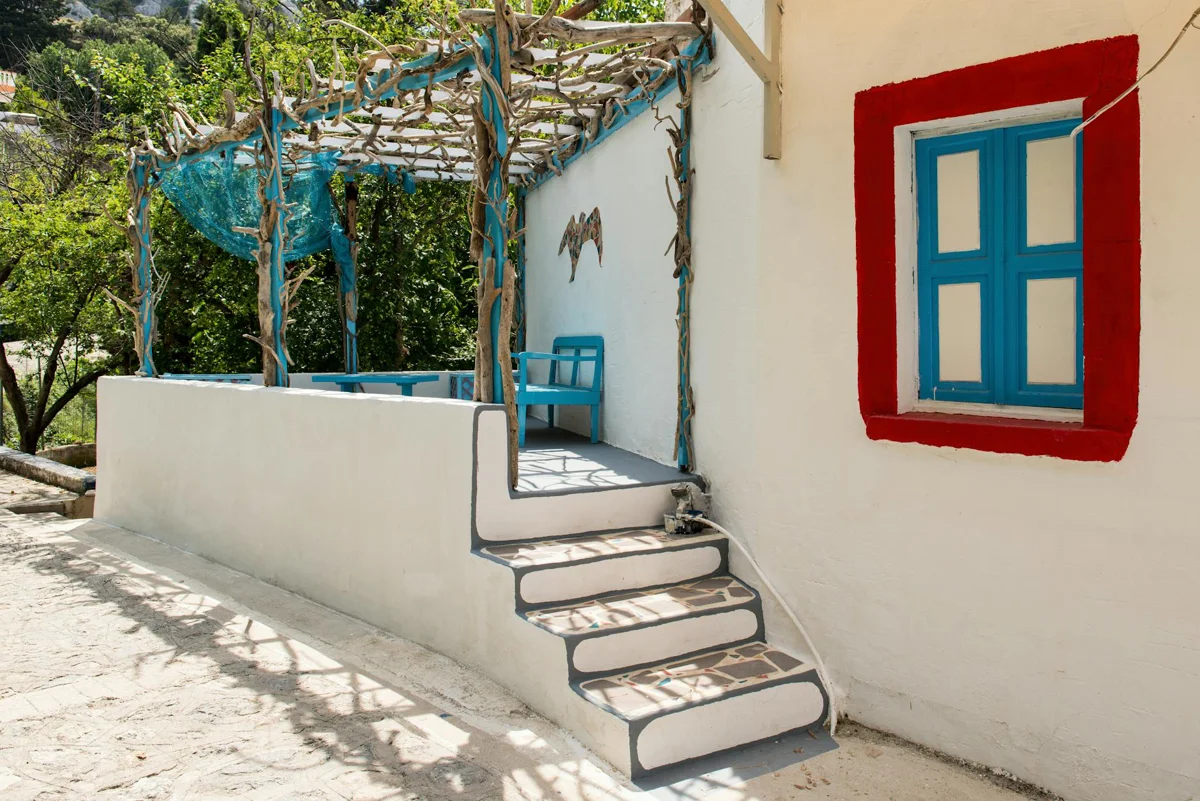
The island has a quality that surprises most visitors: Alonissos draws roughly 15,000 tourists a year, against Santorini's 2 million. The villages have not been reshaped for mass tourism. The food — octopus dried on lines in the sun, goat's milk feta, retsina poured without ceremony — is genuinely local. Hiking trails connect the interior to coastal viewpoints above the Aegean. For groups where some dive and others prefer a slower pace, the balance is right.
Two real limitations. First, ferry dependency: a storm can cancel crossings and strand travellers for a day or two. There is no direct flight to Alonissos from anywhere. Second, the monk seal probability is honest but frustrating: divers who travel specifically for a seal encounter and spend a full week in the water may not see one. The 5-10 % figure per dive is accurate, not pessimistic. Season runs May-October; centres close through winter.
Alonissos makes the most sense for divers who value conservation context and underwater archaeology alongside the diving itself. The marine national park, the monk seal population, the Byzantine wreck, and the unhurried character of the island form a package that nothing else in the Mediterranean quite replicates. A week in May or September, with Peristera Wreck on the schedule, holds up against any Mediterranean alternative for originality. Whether or not a monk seal surfaces, the rest is already enough.