
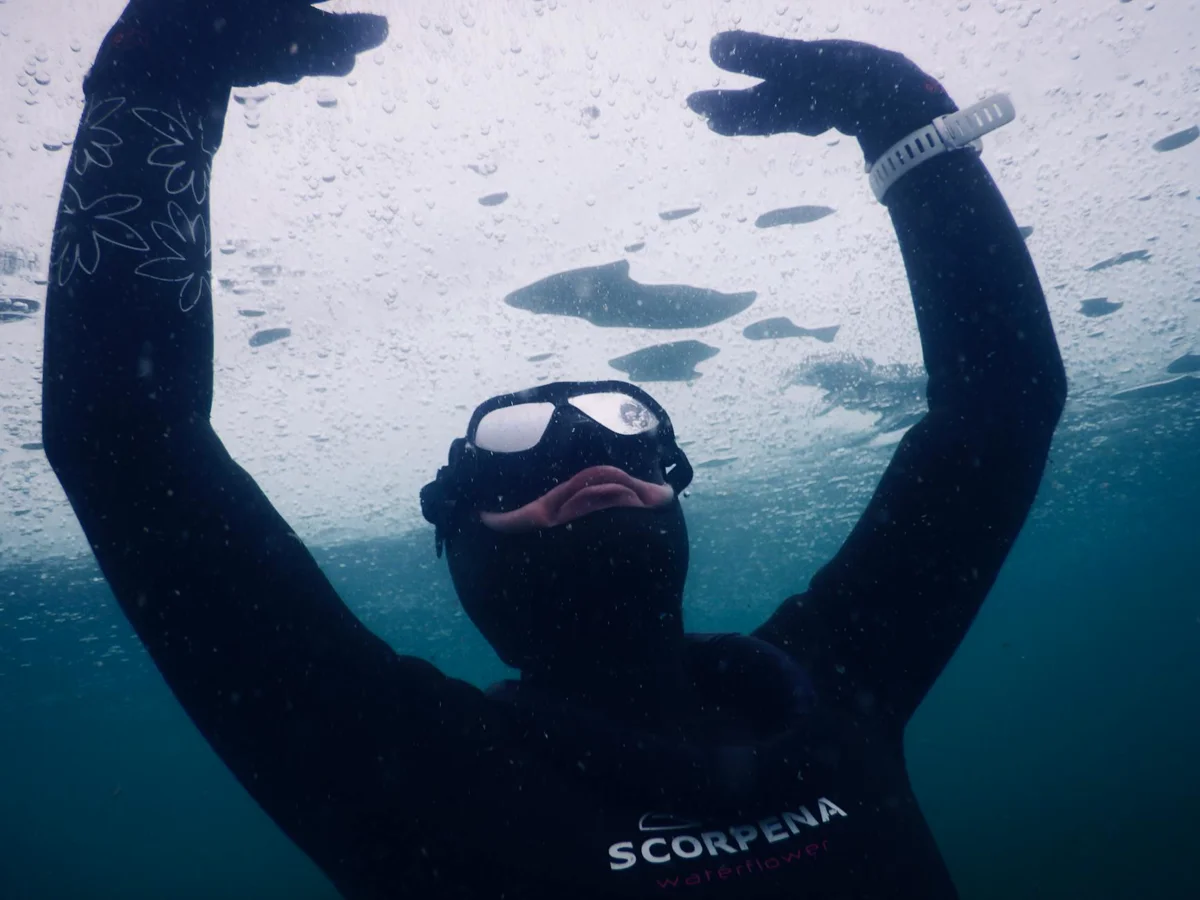
Ice diving ranks among the most extreme disciplines in recreational diving. A frozen ceiling above the diver eliminates the option of surfacing at any point — you must return to the entry hole. It demands specific training, redundant equipment, and a tether line to the surface at all times. A serious pursuit for cold-water divers in the right climate.
Ice diving takes place in frozen lakes, frozen fjords, or arctic waters during winter. The fundamental difference from open-water diving: an ice ceiling between 30 and 150 cm thick hangs above the diver at all times. If something goes wrong, you cannot ascend freely — you must navigate back to the original entry hole. That constraint changes the risk profile entirely, and targeted training is not optional.
The standard protocol: 1) Cut a rectangular hole in the ice (1.5 × 1.5 m, chainsaw required). 2) Main tether line from hole to diver, up to 30–50 m. 3) Signal code on the tether line — 1 pull = OK, 2 pulls = problem, 3 pulls = pull me out. 4) Surface team of at least 3: tender, backup tender, communicator. 5) Typical dive: 15–20 minutes at 5–15 m depth. Return to the hole at the first sign of trouble.
Required equipment: 1) Drysuit with double undergarment. 2) Thick hood, dry gloves. 3) Cold-water regulator kit — ice buildup in a regulator is a serious failure mode at 0–2 °C. 4) Powerful torch (light drops off fast under an ice ceiling). 5) Knife or shears for cutting lines in an emergency. 6) Sled or drag equipment to reach the site. Initial investment in dedicated ice diving gear runs 3,000–5,000 € above a standard recreational kit.
Why never alone: the rule exists for survival. If the tether line fails, if the diver becomes disoriented, if equipment malfunctions — a second diver and a surface team provide immediate extraction. The absolute requirement: two divers always connected to each other by a short buddy line (2–3 m), both connected to the main tether. No connections, no entry.
Training: the standard Ice Diver course runs 2–3 days, with 4–6 practice dives. Cost: 350–600 €. Prerequisites: Open Water + Advanced + Drysuit. The course covers hole planning, line communication, specific equipment, emergency management under an ice ceiling, and surface safety. Specialist instructors operate primarily in Norway, Sweden, Finland, Canada, Switzerland, and Austria.
Top destinations: 1) Lago Léman (Switzerland–France) — the European ice diving classic. 2) Lago di Garda (Italy) — does not freeze completely, but ice windows form at the edges in hard winters. 3) Austrian lakes (Wolfgangsee, Achensee) — well-developed infrastructure. 4) Sweden (central lakes) — deep tradition. 5) Lake Baikal (Russia) — the most spectacular, requires dedicated expeditions. 6) Antarctica — for the minority with the budget and time.
What catches first-timers off guard: the light. On a clear day, light filtering through the ice is an otherworldly blue-white. Visibility often reaches 30–50 m because no sediment has been disturbed. Hovering under a pale ice ceiling in absolute silence is unlike any other dive environment. Divers who complete their first ice dive tend to remember that light above everything else.
Ice diving is a specialist discipline for divers with solid cold-water and drysuit experience. For those living in climates with hard winters — northern Europe, Canada, northern USA — it is a realistic option with the right training. For warm-water or Mediterranean divers, it requires a dedicated trip and a full week. The experience is singular; regular practice only makes sense if cold water is already part of your diving life.