
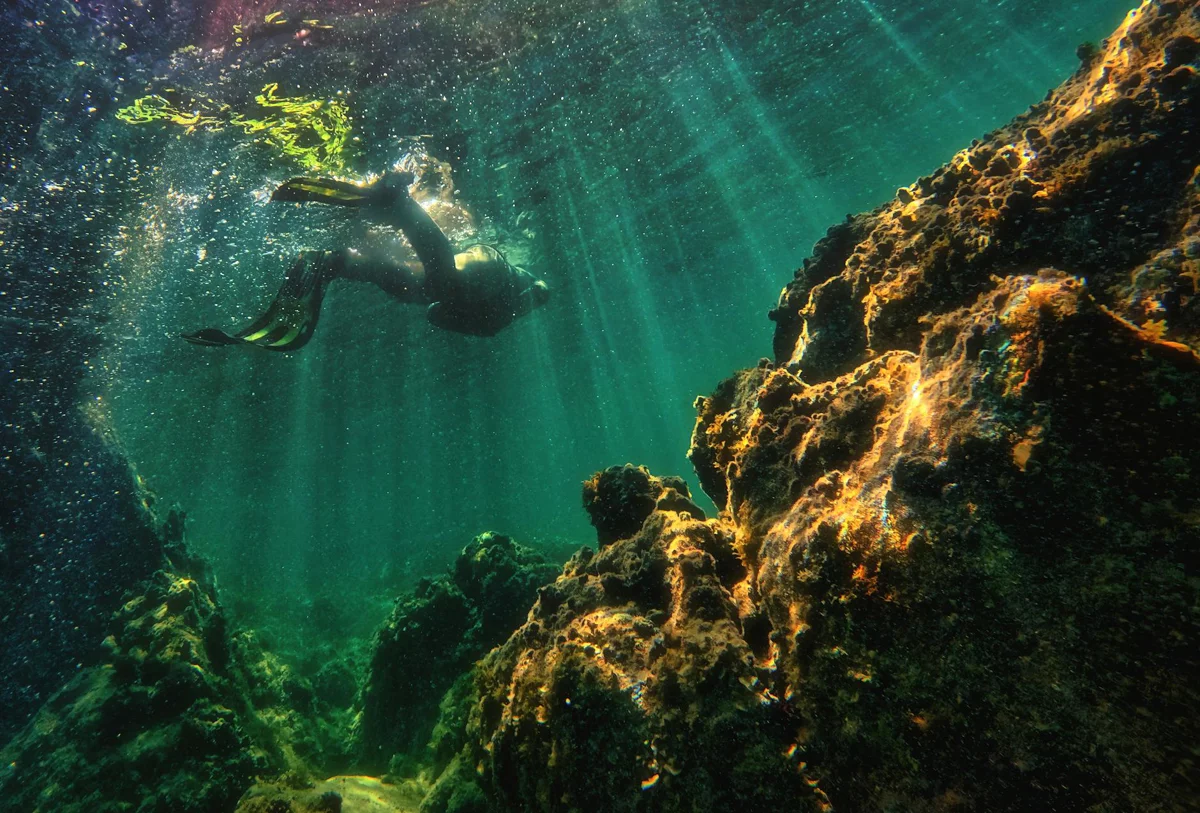
Silfra is a tectonic fissure in Þingvellir National Park (Iceland) between the Eurasian and North American plates. It offers the only opportunity in the world to dive between two continents in glacial water filtered through volcanic rock, with 100+ metre visibility — the best of any dive site on earth. Drysuit diving at 2–4 °C year-round. Easily combined with an Iceland road trip.
Silfra (literally 'silver') is a 600 m long tectonic fissure with a maximum depth of 63 m, located in Lake Þingvallavatn inside Þingvellir National Park (UNESCO 2004), 50 km northeast of Reykjavík. The fissure formed where the Eurasian and North American plates diverge at roughly 2 cm per year. Iceland sits on the visible crest of the Mid-Atlantic Ridge — one of the few places on earth where that ridge rises above sea level. No visa required for EU/Schengen travellers.
The water: Silfra is fed by glacial meltwater from Langjökull glacier, 60 km to the north. That water spends 30–100 years filtering through porous lava rock before reaching the fissure, arriving completely purified. Temperature holds at 2–4 °C all year — summer makes no difference. Visibility is consistently 100 m, often exceeding 150 m. No dive site in the world matches it; the closest comparisons are polar water under ice and filtered cave systems.
The diving: a drysuit is mandatory, along with a drysuit certification (PADI Drysuit Specialty or equivalent — operators offer it on-site). Two guided dives per day is standard. Maximum permitted depth: 18 m (the fissure goes to 63 m but deeper sections are restricted). Four sections: 1) Big Crack (main entry, walls 1–3 m apart, 8–15 m depth). 2) Silfra Hall (wide chamber, 12–18 m). 3) Silfra Cathedral (100 m vertical wall, 8–12 m). 4) Silfra Lagoon (exit lagoon, 5–8 m).
Snorkelling too: snorkelling at Silfra is a genuine option for non-divers — same visibility, same scenery, zero depth. A drysuit is still required. Snorkellers drift single-file along the gentle current through the fissure. Open to beginners (10+ years old) with no certification. Cost: €100–130 (2 hours with guide and full equipment). Scuba: €180–280 (4 hours with guide and equipment).
Other Icelandic sites: 1) Davíðsgjá (another tectonic fissure near Silfra, similar conditions, far less crowded, 12–25 m). 2) Bjarnagjá (geothermal fissure on the Reykjanes peninsula, mixed geothermal water). 3) Garður (shore dive with Arctic fish species, 10–20 m). 4) Reykjavík harbour (cold-water fauna: cod, halibut, lobster). 5) Strýtan (hydrothermal chimney north of Akureyri, requires special permit). Silfra is the primary target; the others are optional add-ons.
Logistics and costs: flights to Reykjavík (KEF, Keflavík International) direct from major European cities — Madrid (Iberia, Icelandair), Rome, Paris, Frankfurt, London, Amsterdam (Icelandair, Wizz Air, easyJet). Transfer to Silfra: hire car (45 min via Route 1) or organised tour with transport. Dive operators: Dive.is (the original operator, exclusive Silfra access), Scuba Iceland, Arctic Adventures. Per-dive cost: €180–280. Guided snorkel: €100–130. PADI Drysuit Specialty: €350–450. Accommodation in Reykjavík: guesthouses from €80, hotels €150–300.
The wider trip: Silfra sits inside Þingvellir National Park, which is one of the three stops on the Golden Circle — Iceland's classic day-tour route including the Geysir geothermal area and Gullfoss waterfall. Easy to build a full Iceland trip around it: waterfalls (Skógafoss, Seljalandsfoss), glaciers (Vatnajökull, Sólheimajökull), black sand beaches (Reynisfjara), northern lights (October–March), hot springs (Blue Lagoon, Sky Lagoon). Seven to ten days gives a solid natural-landscape trip with Silfra as the dive highlight.
Bottom line: Silfra is a genuinely one-of-a-kind dive — the only recreational dive site on a continental rift, 100+ m visibility in filtered glacial water, UNESCO geological context, and straightforward combination with Iceland's main tourist circuit. It is landscape diving, not marine-life diving; anyone expecting a coral reef or fish diversity will be disappointed. For geological and visual uniqueness, nothing else comes close. Recommended year-round (stable conditions). Plan 5–10 days to also cover the Golden Circle, south coast, and Reykjavík.