
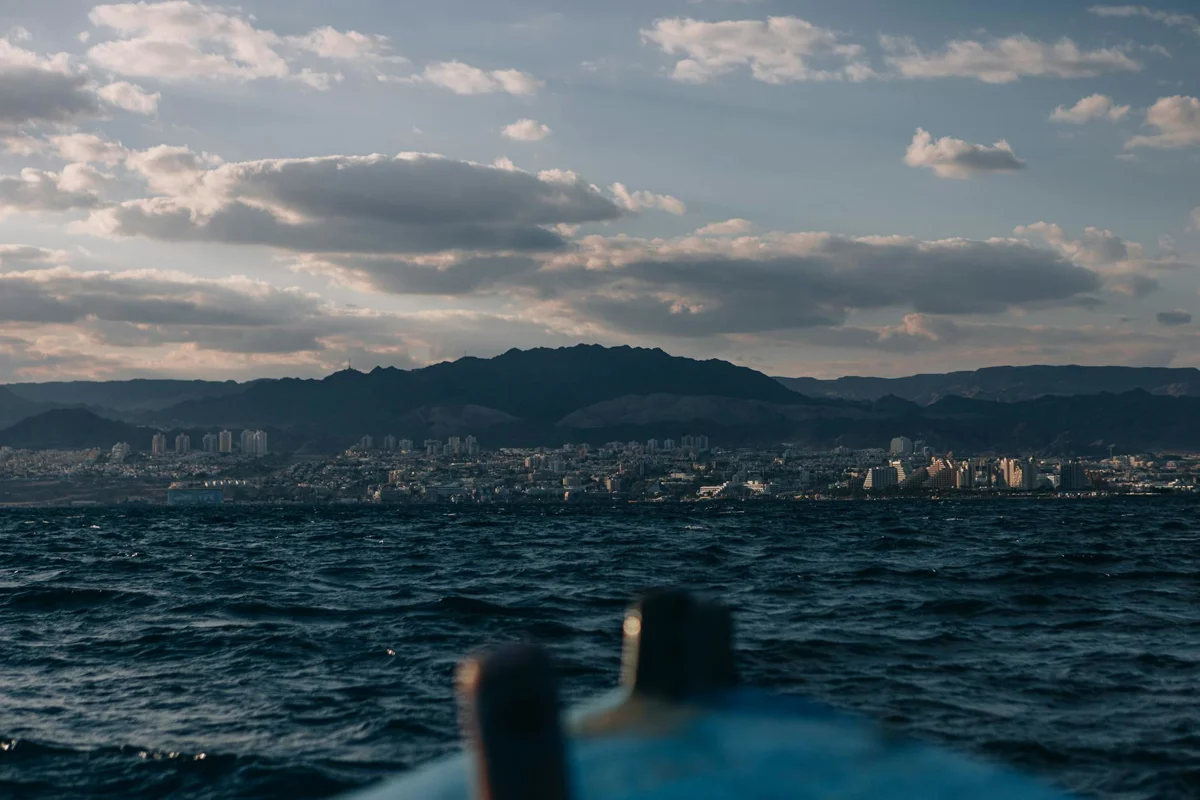
Aqaba is Jordan's only sea access — 27 km of coastline at the northern tip of the Gulf of Aqaba. The destination pairs northern Red Sea coral reefs with wrecks deliberately sunk by the royal family to boost dive tourism. Costs run 30-40% below Egypt, with stable conditions year-round.
Aqaba is Jordan's sole coastal city, sitting at the apex of the Gulf of Aqaba, the northern arm of the Red Sea. The Jordanian coastline stretches just 27 km, bordered by Israel (Eilat to the north), Egypt (Taba/Sinai to the west) and Saudi Arabia to the south. Despite that short stretch, Jordan has 25 registered dive sites, all reachable by shore diving or a short boat ride (5-15 minutes). The city operates as a special economic zone with low taxes: cheap flights, accommodation from €30, meals from €5.
Underwater geography: the Gulf of Aqaba is an active tectonic rift valley dropping beyond 1,800 m at its center. The coral wall falls fast from the shoreline — 5 m of shelf, then a vertical drop to 60-80 m. Water temperature ranges from 21 °C in February to 27 °C in August (warmer than Eilat due to geography). Visibility holds steady at 25-40 m throughout the year. Salinity is high (40-41 ‰), which helps buoyancy but demands more weight.
The king's wrecks: the Jordanian royal family has deliberately sunk several vessels to create artificial reefs and promote diving. The best known: 1) Cedar Pride (74 m Lebanese freighter sunk in 1985 at King Hussein's initiative, 7-25 m depth, now fully coral-encrusted). 2) C-130 Hercules (military aircraft sunk in 2017 at 17 m, intact and penetrable). 3) M42 Duster (anti-aircraft tank sunk in 1999 at 6 m). 4) Khalid tank (sunk in 2019 at 30 m). 5) Russian Mi-24 helicopter (sunk in 2015 at 17 m). Together they form the Underwater Military Museum (since 2019).
Natural reefs: 1) Power Station (coral wall with massive soft corals, 18-30 m). 2) First Bay-Cazar Reef (wall and coral garden). 3) Japanese Garden (coral garden with tabular Acropora). 4) Big Bay (40+ m visibility, sea fans). 5) Eel Garden (garden eels in sand). 6) Seven Sisters (seven coral pinnacles). Typical Red Sea fauna: emperor angelfish, Napoleon wrasse, giant moray eels, green turtles, masked pufferfish, occasional manta rays in summer.
Logistics and costs: flights to Aqaba (AQJ) direct from Munich, Vienna, Warsaw and Istanbul; quick connection from Amman (1 hour). Tourist visa on arrival (€40 for 30 days) or free with the Jordan Pass (Petra-Wadi Rum-Aqaba tourism package). Established dive centres: Aqaba Adventure Divers, Sinai Divers Aqaba, Deep Blue Dive Center, Red Sea Dive Center. Cost per dive: €25-35 shore diving, €35-45 boat diving. 10-dive packages: €250-350. Full equipment rental: €15-20 per day.
Combining with Petra and Wadi Rum: Aqaba is 2 hours from Petra (UNESCO World Wonder, entry €60) and 1 hour from Wadi Rum (sandstone desert with 4WD tours from €30). This diving-archaeology-desert combination is one of a kind: a single week covers Red Sea + Nabataean city + red dunes. The Jordan Pass (€90-105) includes entry to all three sites and the visa. It is the most efficient tourist proposition on the Red Sea.
Where it falls short: hotels. Aqaba has chain resorts (Mövenpick, InterContinental, Kempinski) — comfortable but generic. No local liveaboards (northern Red Sea liveaboards depart from Egypt). Pelagic fauna is sparse — sharks rarely show up, no mass aggregations. This is a reef-and-wreck destination, not a big-animal one. For shark encounters, the nearest option is crossing into Egyptian Red Sea (Taba border, 15 km away) or heading further south to Sudan and Djibouti.
The bottom line: Aqaba is the cheapest entry point to the northern Red Sea, with a unique layer of royal history attached. King's wrecks and natural reefs in an accessible shore-diving format. Easily combined with Petra and Wadi Rum for a complete cultural-natural trip. For high-volume dive-only holidays, Egypt offers more variety. For a mixed Red Sea + Nabataean culture + desert itinerary, Jordan wins on price and operates reliably January through December.