
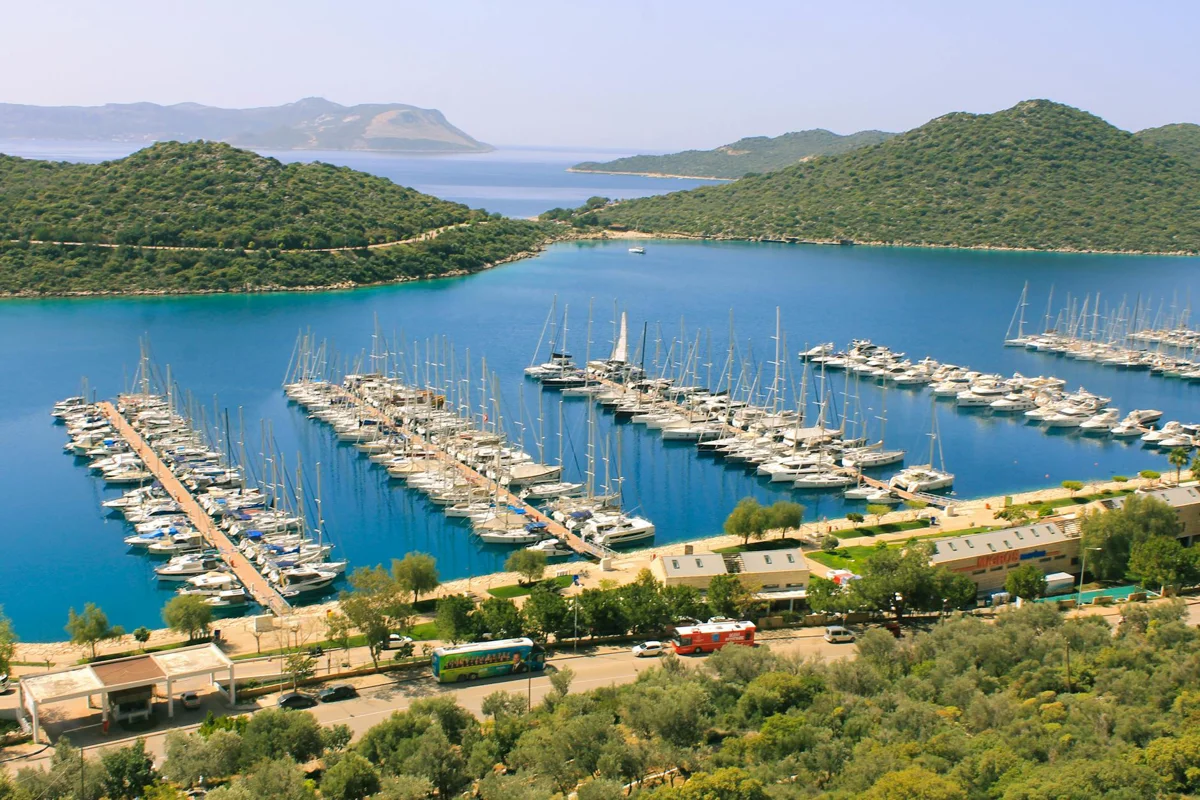
The Lycian coast between Kaş and Kekova holds some of the most remarkable archaeological diving in the Mediterranean. A Lycian city sunk by earthquake in the 2nd century AD, Byzantine wrecks scattered across sandy seabed, amphora fields, and turquoise water with 30 m visibility. A destination for divers drawn to history who have already covered Italy and Greece.
Kaş is a small Turkish coastal town in the province of Antalya, sitting directly opposite the Greek island of Kastellorizo — one of the few places in the Mediterranean where Turkey and Greece are separated by just 2 km of open water. Kekova is an uninhabited island 25 km to the east. The stretch between them, taking in Üçağız and Kaleköy, forms one of the most archaeologically dense marine protected areas in the eastern Mediterranean, its seabed shaped by ancient earthquakes that swallowed whole settlements.
The sunken city (Batık Şehir): the ancient Lycian city of Simena, also identified with Aperlae, partially collapsed into the sea after an earthquake in the 2nd century AD. Today walls, columns, stone steps and mosaic fragments lie between 1 and 6 m depth, clearly visible from the surface. Snorkelling from boats at Kekova gives direct access to the submerged ruins; SCUBA diving over the archaeological remains is prohibited by law. Nearby natural substrate sites do allow diving among scattered amphora and architectural fragments.
Byzantine wrecks: three documented Byzantine wrecks from the 7th to 11th centuries AD lie in the waters off Kaş, all accessible to scuba divers. Amphora cargoes, stone anchors, keel timbers. Depths range from 18 to 35 m. Access is regulated — only dive centres holding an official permit may lead dives on these sites. Shallower wrecks such as the Bayındır Limanı site at 22 m are manageable for Open Water divers; the Üçağız Wreck at 35 m requires Advanced certification.
Other sites: Canyon is an underwater canyon holding large fish; the Hidayet Wreck is a Turkish merchant vessel that sank in 1955 and rests at 28 m; Tatlısu is a relaxed site with good marine life; Big Reef offers varied terrain with soft corals. Depths run from 15 to 35 m. Water temperature ranges from 17 °C in February to 26 °C in August. Visibility typically 25 to 40 m. Currents are light and the diving suits all certification levels.
Getting there: flights to Antalya from most European capitals, with cheap fares outside Turkish peak season. Ground transfer to Kaş takes about 3 hours by bus or hire car. Accommodation ranges from guesthouses around 30 € to hotels between 60 and 150 €. Main operators are Bougainville Diving and Turkey Dive Center, alongside several smaller outfits. A guided dive costs 35–50 €, among the lowest in the Mediterranean; a package of 6 dives runs around 200 €. Turkish is the local language; English is universal at dive centres, German also common.
What stands out: the blend of archaeology and low-key tourism. Kaş is a genuinely quiet town — nothing like the crowds at Bodrum or Antalya — with Ottoman houses, a small historic mosque and a working local market. Food is good and inexpensive. For couples or families where only one person dives, non-diving days are easy to fill: the Lycian rock-cut tombs at Mira, the amphitheatre at Patara, turquoise beaches, and short boat trips to nearby Greek islands.
The limitations: the season is short. Dive centres operate from May through October; in winter the northerly wind shuts everything down. The language barrier is real outside tourist areas — in small inland villages, Turkish is necessary for anything beyond pointing at a menu. Divers who speak only English are better off staying in Kaş rather than exploring surrounding villages without a guide.
In summary, Kaş and Kekova offer high-quality Mediterranean diving for anyone with an archaeological bent. The combination of submerged ruins, Byzantine wrecks, turquoise water and genuinely low prices makes the value hard to match. A week in September or May competes directly with Croatia or Greece. Those chasing pelagics will head to the Red Sea instead — but for mixed diving, archaeology and cultural tourism in one trip, this stretch of the Lycian coast earns its place.