
Komodo is not for everyone. Currents can hit 8 knots, downcurrents are routine, and less experienced divers surface after a single dive swearing they will never go back. Those who can manage current find something rare here: intense drift dives in waters packed with marine life. The question is not whether Komodo is worth it — it is whether you are ready.
Komodo National Park sits in the Nusa Tenggara islands of Indonesia, wedged between Sumbawa and Flores. The main dive islands are Komodo, Rinca and Padar. The Komodo dragons draw wildlife tourists, but it is the diving that justifies the long-haul flight. The underwater geography explains the currents: Indo-Pacific oceanic flows accelerate as they squeeze through the narrow channels between islands, generating surges of up to 8 knots at peak tide.
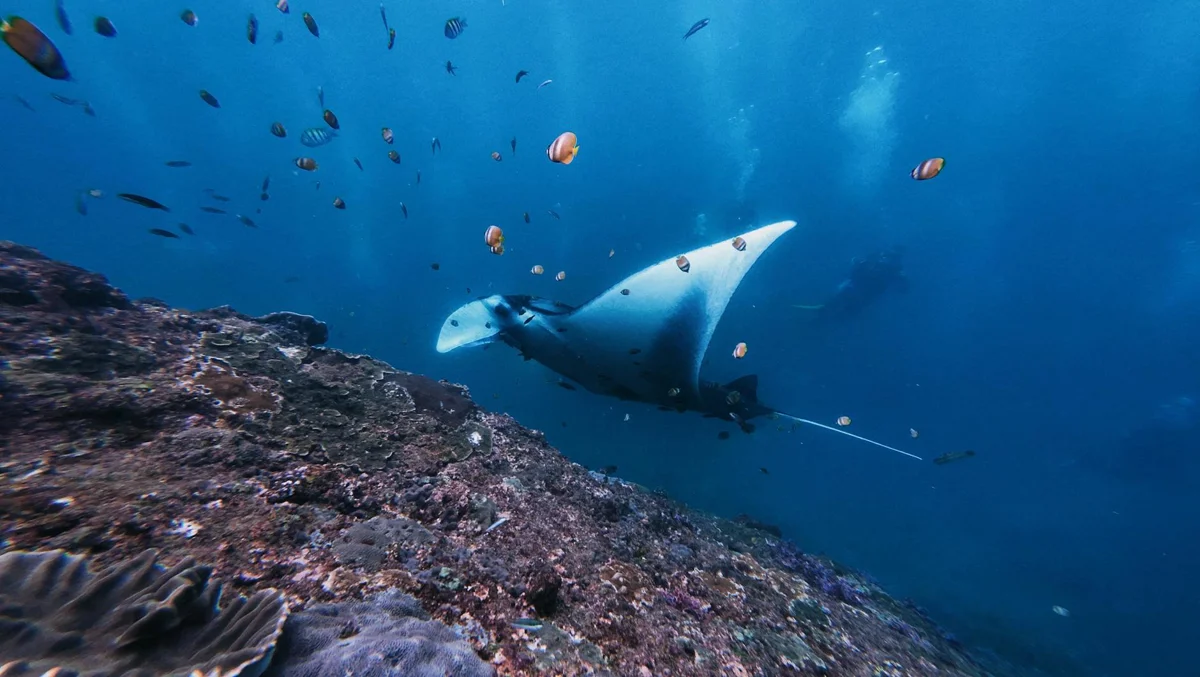
What makes it unlike anywhere else is the pairing of extreme currents with absurd biodiversity. The nutrient upwelling feeds plankton, which feeds baitfish, which pulls in larger pelagics. On any given dive you may see reef sharks, both reef and oceanic mantas, dense jacks and tuna, hawksbill turtles, and the occasional thresher. Below it all, soft corals bloom in the flow like Mediterranean red gorgonians — only at 20 m instead of 35.
The northern sites are the current-heavy classics. Castle Rock delivers drift dives past reef sharks and mantas; Crystal Rock is similar but shallower; Cauldron is an underwater crater with a manageable downcurrent and frequent bait balls; Toko Toko Made is a current-swept coralline plateau. The southern sites — Manta Alley and Pink Beach — are calmer and better suited to intermediate divers. Depths run 12–30 m, water temperature 24–28 °C, visibility 15–30 m.
Current in Komodo is not background noise — it is the main event. A reef hook is mandatory kit. The drill: drop fast to the top of the reef, clip the hook into dead substrate, let your body stream like a flag, and watch whatever the current delivers. Experienced guides time the whole operation: they know precisely when to unclip and start the drift, and they hold the group tight on the way.
The trickiest hazard is the downcurrent. At certain sites and certain tidal moments, a vertical pull can drag a diver down at 30–40 m per minute. Reading the warning signs — bubbles deflecting downward, fish suddenly agitated and swimming hard — and reacting correctly (fin perpendicular toward the reef, never fight straight up against the flow) is not advanced technique, it is basic survival at Komodo. The local guides are highly competent, but the diver must stay alert.
Getting there: fly to Bali (Denpasar) from Europe with one stop (Singapore, Doha or Dubai), then take a domestic connection to Labuan Bajo on Flores, where the liveaboard fleet is based. Standard itineraries run 7–10 days. Established operators include Mermaid Liveaboards, Aurora and Tiare, with several solid mid-range alternatives. Budget 2,500–4,000 € for a 7-day trip all-in excluding flights; flights from Europe add roughly 1,000–1,500 €.
The main disappointment is overcrowding. Komodo's reputation exploded in the last 15 years and the liveaboard fleet grew with it. In high season (May to October) 8–10 boats can share the park simultaneously. Sites like Castle Rock and Manta Alley fill up fast. The better operators know which lesser-known spots to run when the crowds pile in. Choosing a liveaboard with deep local knowledge matters more here than in most destinations.
Bottom line: Komodo is a top-tier global destination for divers who are already comfortable with current and drift diving. For someone whose ceiling is the Mediterranean or the Red Sea with a hundred or fewer dives logged, it will be a rough week. For divers past 100 dives who have done Egypt and the Maldives, it is the logical next step in Asia. The diving intensity, the sheer variety of fauna, and the overwater scenery — dragons, lunar landscapes, pink sunsets — make the logistical effort worthwhile.