
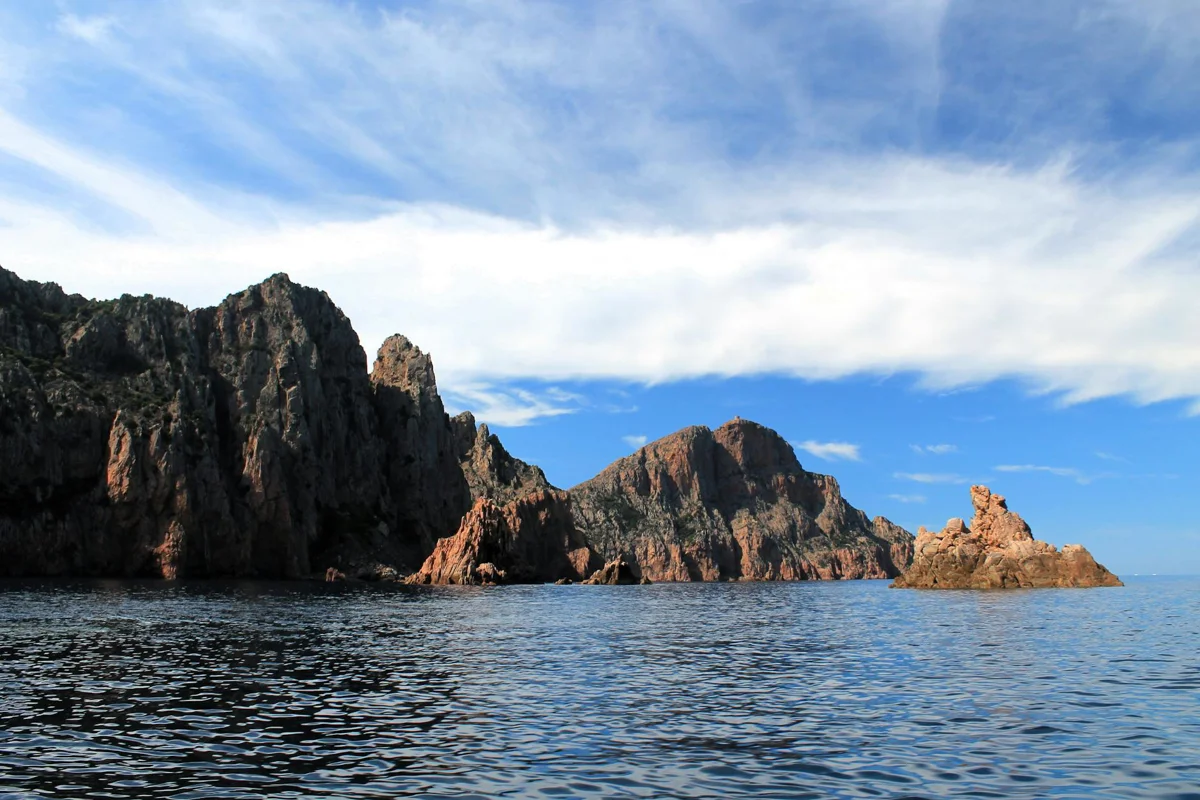
Scandola Natural Reserve on western Corsica was France's first marine reserve (1975) and the Mediterranean's first UNESCO World Heritage marine site. Strictly regulated access, red porphyry walls, 25 kg dusky grouper that hold their ground, and recovering pelagic populations make it a top Mediterranean destination for conservation-minded divers.
Scandola is a peninsula on western Corsica, facing the Golfe de Porto, with 1,000 hectares of marine protected area and 919 hectares of terrestrial reserve. Designated in 1975, extended in 1983, and listed as UNESCO World Heritage since 1983 as part of the 'Gulf of Porto, Calanques de Piana, Gulf of Girolata and Scandola Reserve'. Day-to-day management falls to the Parc Naturel Régional de Corse under strict regulations.
Access is tightly controlled: only two dive centres hold permits to operate inside the reserve, subject to daily quotas. Diving is restricted to the perimeter zone — the core area is off-limits. All dives are guided without exception; fishing, collecting, and approaching protected species (monk seal, osprey) are prohibited. Fines for violations run up to 1,500 €.
Red porphyry: Scandola's defining geology is volcanic red porphyry — igneous rock studded with large crystals. The vertical walls carry a signature red-orange tint that pops against Mediterranean blue and the amber of sea fans. For underwater landscape photography, few western Mediterranean sites come close. Overhead sunlight hitting a red wall dense with gorgonians produces images that are hard to replicate elsewhere.
Wildlife: four decades of protection have produced a recovery story rarely seen in the Mediterranean. Dusky grouper weighing 25–30 kg cruise the walls without fear — elsewhere in the sea their large counterparts have vanished. Barracuda schools, migrating bluefin tuna, common dentex, white seabream, conger eels, spiny lobster. The Mediterranean monk seal (*Monachus monachus*) is documented in the area, though sightings during dives remain rare. Red gorgonians grow thick from 25 to 40 m.
Notable dive sites: 1) La Calanche — wall dive carpeted in gorgonians. 2) Senino — gentle drift with light currents. 3) Punta Palazzu — rocky formation with swim-throughs and small caves. 4) Capo Rosso — consistently high fish density. Depths range from 12 to 40 m, water temperature 14–25 °C depending on season, visibility 25–40 m. Currents are mild; Open Water certified divers can manage with a guide.
Getting there: flights into Ajaccio or Calvi from mainland France are short and inexpensive, or take the ferry from Nice or Marseille (6–12 hours). A hire car on the island is essential. Accommodation in Porto or Osani — small villages close to the reserve — starts at around 60 € for a guesthouse, with hotels ranging 100–200 €. Licensed operators: Centre de Plongée du Golfe de Porto and OK Plongée. Dives cost 55–75 €, a premium over the Mediterranean average that reflects the site's exclusivity.
The upside: Corsica pairs serious diving with exceptional land-based travel. The island's landscapes — mountains topping 2,000+ m, white-sand beaches, stone villages — justify the nickname 'Île de Beauté'. The combination of quality diving, hiking trails, Corsican food (cured meats, brocciu cheese, Patrimonio wines), and a French culture with a fiercely independent identity sets it apart from more overrun Mediterranean islands.
The downside: cost and limited availability. On peak summer days, entry slots fill before boats leave the harbour. Booking one to two months ahead is necessary in July and August, and prices exceed those in Sardinia or Croatia. As a pure budget diving destination, Scandola does not compete. As a high-quality diving destination with a model conservation record and genuine French island travel layered on top, it earns its reputation. A week in September hits the sweet spot. A long weekend trip rarely justifies the transport cost.