
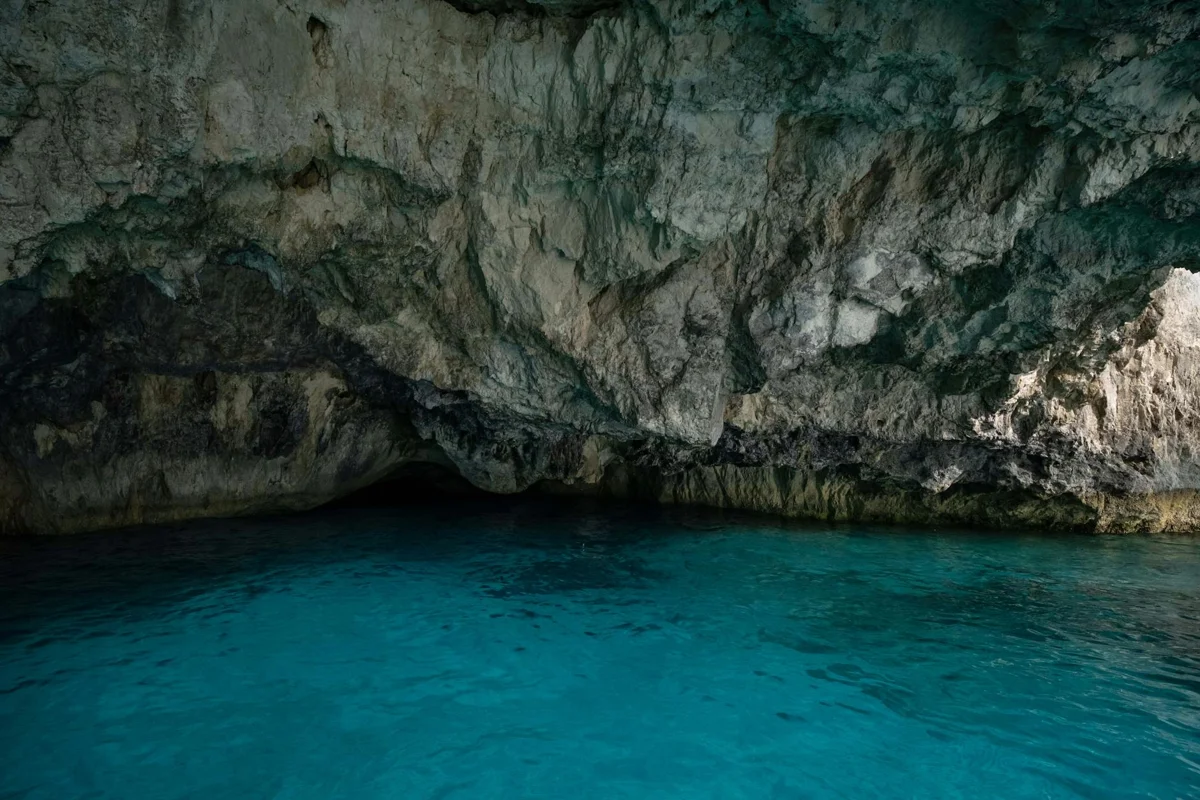
Modra Špilja (Blue Cave) on Biševo is probably the most photographed sea cave in Europe. A natural chamber where sunlight passes through an underwater entrance and refracts into a surreal cobalt-white glow that fills the entire interior. Photos never do it justice. Day-trip destination from Vis or Split, reachable by guided dive or snorkel, with specific conditions for seeing it at its best.
Modra Špilja (Blue Cave) sits on the small island of Biševo, 5 km southwest of Vis (see note 101). The cave measures 24 m long, 12 m wide, with an average depth of 16 m. The main above-water entrance is just 1.5 m high—accessible only to small boats in flat-calm conditions. The real magic comes from a submerged arch 3 m below the surface: the underwater entrance through which sunlight pours in.
The optical phenomenon: between roughly 10:00 and 13:00 local time, when the sun is high enough, rays enter through the submerged arch and refract off the water. Blue wavelengths scatter far more than red, flooding the entire chamber with an unearthly cobalt-white light locals call the 'blue bell.' For photography, clear cloudless days between 10:30 and 12:00 give the most saturated result.
Standard tourist access: most visitors arrive on snorkel excursions from Vis, Hvar, or Split, paying 50–90 € per person for a fast-boat trip of two to four hours. Electric-motor tenders carry groups inside—petrol engines are banned to protect air quality—and guests spend five to ten minutes photographing before heading back. In peak season the cave draws 200+ visitors a day, with queues of boats waiting on the surface.
Dive access: only two operators—Manta Diving Vis and Issa Diving Center—hold permits for SCUBA inside the cave. Dives run at 12–18 m, last around 30–40 minutes, and offer a perspective no snorkeller ever sees: the refracted light from below, looking up through the arch. Cost is 50–65 € per dive, or 100–130 € for a full-day kit-and-transport package. Book one to two days ahead in July or August.
Biševo's other caves: the island has four accessible cavities. Zelena Špilja (Green Cave) in Ravnik produces a marine-green glow—less dramatic but more spacious. Medvidina Cave was historically a monk seal habitat; no seals remain, but the interior is worth the stop. Sokolova is a small bat cave. Local dive centres routinely combine two or three caves into a full-day excursion with a lunch break at Komiža on Vis.
What surprises most: the sheer simplicity of the effect. No technology, no artificial lighting—just basic refracted light physics. Yet the visual impact rivals world-famous sites like Cenote Angelita in Mexico or the Blue Hole in Belize. The key difference: the Blue Cave is reachable from anywhere in Europe on a low-cost flight, a short ferry, and a half-day excursion.
What disappoints: the crowds. In July and August, 30+ boats queue outside daily. SCUBA divers get priority over snorkellers, but any sense of solitude evaporates. The remedy is straightforward—visit in May, June, September, or October, or take the first departure of the day (8:00–9:00) before the tourist fleet arrives. An early start almost guarantees near-empty conditions inside.
The verdict: Biševo's Blue Cave is an accessible Mediterranean destination that delivers photographically. It pairs naturally with Vis (note 101) for a full week of Croatian diving. For underwater photographers the blue-light phenomenon is genuinely hard to replicate anywhere else in Europe. At 100–130 € for a combined transport-and-dive package, the accessibility-to-impact ratio stands alone. For pure marine-life diving there are stronger options; for a photographic objective, Biševo is the clear choice.