
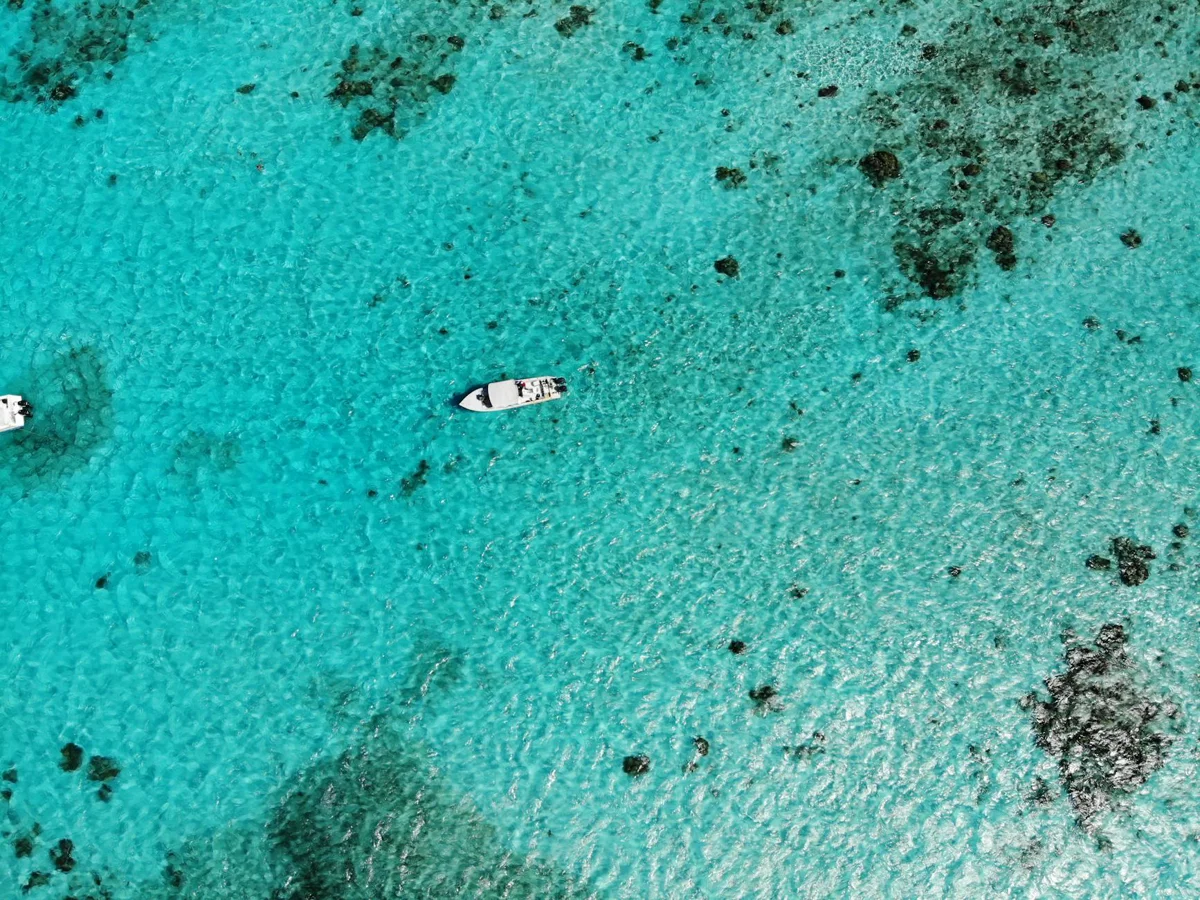
The Great Blue Hole in Belize lands on every bucket-list ranking of the world's best dives. A near-perfect circular sinkhole, 300 m across and 124 m deep, carved out when a limestone cave collapsed 10,000–12,000 years ago. The question serious divers ask before booking: does it actually deliver underwater, or does it exist mainly as an aerial photograph?
The Great Blue Hole sits at the centre of Lighthouse Reef atoll, 70 km east of Belize City. Its almost exact 300 m diameter and the sharp colour contrast between the dark void and the surrounding turquoise reef have made it one of the most reproduced underwater images on the planet — an icon that owes much of its fame to aerial photography rather than what waits below the surface.
What the blue hole actually offers: a vertical circular wall dropping to 40 m, where the first stalactites appear — formations that grew in dry air more than 12,000 years ago and are now submerged. Between 40 and 60 m a chamber opens up, its ceiling hung with massive angular stalactites. Deeper than that, oxygen-depleted water and a hydrogen-sulphide layer make life impossible. Most dives run 25–30 minutes: a vertical descent to 40 m, a brief transit among the stalactites, then ascent.
What the blue hole does not offer: marine life. Geologically the site is extraordinary; biologically it is sparse. The walls carry almost no coral, fish are scarce, and shark sightings — mentioned in many trip reports — are occasional at best. Any average Caribbean reef has more fauna. Divers arriving with wildlife expectations tend to surface puzzled.
The surrounding reefs are where the actual diving happens. Every day trip and liveaboard to Lighthouse Reef adds two or three dives at Half Moon Caye, Aquarium, or Long Caye. Caribbean reef sharks, turtles, spotted eagle rays, and large groupers are routine there. Without those complementary dives, the journey to the blue hole is hard to justify on cost alone.
Getting there: flights connect to Belize City via Miami or Houston, with European connections through either hub. Day trips leave Belize City or Ambergris Caye (San Pedro) at around 05:30, reach Lighthouse Reef after roughly 2.5 hours, complete three dives (blue hole plus two reef sites), and return by 17:30. Cost runs 250–330 € all-in. Seven-day liveaboards covering Lighthouse Reef, Turneffe, and Glover's range from 2,500–3,500 €. Main operators: Aggressor Adventures (Sun Dancer II) and Belize Diving Holidays.
The honest assessment of value: many experienced divers feel the blue hole does not justify a dedicated trip. The dive itself is geologically striking but short and biologically thin. The high day-trip price, compared with reef diving across the Caribbean, stings more when expectations are set by the famous aerial image rather than what actually happens at depth.
Context among similar sites: the Great Blue Hole belongs in the same category as Dean's Blue Hole (Bahamas) and Cenote Angelita (México) — each with distinct geological character, none of them stand-alone diving destinations. They work as anchors within broader itineraries. For divers already familiar with Cuba, the Bahamas, or the Yucatán, Belize offers genuinely differentiated reef systems; the blue hole is the emblem, not the substance.
The practical verdict: one dive at the Great Blue Hole is worth doing for the geology alone, provided it sits inside a multi-dive itinerary that includes Lighthouse Reef and Turneffe or Half Moon Caye. For pure Caribbean reef diving, Belize competes with Roatán and Cozumel without needing the blue hole to justify the trip. The reputation exceeds the underwater reality — which is not a condemnation, just a calibration.