
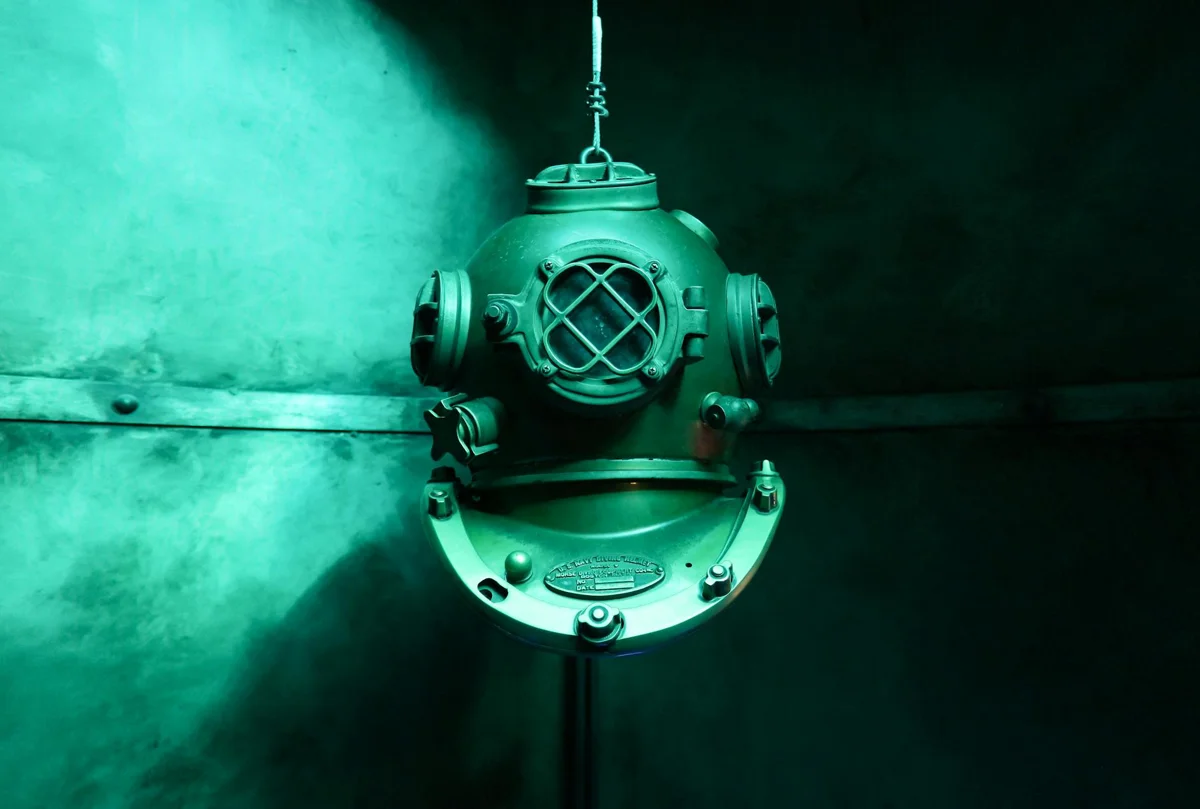
The Mark V was the US Navy's standard professional diving suit from 1916 to 1980. A 25 kg brass helmet, waterproof canvas suit, and 9 kg lead boots apiece — 86 kg in total. It appears in virtually every vintage naval diving photograph. Its development traces the arc of diving history from Victorian-era pioneers to the modern era of mixed-gas systems.
Before the Mark V, the first professional diving suit emerged in 1837 under Augustus Siebe, a German engineer who had settled in England. His Standard Diving Dress was the first fully closed system: a rigid brass helmet joined by hose to a surface pump. Over the following seventy years the design evolved steadily — stronger helmets, more reliable hoses, steadier boots — but the core principle of surface-supplied air never changed.
In 1916 the US Navy adopted the Mark V as its standard diving suit across all operations. Improvements over earlier designs included a 12-inch (30 cm) brass helmet with three glass ports, an integrated telephone communication system, more efficient exhaust valves, a heavier-duty reinforced canvas suit, and standardised hose fittings. With boots attached, total weight reached 86 kg on the surface; the suit became effectively neutral at depth.
From 1916 to 1980 — those 64 years — the Mark V served naval divers in submarine rescue operations (USS Squalus, 1939), underwater demolition, aircraft recovery, mine laying, and hull maintenance. Typical working depth was 60 m. The deepest documented dive in the suit reached 91 m under controlled test conditions.
The Mark V had serious constraints. Mobility was minimal: a diver could walk the seabed but not swim. Bottom time was restricted by surface-pumped air and mandatory decompression stops. A severed hose or pump failure at the surface risked gas embolism. Operating inside wrecks or caves was impractical because the umbilical fouled easily. Donning and doffing the complete rig took 15–20 minutes each way.
During the 1950s–60s, Cousteau and other pioneers developed SCUBA — Self-Contained Underwater Breathing Apparatus — giving divers full autonomy without a surface hose. The US Navy retained the Mark V for deep work beyond SCUBA reach while adopting autonomous equipment for tactical operations. The full transition to modern gear — gas mixtures, heated drysuits, wireless comms — stretched into the 1980s.
The Mark V left active service in 1980 but has never left the cultural memory of naval diving. It is displayed today at the US Navy Museum in Washington DC, the Museum of Diving in Hawaii, and the Naval Diving and Salvage Training Center in Panama City, Florida, as well as in private collections worldwide. A number of surviving examples remain functional and appear at historical demonstrations.
The professional successor to the Mark V is the MK-21 system used by the US Navy and its international equivalents. A demand-valve helmet removes the need for continuous surface pumping; modern drysuits incorporate heating; wireless communication is standard; mixed gases such as heliox and trimix extend safe depth. Total equipment weight drops to 30–40 kg, and operational time at 60 m can reach four to six hours with appropriate rest intervals.
Across 64 years the Mark V shaped what military salvage diving could achieve. Without it the submarine rescues of the twentieth century — USS Squalus, Thetis, and others — would not have been possible. The brass helmet and canvas suit of 1916 are the direct ancestors of every surface-supplied helmet worn today. One hundred-plus years of refinement separate Siebe's original Standard Diving Dress from an Apeks XTX200 regulator, but the engineering lineage is unbroken.