
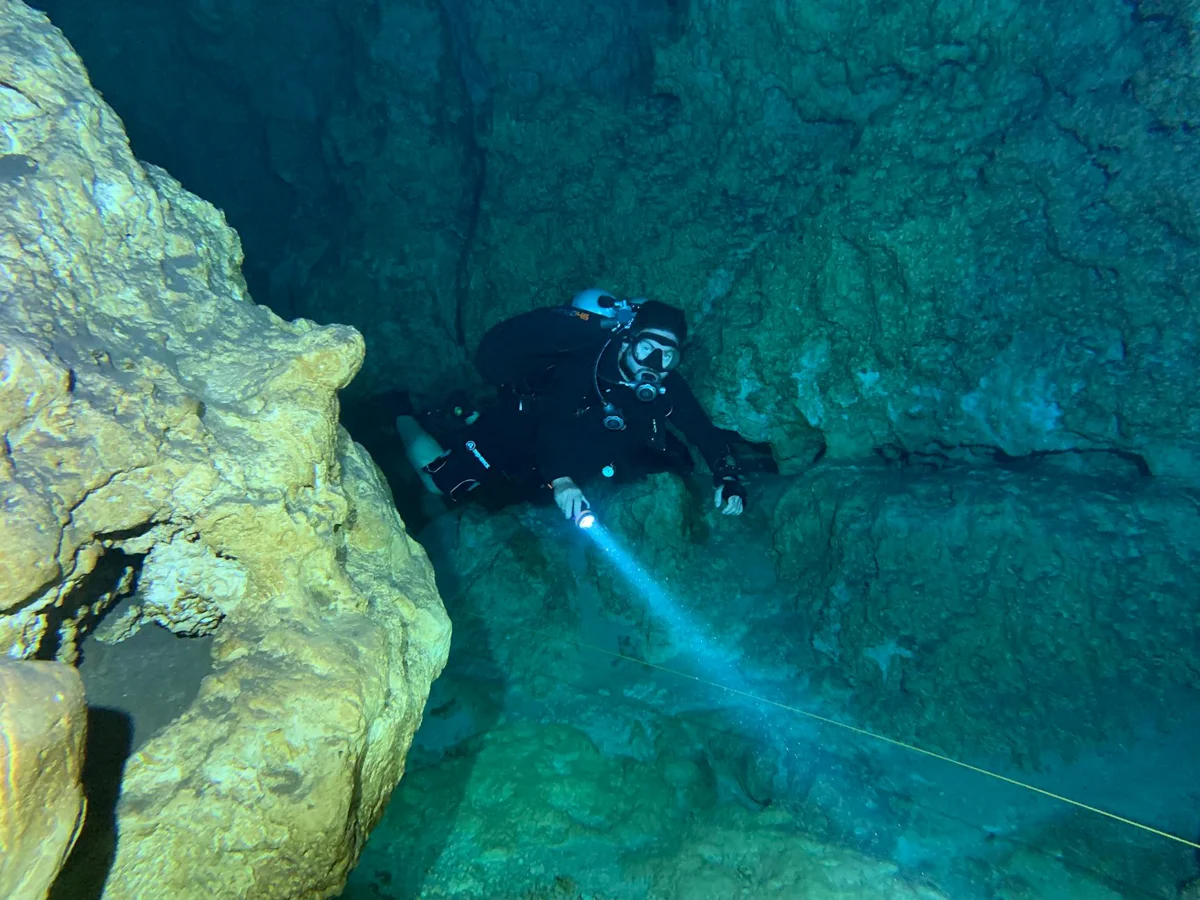
The dive torch market is noisy and divers get lost chasing inflated lumen figures. The reality: 1,000 lumens with the right beam angle outperform 5,000 poorly focused ones. This guide covers the three specs that actually matter — lumens, beam angle, burn time — with honest model recommendations for recreational, technical, underwater photography, and night diving.
Lumens measure total light output. It's the most advertised figure and the least useful without context. 1,000 lumens in a narrow beam (8–10°) reach 50 m with concentration; the same lumens spread over a wide beam (60–90°) light a broad area but only to 5–8 m. The number alone tells you nothing — lumens and beam angle must be read together.
Beam angle categories: 1) Narrow (8–15°): deep diving, underwater photography with a focus light, long-distance signalling. Examples: Light Monkey 32W LED, Big Blue VL18000P. 2) Medium (30–45°): all-round use, good for night recreational and general exploration. Examples: Mares EOS 7RZ, Aqualung Vega 600. 3) Wide (60–90°): large-scene illumination, underwater video, cave diving. Examples: Big Blue AL1200WP, Backscatter Mini Flash 2 with extension.
Burn time: how long the battery lasts at maximum power. Critical for night and technical diving. A 2,000-lumen torch with 60 minutes of burn time is more practical than 5,000 lumens lasting 20 minutes. Serious divers carry two torches — a primary torch and a backup torch — with interchangeable batteries.
For recreational night diving: 800–1,500 lumens, 30–45° beam angle, 60–90 minutes burn time, compact size. Models worth considering: Mares EOS 7RZ (550–1,200 €), Light & Motion Sola Dive 800 (250–350 €), Aqualung Vega 600 (200–300 €). These cover virtually every recreational scenario.
For underwater photography: the torch functions mainly as a modelling light or pre-shot focus tool — used to locate and frame a subject before firing the strobe. What you need: moderate lumens (500–1,000), medium-wide beam (45°), moderate burn time (45–60 min), ideally with an adjustable beam. Models: Light & Motion Sola Photo 800, Backscatter Macro Wide 4300.
For technical diving (caves, deep wrecks): 3,000–5,000+ lumens, narrow beam, 90+ min burn time, extreme reliability. Models: Light Monkey 32W LED Mark IV (700–900 €), Hartenberger Mini Compact (600–800 €), Halcyon Focus 1.0 (500–700 €). When penetrating a wreck or cave, carry a minimum of two torches — primary torch plus at least two backup torches.
What few people mention: lumen figures from Chinese-market brands (Big Blue, entry-level Light & Motion, Underwater Kinetics) are typically overstated by 20–50 %. A torch claiming 5,000 lumens often outputs 2,500–3,500 in practice. Premium European and American brands (Light Monkey, Halcyon, Hartenberger) publish honest specs. Paying more buys genuine accuracy.
The bottom line: for recreational diving, a solid 800–1,500-lumen torch with 60 minutes burn time covers all needs for 200–400 €. For photography, choose a light with adjustable beam and colour temperature. For technical work, quality is non-negotiable. What to avoid: cheap Chinese torches marketed at 'X,000 lumens' for 50 €. Real burn time is 15–20 minutes and reliability is poor. On torches, the mid-to-high range earns its price.