
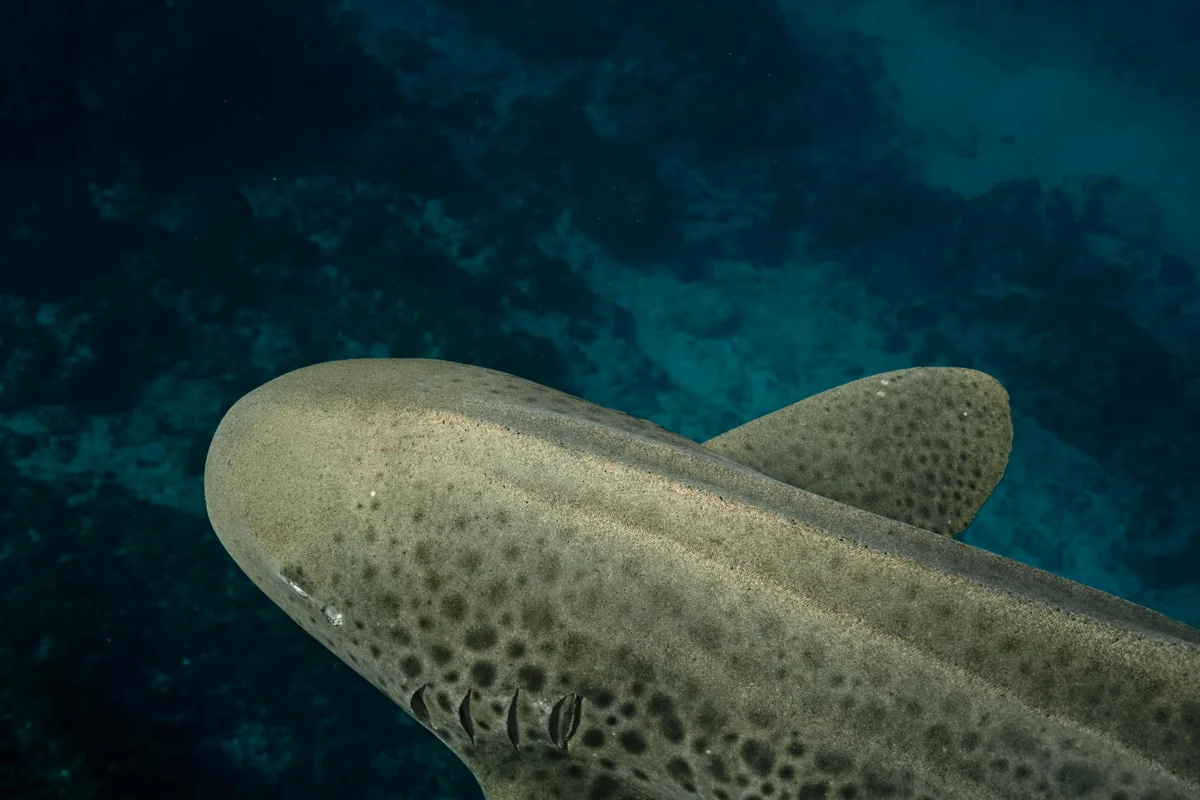
The angel shark was once common throughout the Mediterranean and eastern Atlantic. Today it is regionally extinct in the Mediterranean and critically scarce elsewhere — except in Lanzarote, Canary Islands, where 500–1,000 adults persist. That makes this volcanic island the probable global stronghold of the species, and one of the most overlooked dive destinations in Europe.
The angel shark (*Squatina squatina*) looks nothing like what most people picture when they hear the word shark. The body is dorsoventrally flattened — closer in silhouette to a ray than to a typical elasmobranch — with broad pectoral fins and a flexible trunk built for burying into sand. Adults reach 1.5–2.4 m and 25–80 kg. During the day the animal lies motionless, submerged in the substrate with only the eyes and the spiracle — the respiratory opening behind the eye — breaking the surface.
By night the angel shark shifts into ambush predator mode, lunging upward to engulf small fish and crustaceans with a strike so fast it is difficult to see with the naked eye. This lifestyle made the species highly susceptible to bottom trawling: nets dragged along sandy beds at night caught adults in the exact habitat and at the exact hour when the animals were active. Between 1950 and 1990, intensive bottom-fishing reduced the population to an estimated 1–5 % of historical levels across its former range in roughly 40 years.
The collapse was near-total. In the Mediterranean, *Squatina squatina* is now considered regionally extinct — last confirmed sightings in most areas date to the early 1990s. In the northeastern Atlantic (continental Spain, Portugal, France, the United Kingdom), scattered individuals are occasionally reported but no resident breeding populations are documented. Two exceptions survive: the Welsh coast, where numbers are marginal, and Lanzarote, Canary Islands, where something genuinely unexpected has endured.
Research by the Instituto de Ciencias del Mar (CSIC) and the Angel Shark Project estimates 500–1,000 adult angel sharks between Lanzarote and Fuerteventura. The reasons for this refuge are biological and political simultaneously. Biologically, the archipelago offers extensive shallow sandy plains, year-round prey availability, and relative isolation from continental trawling fleets. Politically, the Canarian government introduced a partial fishing moratorium on the species, and the islands have held UNESCO biosphere reserve status since 1993.
For divers, sightings are most consistent from November to March, when females move into shallower coastal waters. The principal sites lie in the southern half of the island: Punta Tiñosa, Playa Chica, La Cala. Depths range from 12 to 25 m on sandy substrate. Detecting the animals takes practice — a buried angel shark in fine volcanic sand shows almost nothing except two slightly raised eyes and a faint outline of the body margin. Experienced local guides from operations like Calipso Diving and Manta Diving Lanzarote know what to look for.
Angel sharks are not aggressive toward humans under normal circumstances. When disturbed they typically bolt for deeper water. However, if cornered or grabbed they bite cleanly with sharp, fish-catching teeth — the same reason that handling is prohibited. Standard protocol: remain at least 1 m away, avoid direct flash on the animal, and make no contact. The spiracle flaring and the body tensing are early signs that the shark is about to move; backing away at that point is the right call.
The conservation stakes are unusually clear. Lanzarote almost certainly holds the last viable breeding population on the planet. If it collapses under continued poaching pressure, climate-driven prey shifts, or tourism disturbance, the species enters a trajectory toward global extinction. The Angel Shark Project, the IUCN Shark Specialist Group, and Misión Tiburón Canario maintain monitoring programs; citizen science data from dive operators feeds directly into population models used for IUCN assessments.
Getting there is straightforward. Low-cost direct flights from most European cities keep costs reasonable, and a rental car is the only practical way to reach the southern dive sites from the airport. Guided dives in Puerto del Carmen or Playa Blanca run 35–55 €. No sighting is ever guaranteed, but within the November-to-March window, encounter rates reported by the main operators are genuinely high. The context alone — diving with what may be the last significant population of a once-widespread Atlantic shark — gives the trip a weight that most dives simply do not carry.