
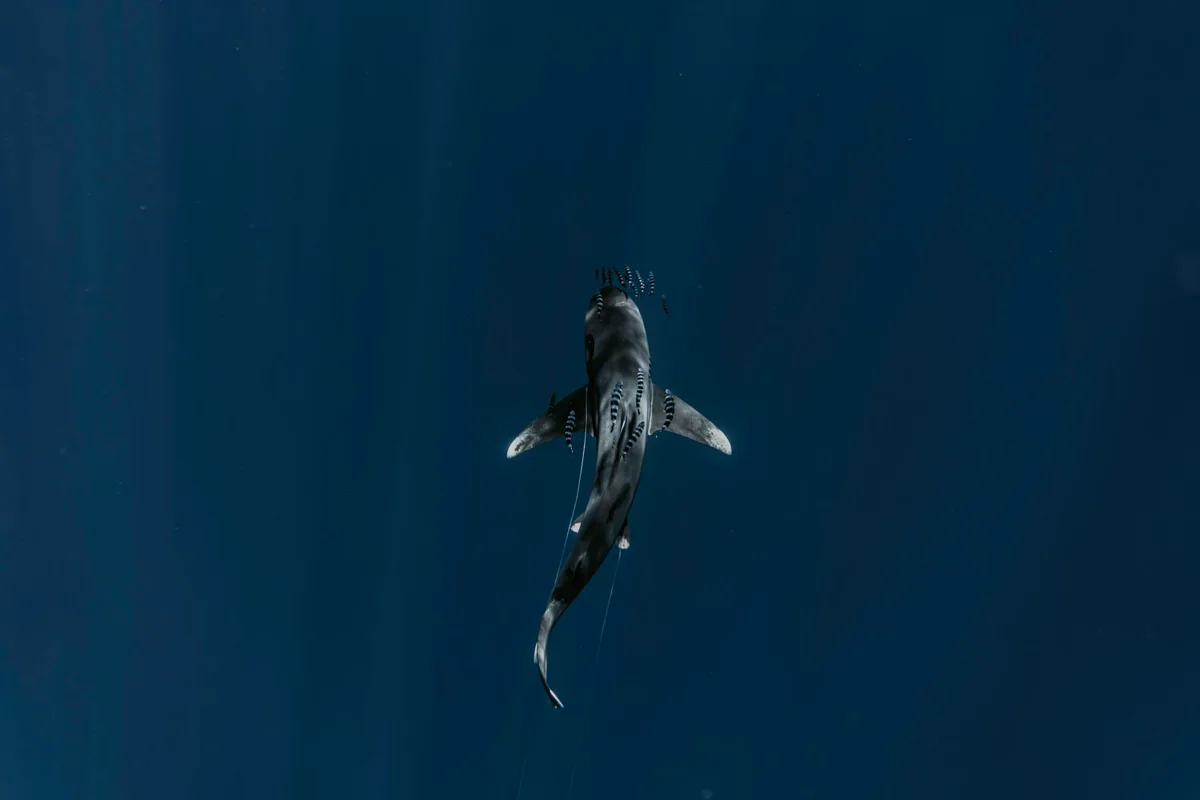
Malapascua is a small island north of Cebu with one compelling draw: Monad Shoal, a seamount where *Alopias pelagicus* thresher sharks ascend to 25 m every morning at first light to be cleaned. Nowhere else on the planet can recreational divers reliably encounter thresher sharks. Boats leave at 5 a.m., the window closes by 7. Everything else about the island is secondary to this single, repeatable ritual.
Malapascua sits roughly 8 km north of Cebu, reached by a 30-minute ferry from Maya on Cebu's northern tip, or by a four-hour road transfer from Cebu City. The island itself is about 2 km across: a fishing village that grew a cluster of dive centres through the 1990s. It entered the dive world's radar in the late 1990s when the thresher shark cleaning behaviour at Monad Shoal was first documented and word spread fast.
Monad Shoal lies 8 km east of Malapascua. The summit peaks at 18 m, then the walls drop vertically beyond 200 m. Each morning between roughly 5:30 and 6:30, pelagic thresher sharks (*Alopias pelagicus*) rise from the deep, sometimes from below 200 m, to visit the cleaning stations at the top. Wrasse pick off parasites while the sharks circle in slow, deliberate arcs. By 7:00 they're gone. The opportunity is narrow and the reason boats leave before dawn.
The dive itself is unhurried in the wrong sense: divers kneel or hover at 25 m on flat rock, watching the cleaning station without sudden movement, strobes off. Flash photography startles the sharks and shortens the visit — this is one situation where ambient-light shooting is the right approach. Encounters typically run 30 to 45 minutes, with between two and five individual threshers passing through, some coming within 3–5 m of the group.
The thresher shark's tail fin is as long as its body — that is the feature that makes *Alopias pelagicus* immediately recognisable. In open water they use it as a weapon, whipping schools of sardines to stun prey before feeding. At Monad Shoal they arrive unhurried and visibly relaxed, the long tail sweeping in wide, slow passes. In terms of natural-light underwater photography, the combination of distinctive silhouette and predictable behaviour is rare.
Beyond Monad Shoal, Malapascua offers: Gato Island with its bamboo sharks sleeping in shallow caves and healthy lionfish density; Lapus Lapus for easy drift diving over mixed coral and reef fish; Capitancillo for large schools of trevally and napoleon wrasse; Calumbuyan for macro work. Water temperature holds at 26–29 °C year-round, visibility ranges 15–25 m, depths 10–30 m across most sites. Groups run four to eight divers per boat.
Getting there from Europe means a connecting flight through Doha, Singapore, or Dubai into Manila or Cebu City, then — if arriving in Manila — a domestic flight to Cebu, ground transfer north to Maya, and the ferry. Door-to-door runs 24 to 30 hours. On the island, doubles run 30–100 € depending on category. Guided dives cost 35–50 €; the Monad Shoal slot runs 50–70 € per dive. Six- to ten-dive packages are available at most centres.
First-time visitors are often caught off guard by how modest the island is. Malapascua is not a resort destination. The food is simple Filipino, the accommodation functional, the infrastructure basic. The kit rooms are small and the boats are outrigger bancas. None of that changes the fact that thresher shark sightings run at roughly 90% of morning outings during season — a consistency that most species-specific dive destinations cannot match, anywhere.
Malapascua is a single-purpose destination wrapped around a single animal. Add in the surrounding macro sites and the gentle drift dives and a week fills naturally, but the thresher shark is the reason to come. Paired with Anilao on Luzon or with Apo Reef, it anchors a solid two-week Philippines itinerary. At its price point, with encounters this reliable for a species this unusual, few tropical destinations offer comparable value.