
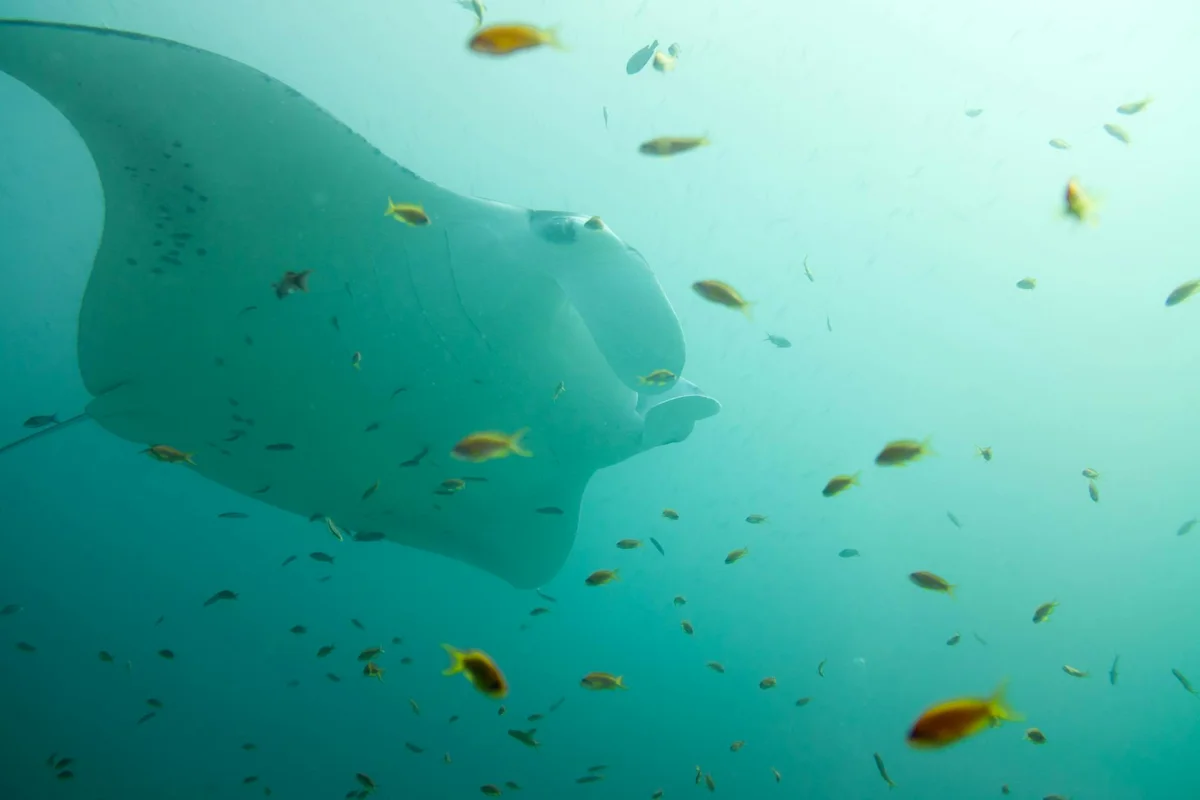
Peak season in the Maldives (December–April) dominates every catalogue: flat seas, record visibility, premium prices. But monsoon season (May–November) carries rewards few operators mention — whale sharks at bait balls, oceanic mantas crowding cleaning stations thick with plankton, prices running 40% lower. It demands more flexibility than peak season, and delivers more big-animal encounters.
The Maldives runs on two monsoons. The northeast monsoon (Iruvai) blows December through April: gentle winds, flat water, visibility touching 40 m, low plankton — which means pelagic life is spread thin. Classic tourist season. The southwest monsoon (Hulhangu) runs May through November: southwest winds, choppier surface, visibility down to 15–25 m, plankton blooms — which means pelagic life stacks up in upwellings and channels.
The thing most divers miss: for big animals, the southwest monsoon beats the northeast. Whale sharks concentrate in Hanifaru Bay (Baa Atoll) upwellings June through November, peaking August–September. Oceanic mantas (*Mobula birostris*) arrive at cleaning stations in serious numbers — 50–100 individuals circling plankton bait balls. Grey reef sharks grow more active as prey density rises.
The price gap is real. A 7-night liveaboard in peak season runs 2,500–4,000 €. The same vessel during monsoon runs 1,500–2,500 €. Dive resorts drop from 350–700 € per night to 200–400 €. Flights follow the same curve. For a trip focused on pelagic encounters, monsoon timing saves 1,500–2,000 € per person without giving up the wildlife.
Recommended atolls during monsoon: Baa Atoll (UNESCO Biosphere Reserve) for Hanifaru Bay, Ari Atoll for year-round resident whale sharks, Hadhdhunmathi (Laamu) for mantas and open-water pelagics with no crowds. The northern atolls — Haa Alif, Haa Dhaalu, Shaviyani — see fewer divers and produce strong monsoon-season wildlife. Addu in the south offers wrecks and seasonal tiger shark aggregations.
Monsoon logistics: liveaboard itineraries shift to the windward side of the archipelago, and route changes mid-trip are standard practice. Visibility can drop to 10 m on heavy-sediment days. The surface can be rough, but below 5 m the water settles and dives run smoothly. Divers prone to seasickness find monsoon challenging; those who aren't find the trade-off straightforward.
Monsoon dives run hot. Thila (submerged pinnacles) and kandus (channels) carry stronger currents, which pack fish tight and generate proper drift dives. Divers who want current and action come back for monsoon season. Divers who want macro and gin-clear water schedule peak season. It is a style preference, not a quality ranking.
The honest downside: visibility is inconsistent. Some monsoon days deliver 30 m; others cap at 12 m. If underwater photography in perfect visibility is the priority, peak season is more reliable. Tropical rain squalls are also more frequent — short, intense bursts several times a day. Full washout days are rare, but the onboard mood can suffer when squalls hit repeatedly.
The monsoon window opens June for whale sharks at Hanifaru Bay, and runs through October for peak manta activity. For a first trip to the Maldives, peak season remains the simpler call. For the second or third, monsoon is the logical choice. At 40% lower cost and with the highest density of big-animal encounters the archipelago produces, the numbers speak for themselves.