
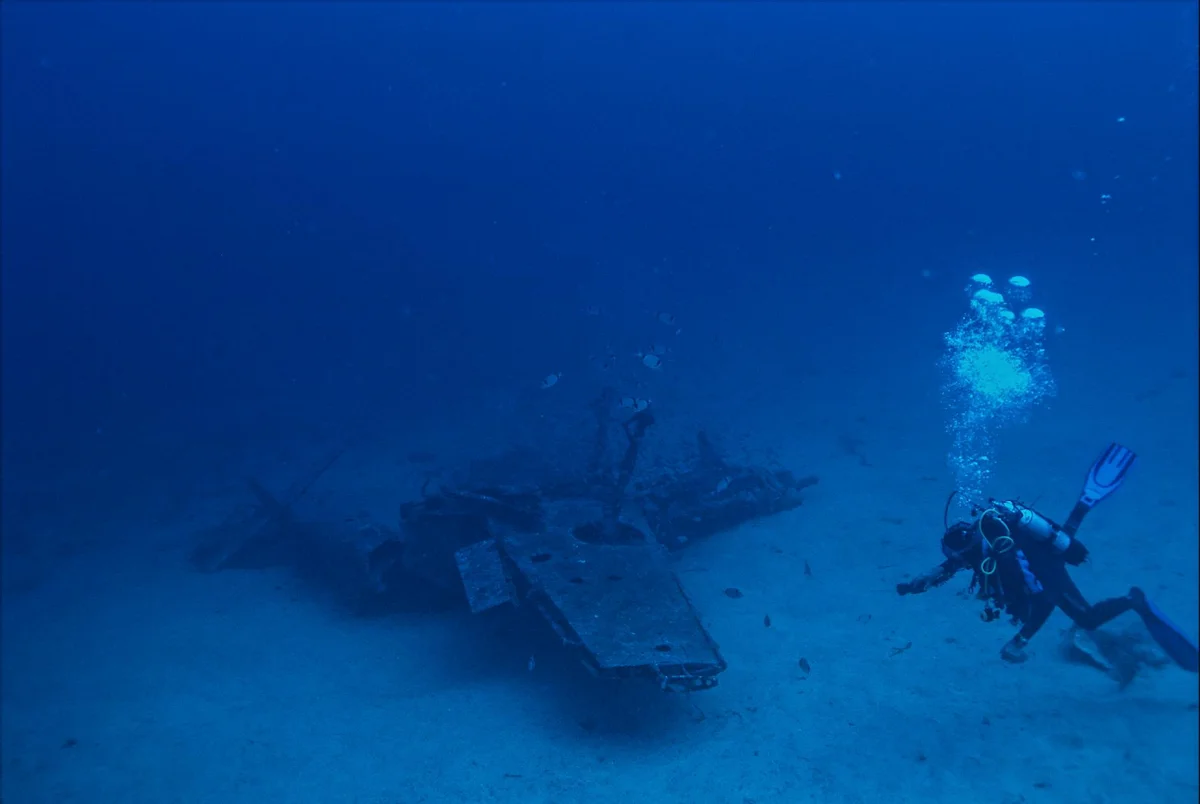
The SS Thistlegorm is probably the most dived wreck on the planet. Loaded with British WWII military cargo, sunk by German bombers in 1941, discovered by Cousteau in 1955 and forgotten until 1992. Today half the diving world visits it, and that has created the core problem: how to see it properly when 80 other divers are already in the same hull. There are ways.
The SS Thistlegorm was a 130 m British merchant vessel sunk on 6 October 1941 by two bombs dropped from a German Heinkel He 111 near the strait of Gubal in the Red Sea. Its military cargo was extraordinary: BSA M20 motorcycles, Bedford trucks, Lee-Enfield rifles, ammunition, field kitchens, 100-tonne steam locomotives, railway wagons. All of it remains in the cargo holds, corroded but unmistakable, an 80-year time capsule sitting upright on the seafloor.
The wreck rests between 18 and 32 m, sitting upright on the bottom. The cargo holds are open and penetrable with a guide, which puts it within reach of Advanced Open Water divers with some prior wreck dive experience. The standard dive goes like this: descend the fixed line to the stern (32 m), work along the deck to the central break where the bombs detonated, drop into hold 2 with the motorcycles and trucks, exit along the deck and ascend.
What rarely gets mentioned: the Thistlegorm is badly overvisited. In high season, 80 to 120 divers pass through the wreck every day. Groups collide, silt rises, visibility drops to 5–8 m, and the marine life has grown wary. Avoiding the peak window — roughly 10:00 to 13:00, when the safari boats pile in — is not optional if you want a decent dive. Early morning (08:00) or mid-afternoon (15:00) are the two realistic slots.
Liveaboards that work the Thistlegorm intelligently schedule three dives: one at first light (05:30–07:00, before anyone else arrives), one in the mid-afternoon after the rush clears (15:30–16:30), and one night dive (19:00–20:00). That sequence gives you the wreck in reasonable visibility without the crowd. The safari boats that sprint in for two dives at 10:00 and 13:00 are the ones turning it into a car park.
Night dives on the Thistlegorm draw the strongest recommendations from experienced wreck divers. Animals that hide during the day emerge: large moray eels, stonefish, lionfish in numbers. The locomotives lying alongside the hull, lit up by a primary torch, carry a ghostly quality that no daylight dive can match. Night diving experience is required, and a local guide who knows the wreck layout is not optional.
Logistics: the Thistlegorm is liveaboard or safari boat only. There is no shore diving option — it sits 40 km from Sharm El Sheikh. Northern Red Sea liveaboards (typically seven days) include three Thistlegorm dives as a standard part of the itinerary. Budget: €800–1,200 per week on a liveaboard, everything included except flights.
What disappoints: the wreck has degraded significantly over 80 years. History enthusiasts note that many small artefacts have been removed or destroyed. The cabins hold far less detail than they did in the 1990s. The no-touch rule exists for a reason, and many divers ignore it. To protect what survives: avoid areas with disturbed silt, do not rest against fragile structures, leave everything in place.
The Thistlegorm remains a genuinely singular wreck because of its intact military cargo. Good planning makes it worth the trip; poor planning makes it a queue. For underwater photographers and those drawn to 20th-century naval history, it belongs on the list at least once. The specific recommendation: a northern liveaboard with three dives scheduled outside peak hours. The coordination effort pays off.