
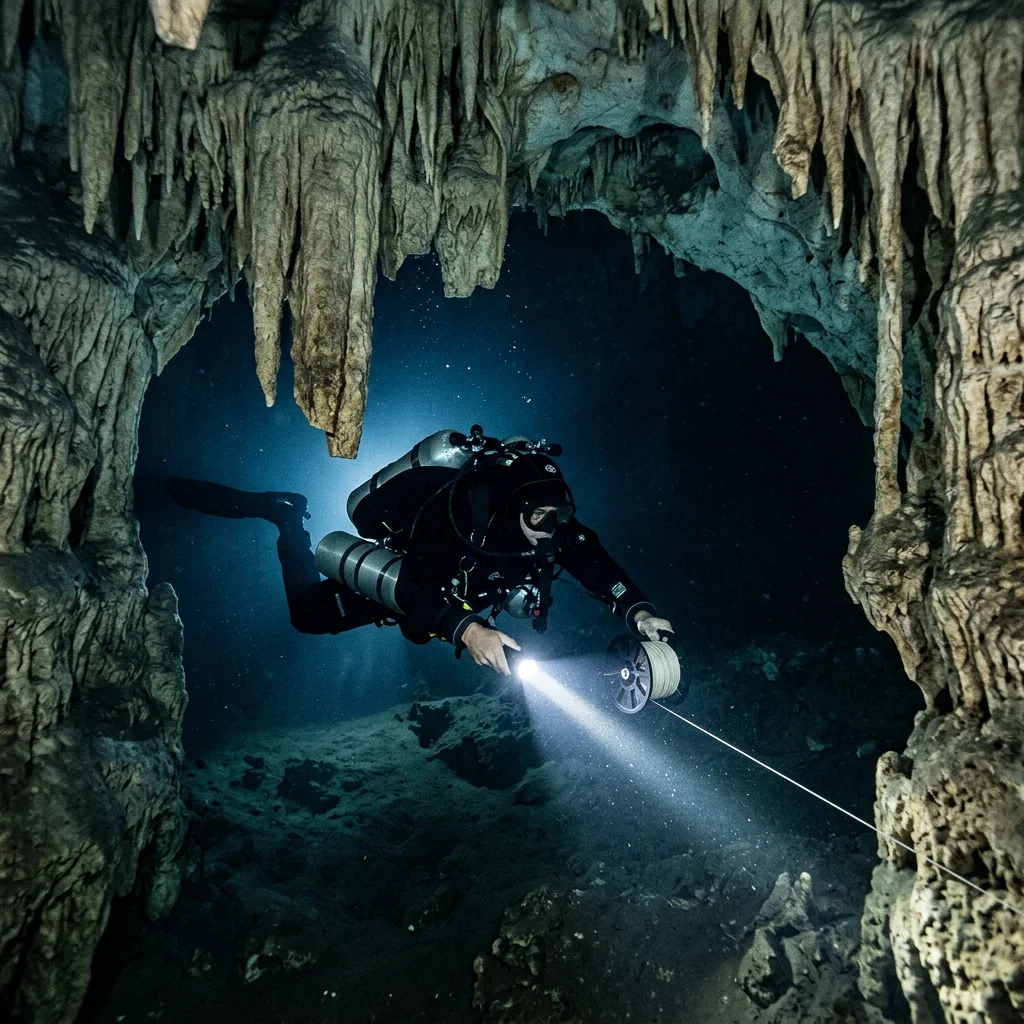
More than 400 divers have died in Florida caves since 1950. Learn the three main causes of accidents according to NSS-CDS.
Cave diving has the highest mortality rate within recreational and technical diving. This is not an alarmist statement: it is a documented reality backed by decades of data that anyone curious about exploring these environments should know. Since 1950, the caves of Florida, which concentrate some of the most extensive underwater cave systems in the world, have recorded more than four hundred diver deaths. The National Speleological Society Cave Diving Section (NSS-CDS), the reference body for cave diving accident research, has analyzed these incidents over decades and has consistently identified three main causes: inadequate specific training, non-use or improper use of the guideline, and incorrect gas management. These three causes are avoidable with proper training. And without training, they are almost inevitable.
Understanding why caves are so dangerous requires grasping the concept of an overhead environment, which in technical diving parlance designates any environment where the diver cannot ascend vertically to the surface directly in an emergency. In open water, faced with any problem, the immediate response is always the same: go up. In a cave, that option does not exist. The rock ceiling above the diver's head eliminates the margin of error that the open ocean allows. This does not mean caves are inherently lethal: it means that mistakes which have manageable consequences in open water can be fatal in a cave. Specific training does not serve to eliminate the risk, but to develop the skills and protocols that allow it to be managed within acceptable margins.
The training progression established by the NACD (National Association for Cave Diving), one of the organizations with the greatest authority in this field, is clear and admits no shortcuts. The first level is the cavern diving certification, which qualifies the diver to explore areas illuminated by natural light, without entering the dark zone and always with the exit visible. The second level is the cave introduction certification (cave intro or cave 1), which allows entry into the dark zone but with strict depth and distance restrictions. The third level, the full cave certification, is what qualifies divers for dives in complex cave systems. Each level builds on the previous one and requires demonstrating specific technical competencies before advancing. Skipping any step in this progression is not a courageous decision: it is a statistically dangerous one.
The guideline is the cave diver's lifeline. Without it, disorientation in an environment with no external visual references and with visibility that can drop to zero in seconds due to disturbed sediment is practically immediate. The technique for installing and following the guideline is one of the fundamental skills taught from the first level of training. It involves attaching the line to a fixed point near the cave entrance, maintaining constant tension while advancing, making proper connections at junctions so as not to confuse the way back, and never releasing it under any circumstances while in the dark zone. Accidents in which the guideline was not used or was installed incorrectly represent an alarming proportion of the deaths analyzed by the NSS-CDS.
Gas management in caves follows the rule of thirds, one of the best-known and most frequently ignored safety protocols in technical diving. The rule states that the diver should reserve one third of available gas for the entry, another third for the exit, and the remaining third as an emergency reserve. This reserve is not intended for personal use: it is meant for sharing gas with a buddy who has had equipment failure. In a cave, the option of surfacing to seek help does not exist, so the gas you are carrying is the only gas you will have. Divers who violate the rule of thirds to go a little further, often motivated by curiosity or group pressure, are the ones who appear in accident statistics.
Spain has some of the most significant underwater cave systems in Europe for this type of diving. The Cueva del Agua in Murcia and the cave system of Manacor in Mallorca are two outstanding references for technical divers with the appropriate training. The Manacor system in particular, with its exceptionally clear waters and its halocline formations where the fresh water from inside the cave visually mixes with salt water, offers a visual experience without parallel for those who access it with the right preparation. Both systems are also examples of why specific training is indispensable: their particular conditions of current, visibility, and configuration require knowledge and skills that are not acquired in a weekend course.
The mindset with which a diver must approach caves is radically different from the one that works in most recreational diving situations. In open water, improvisation has a margin. In an overhead environment, that margin disappears. This demands a discipline of rigorous planning that includes detailed analysis of the dive profile, precise calculation of the required gas, verification of redundant equipment (two torches, two line-cutting tools, two gas sources in advanced dives), and a clear definition of turning points before entry. An experienced cave diver who senses that something is not right, that the equipment is not performing as it should, or that conditions have changed from what was expected, turns around without hesitation. That instinct to return is, frequently, what distinguishes long-lived divers from those who appear only in accident reports.
Cave diving, for those who follow the appropriate training progression and respect the established protocols, is one of the deepest and most beautiful experiences the underwater world has to offer. Flooded cave systems are unique geological environments, preserved in crystal-clear fresh water for millennia, inhabited by fauna adapted to total darkness and decorated with speleothems of a delicacy that words cannot describe. Access to them is not an automatic right of the curious diver: it is a privilege earned through training, practice, respect for protocols, and the humility to recognize one's own limits. Those who accept these conditions find rewards that more than justify the journey.