
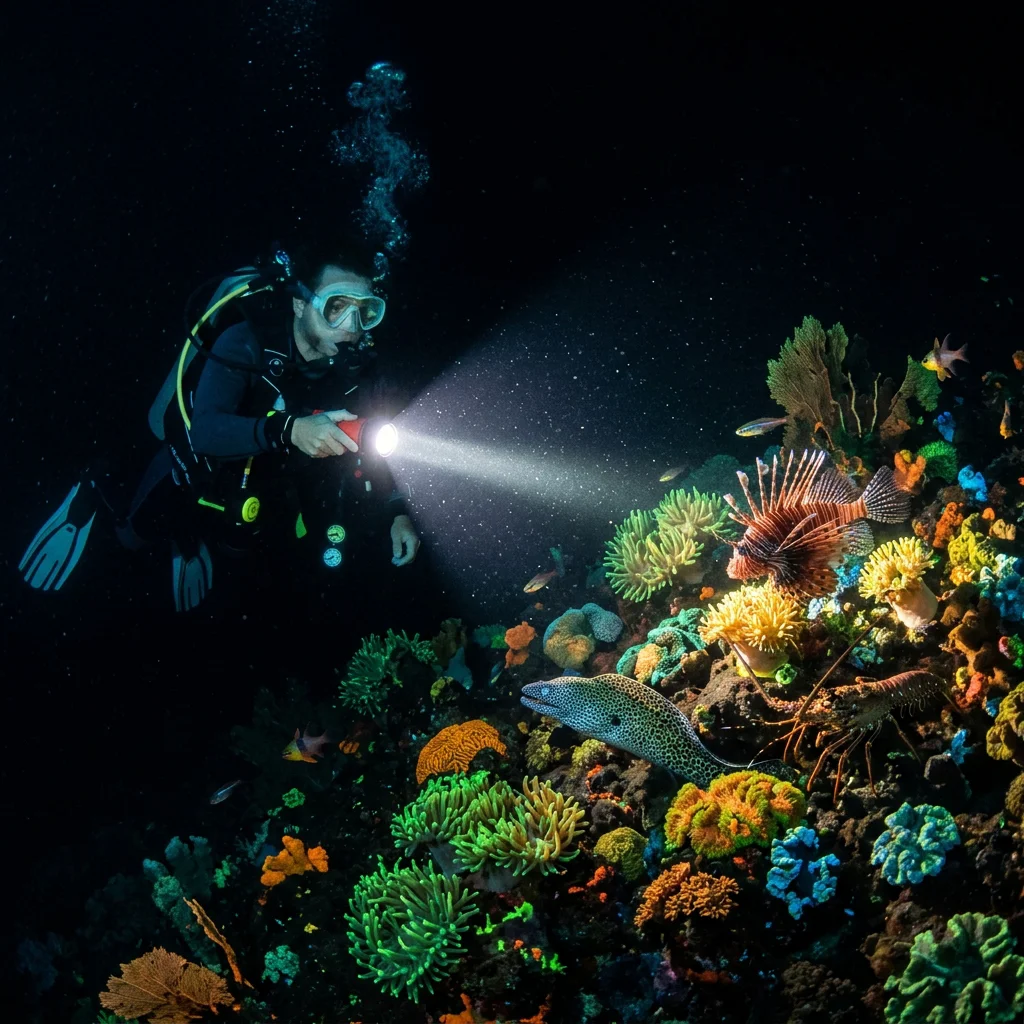
Night diving reveals lobsters, octopuses, moray eels and plankton bioluminescence. Learn the necessary equipment, light signals and the recommended maximum depth of 20 metres.
The same reef you know by day becomes a completely different place when the sun disappears. Colors change, sounds intensify, and nocturnal animals come out to hunt. Night diving is one of the most transformative experiences in recreational diving.
Nocturnal fauna is the main attraction. Lobsters emerge at nightfall, octopuses are at their peak activity, moray eels patrol the reef, and in tropical areas it is common to encounter whitetip reef sharks hunting.
Bioluminescence is the most magical phenomenon. Dinoflagellates emit blue-green light when disturbed: if you switch off your torch and move your hand, the luminous trail is of an absolutely unreal beauty. Every fin stroke leaves a ghostly trail of light.
Additional equipment needed: two light sources per diver (primary torch plus backup), a glow stick on the cylinder or BCD as passive signaling. Losing your only light source can cause severe disorientation.
Torch signals: slow circles mean OK, rapid side-to-side movements indicate an emergency, pointing upward requests the buddy's attention. These protocols are reviewed in the briefing before entering the water.
Recommended maximum depth: 20 meters. Darkness adds cognitive stress, disorientation is more likely, buoyancy control demands more attention, and communication is more complex.
The dive site should be familiar from daylight. Diving somewhere for the first time at night is a bad idea even for experienced divers: the topography can become confusing in the dark.
The night briefing should be more detailed: torch protocols, procedure if someone loses visual contact, ascent signal, and surface meeting point. With this preparation, night diving is one of the most memorable adventures in diving.