The Cíes Islands offer some of Galicia's most accessible diving, but accessible is not the same as comfortable. Water sits at 13–17 °C year-round, visibility swings from 4 to 20 m between one week and the next, and common octopus density here is something the Mediterranean can no longer match. For divers used to warm, clear water, this corner of the Atlantic operates by different rules.
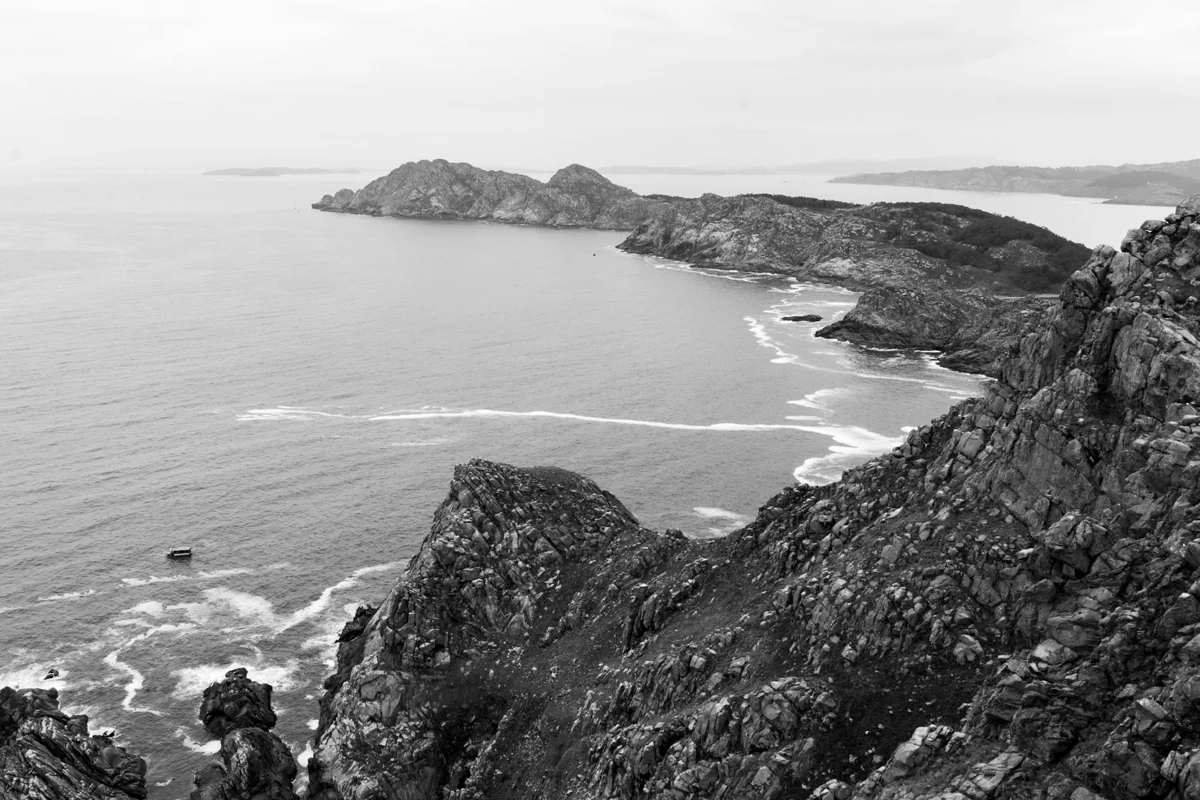
The Cíes are three islands — Norte, Faro and San Martiño — sitting at the mouth of the Vigo estuary, declared a Maritime-Terrestrial National Park in 2002 alongside Ons, Sálvora and Cortegada. Summer access requires a permit, and diving within the Park is regulated by the Xunta. Water temperature ranges from 13 °C in February to 17 °C in September. Typical visibility runs 6–12 m, with occasional windows up to 20 m in autumn.
The diving here is shaped by northeast Atlantic fauna — almost the inverse of what you find in the Mediterranean. Common octopus (*Octopus vulgaris*) turn up everywhere; the biggest weigh 5–6 kg. Spider crabs, lobsters, and crawfish share the granite walls with schools of red mullet, poor cod and horse mackerel. Below 30 m, turbot and monkfish of absurd proportions appear. For underwater photographers, the octopus is the headline subject: inside the reserve, they hold their ground and let you get close.
Visibility here is best described as 'it depends'. Galicia has large tides — 4–5 m range — strong bottom currents, and river runoff that clouds the water unpredictably. Three days of Atlantic storm can cut visibility to 3 m for a week. Five days of dry easterly wind and it climbs to 15–20 m. The general pattern: aim for autumn after a sustained spell of settled weather. May and June are inconsistent. August ranges from decent to mediocre depending on tides. September and October offer the best odds.
The main dive sites: O Castelo (between the islands and the coast), Cantil de los Viaos (wall dive on the southern Cíes), A Pereira (cliff with cave sections), Os Estramundis (mixed-fauna ground), Punta Vicos (octopus habitat over sand and rock). Depths run 12–35 m. The main dive centres are based in Vigo and Cangas do Morrazo, with fast-boat transfers of 30–45 minutes.
Kit requirements: a 7 mm semidry suit as a baseline, integrated hood, 5 mm gloves, thick boots. Divers in a drysuit are considerably more comfortable in April and May. Anyone arriving in August with a 5 mm wetsuit will be cold by the second dive of the day. In Galicia, cold limits bottom time more reliably than air supply or decompression schedules.
Getting here: Vigo airport handles a limited range of European routes; flying into Santiago or Porto and driving 1.5–2 hours is usually the better option. Accommodation is available in Vigo, Bayona, and Cangas. Vigo-based operators such as Galisub and Vigo Diving charge 50–65 € per guided dive with kit. Packages of 4–6 dives are available. Day and half-day trips to the Cíes are planned around tides. Centres run at reduced capacity over winter.
What to expect if you're coming from Egypt or the Maldives: the palate here is green-brown, not blue. No corals — anemones and sponges instead. The fauna is cryptic rather than showy. The water is never crystal-clear. Galicia suits divers who want to see the real underwater face of Spain rather than a travel-brochure version. Arrive with calibrated expectations and you leave satisfied; arrive expecting the Mediterranean and you leave cold in more than one sense.
Ultimately, diving Galicia means learning to value a different kind of diving. The moment a 5 kg common octopus locks eyes with you from a granite crack, or you find Atlantic nudibranchs on a wall at 14 °C, there is nothing quite like it on the Spanish coastline. It demands more physically and rewards those who know what to look for. After several trips, it remains the only place in Spain where the sea still feels genuinely wild.