
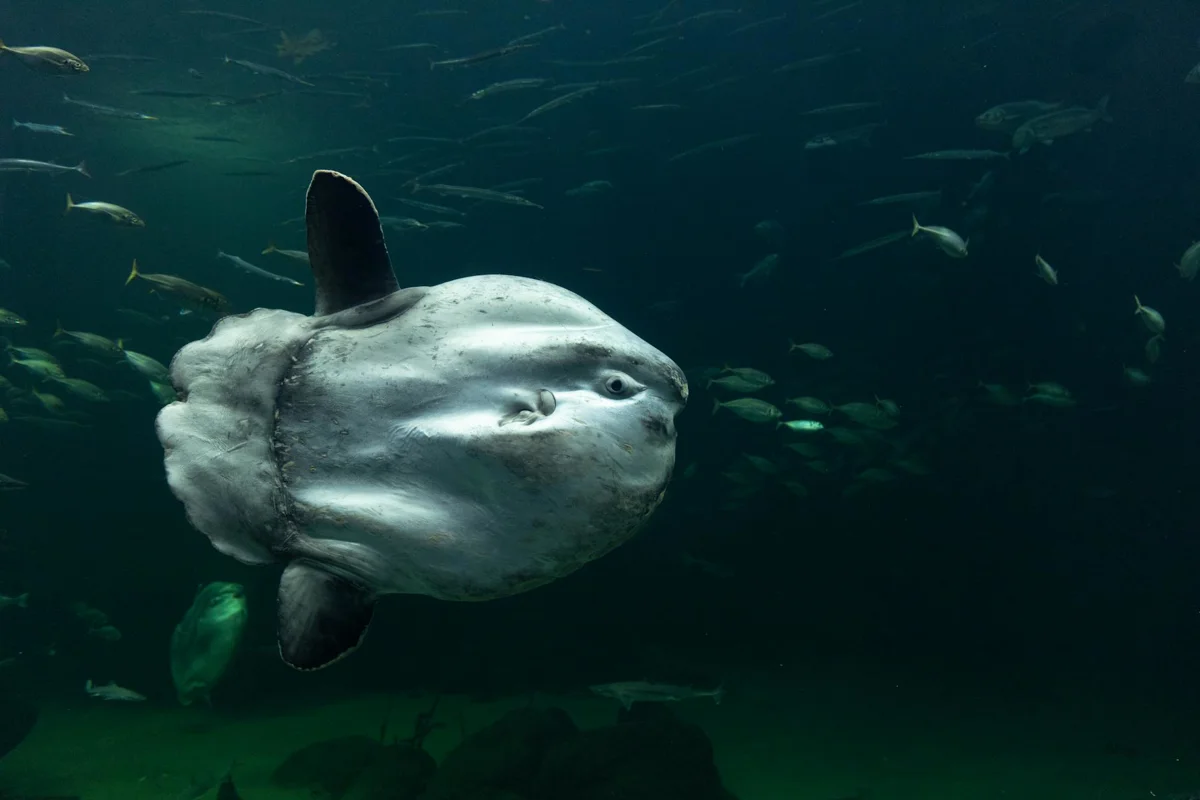
*Mola mola*, the ocean sunfish, ranks among the strangest animals a diver will ever see. No tail, a near-circular body, two fins that look like anatomical afterthoughts — adults reach 2–3 m and 2,000 kg. It visits seasonal cleaning stations in Bali (July–October) and a handful of other sites worldwide where cleaner fish strip it of parasites. For underwater photographers, few subjects come close.
*Mola mola* is the heaviest bony fish on Earth. Typical adults weigh 1,000–2,000 kg and measure 2–3 m in length, though their height — 2–3.5 m, fin-tip to fin-tip — exceeds their length. The shape is a vertical disc: picture a fish head with no body, two fins jutting up and down. Evolution discarded the tail and most features we associate with fish. Open-ocean animals, they range from the surface down to 600 m.
The biology is improbable. Adult females produce up to 300 million eggs in a single spawning event — more than any other vertebrate on record. Larvae hatch at 2 mm; five years later some individuals top 1,500 kg, a mass increase of 700 million times. Diet is overwhelmingly jellyfish, a food so low in calories that molas must eat constantly. Ocean plastic is a genuine threat: molas cannot distinguish a floating plastic bag from a jellyfish.
Bali is the most reliable destination on the planet for recreational encounters with *Mola mola*. The season runs July–October, peaking in August–September, when cold deep water wells up to the cleaning stations at Crystal Bay (Nusa Penida) and Manta Point. Molas ascend from 200–400 m so that bannerfish (*Heniochus*) and other cleaner species can work through the parasites on their skin. Divers hold position at 20–30 m, move as little as possible, and watch the molas pass within 1–3 m.
Other destinations: Galápagos (mola sightings but less consistent), Azores (rare but documented), central California coast (Monterey Bay, seasonal encounters), and occasional individuals in the Mediterráneo off Italia and Cerdeña. None match Bali for frequency or diving logistics.
Getting there: Crystal Bay dives depart from Nusa Penida, roughly 30 minutes by speedboat from Bali. Local dive centres know the specific cleaning stations and the windows when molas tend to appear. At 25–30 m the thermocline drops water temperature to 18–22 °C during mola season; a 5 mm wetsuit with hood is the standard choice. Encounter probability runs 60–70 % at peak season — on off-days the nearby sites keep the diving worthwhile.
At the cleaning station, molas are unhurried and oddly curious. They will approach divers, fix them with one enormous eye, and linger over the reef for 5–15 minutes while the cleaners work. Any abrupt movement breaks the spell; a composed, patient diver earns the longest encounters. For underwater photography — macro shots of the eye, wide shots with ambient light or balanced flash — the mola is an extraordinary subject.
The genus has more members than most divers realise. *Mola tecta* was formally described only in 2017 and is morphologically distinct from *M. mola*. *Mola alexandrini* grows even larger — up to 2,700 kg — and currently holds the record for heaviest bony fish. *Masturus lanceolatus* retains a rudimentary tail projection. In the field, non-specialists call all of them 'mola'; marine biologists distinguish species by subtle anatomical markers invisible at recreational depths.
Bali in August–September sits at the top of any serious diver's list for a reason. The mola encounter combines with Manta Point, the USAT Liberty Wreck at Tulamben, and world-class macro diving to fill a full week without repetition. Bring a wide-angle lens and a macro lens, a drysuit if you run cold, and the patience to hold still. The fish will do the rest.