
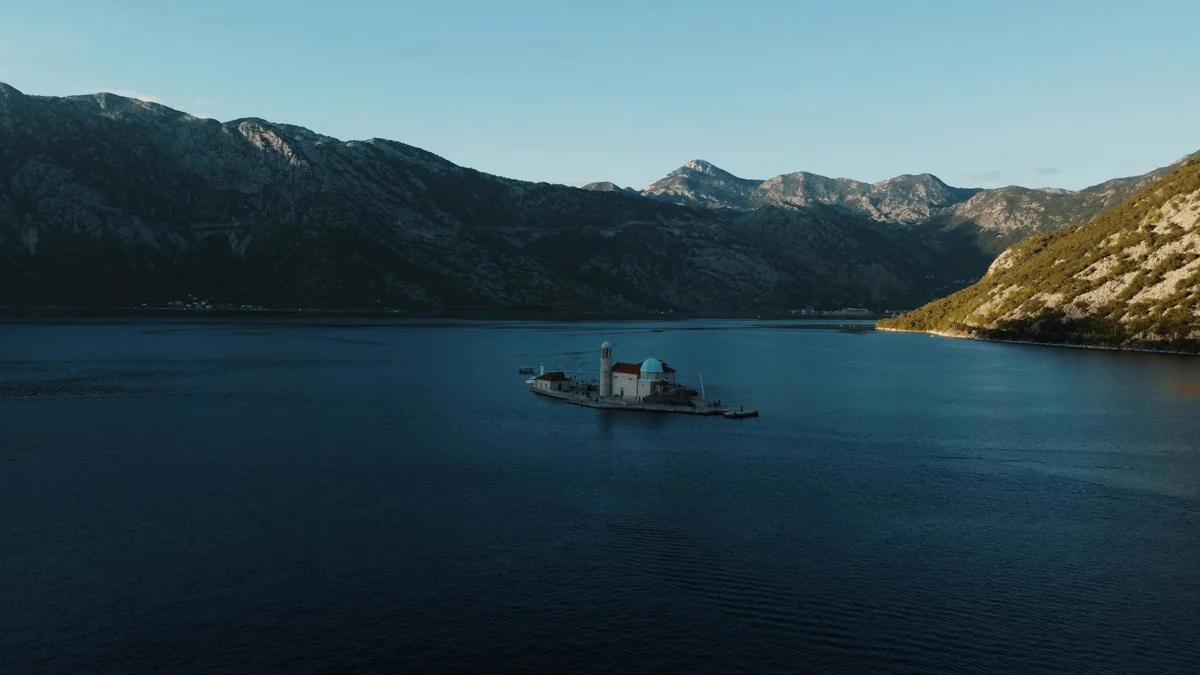
Boka Kotorska in Montenegro is one of the Mediterranean's natural fjords — 28 km long, up to 40 m deep. It sheltered the Austro-Hungarian fleet until 1918 and the Yugoslav navy until 1992. Below the surface lie 8–10 documented wrecks spanning WWI, WWII and the Yugoslav era, most of them rarely dived. A genuine frontier destination for wreck divers who have already worked through Italy and Croatia.
Boka Kotorska — the Bay of Kotor — is geographically unlike anything else in the Mediterranean. Four interconnected inlets carve a natural fjord into the Montenegrin coastline, flanked by historic towns: Kotor (UNESCO-listed since 1979), Perast, Risan and Tivat. The bay stretches 28 km, bottoms out at 40 m and offers calm, sheltered water that made it a natural anchorage for centuries. That shelter is also what turned it into a strategic naval base.
The naval history runs deep. Austro-Hungarian forces held Boka Kotorska from 1797 to 1918, and during WWI their U-boats left Kotor to hunt Allied shipping across the Adriatic. After the war the bay passed to the Yugoslav fleet — Jugoslovenska Ratna Mornarica — which operated here from 1945 to 1992. Two centuries of continuous military activity meant that every vessel lost in those waters simply stayed put. The result: 8–10 accessible wrecks spread across three distinct eras of conflict.
The headline wrecks: the Sloboda, a Yugoslav freighter at 25–32 m and reachable on Open Water certification; the Tihany, an Austro-Hungarian steamer from 1918 lying at 30–40 m (Advanced); the Beograd, another Yugoslav freighter at 35 m; an Italian submarine lost in 1944 at 50+ m (technical); and the Mati, a modern Turkish freighter at a manageable 25 m. Cold, low-oxygen water has slowed corrosion on the WWI wrecks considerably — the Tihany in particular holds its structure well.
Beyond the wrecks, the bay offers Cathedral — a small cavern lit by a natural shaft from above — Žanjic Beach Wall with soft corals from 18 to 30 m, a drift dive along the vertical walls of Mamula Island, and the easy, fish-rich site at Plavi Horizonti. Water temperatures run from 14 °C in February to 25 °C in August, visibility typically 25–35 m, and currents inside the bay stay light year-round.
Getting there: fly into Tivat (the local airport) or Podgorica, the capital — about 90 minutes by road. Both have seasonal low-cost connections via Wizz Air and Ryanair. Accommodation in Kotor or Tivat starts around 40 € for a guesthouse and reaches 200 € for decent hotels. Operators on the ground include Adriatic Blue, Diving Club Boka and Pro Dive Center. Expect to pay 40–55 € for a guided dive or 200 € for a five-dive package. English is standard in dive centres; Italian and Russian are also common — the Serbian and Russian tourism market is significant here.
The surprise is the cultural density. Kotor's medieval walls, Byzantine churches and Venetian architecture are genuinely worth the extra day. The bay is often described as the Mediterranean's southernmost fjord — technically it's a drowned river valley rather than a glacial fjord, but the landscape stands up to the comparison. Prices run roughly 40 % below equivalent Croatian destinations, which makes it an easy sell for mixed diving-and-travel trips.
The honest disappointments: the operational window is tight. May through October is workable; winter months see most dive centres close or go minimal. Deep technical wrecks require qualifications and kit that not every local centre can support — serious wreck divers often arrive with a technical guide from Italy or Croatia rather than relying on whoever is available locally. And the luxury marina development at Porto Montenegro has pushed accommodation prices in the Tivat area noticeably upward.
The overall read: Boka Kotorska rewards wreck divers with a taste for history and a tolerance for frontier logistics. The combination of Austro-Hungarian wrecks, protected water, Venetian old towns and mid-range prices sits in a gap that Croatia and Albania do not fill in quite the same way. September or May, one week — the balance is right. Go before the next wave of resort development lands.