
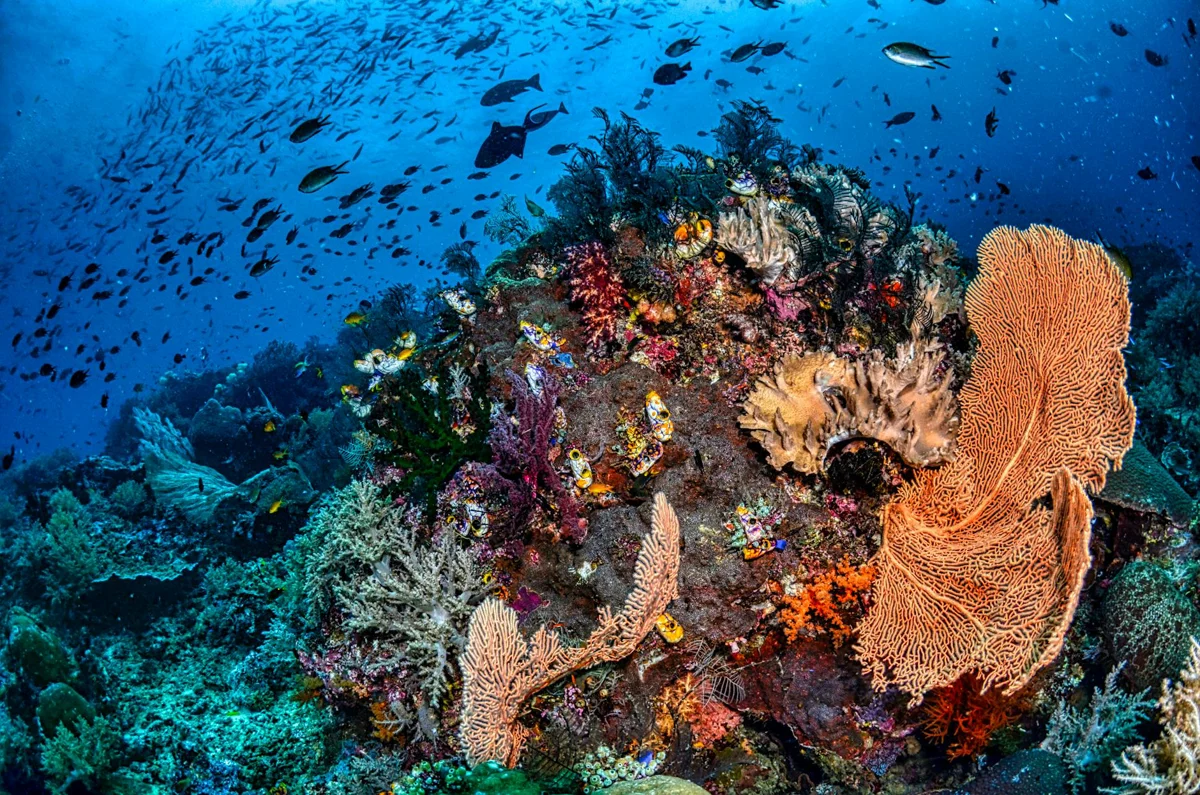
Papua New Guinea ranks among the least-dived destinations in the Pacific, and Kimbe Bay on the island of New Britain is its best-kept secret. Marine reserves with biodiversity on par with Raja Ampat, virtually no crowds, and the rare feeling of diving reefs that tourism has barely touched. For divers who have already done the famous circuits, PNG is the next frontier.
Papua New Guinea occupies the eastern half of the island of New Guinea plus around 600 smaller islands scattered across the southwestern Pacific. It receives fewer than 200,000 tourists a year — a fraction of Thailand's 30-plus million — making it one of the least-visited countries on earth. Diving concentrates in four regions: Kimbe Bay (New Britain), Madang (north coast), Tufi (east coast), and the Milne Bay area in the southeast.
Kimbe Bay is the most consistently recommended zone for its blend of quality and relative accessibility. The bay sits on the northern coast of New Britain and holds more than 50 registered dive sites within a 30 km radius. The marine life represents the best of the Coral Triangle: 860-plus documented fish species, 60 % of the world's coral genera, and healthy populations of sharks, mantas, cetaceans and dugongs. Walindi Plantation Resort has operated as the benchmark dive centre in the bay for more than 35 years.
The headline sites: Vanessa's Reef, a coral garden thick with anemones and clownfish; Inglis Shoal, a drift dive past reef sharks and mantas; South Emma, a reliable manta cleaning station; Bradford Shoals, a seamount that draws trevally and tuna; Krakafat, a pelagic pinnacle worth two tanks. Depths run 12–30 m, water temperature holds at 27–30 °C year-round, and visibility is consistently 25–40 m. Currents are mild to moderate — nothing like Komodo.
The real surprise is the condition of the reefs. PNG sees little diving pressure precisely because it is hard to reach and services are basic. The result is coral in near-pristine health: no visible bleaching, fish that hold their ground rather than flee, and a silence underwater that divers from Egypt or the Maldives rarely encounter any more. The Pacific as it looked before mass tourism is still here.
Logistics: fly to Port Moresby — Papua New Guinea's capital — via Singapore, Brisbane or Cairns, then take a domestic flight to Hoskins on New Britain. A 45-minute boat transfer brings you to Walindi. Door-to-door from Europe is 30-plus hours with multiple connections. A visa on arrival costs USD 50. A 5–6 night stay at Walindi with 8–10 dives, full-board, runs roughly €1,800–2,800; add €1,500–2,000 for flights from Europe.
Madang on PNG's north coast offers a different profile: a small town with several dive operators, varied accommodation, and outstanding macro and muck diving. Tufi on the east coast is fjord country with sheer walls dropping into the abyss. Milne Bay holds PNG's finest muck diving and is usually covered by liveaboard. Each region has its own character; Kimbe is the easiest entry point for divers new to PNG.
The weak points are logistics and cost. PNG is not a destination for budget trips. Flights are expensive, domestic connections can run late, and accommodation options are limited. The operating season is year-round, but June–October delivers the best conditions — dry season, stable visibility. January–March brings monsoon rains and some sites close. Non-English speakers will find that dive staff communicate well in English, but services outside the resort are thin.
Kimbe Bay delivers reef diving comparable to Raja Ampat with roughly 30 % fewer divers in the water. The kit and infrastructure at Walindi Plantation Resort are solid, the guides know the sites cold, and the marine life does not disappoint. A week here resets expectations. Divers who return to mainstream destinations afterwards tend to notice, for the first time, how busy those places really are.