
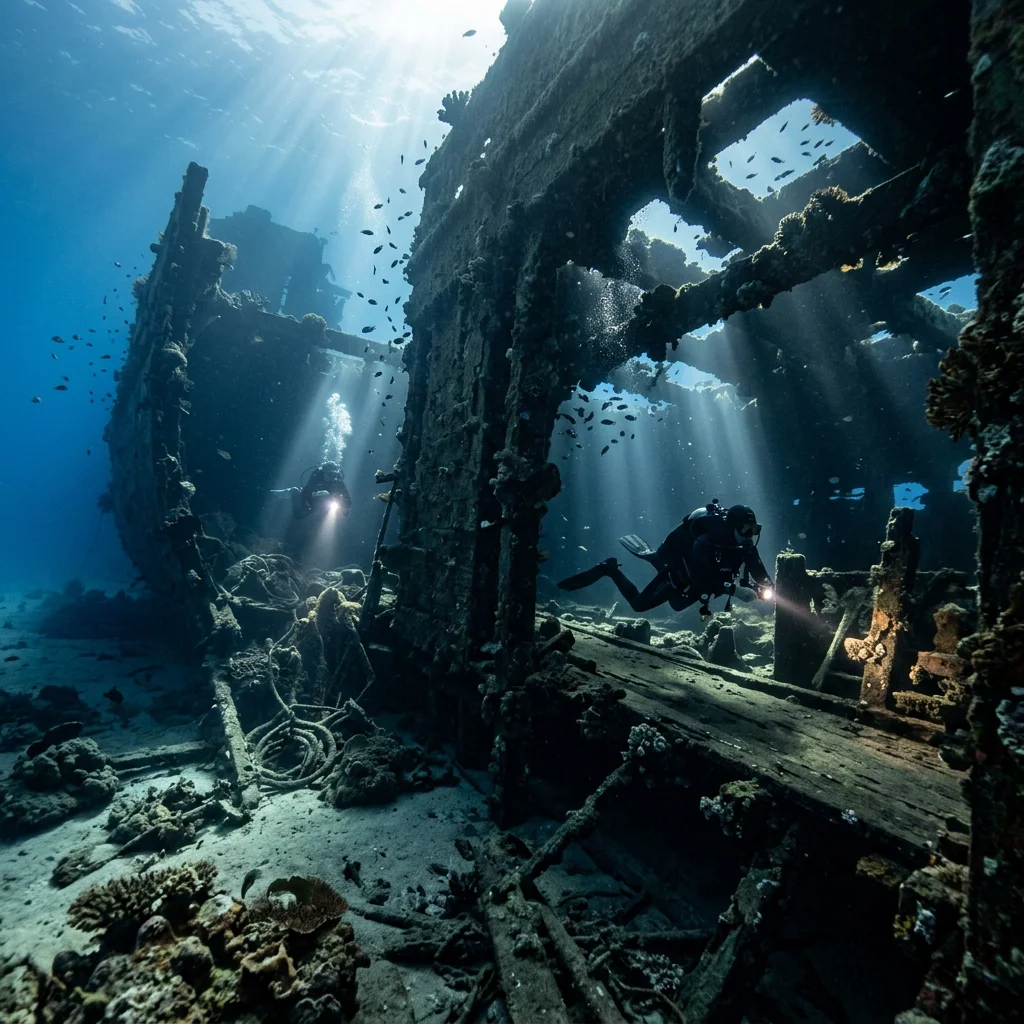
Spain hides an extraordinary underwater archaeological heritage: from the Don Pedro in Ibiza to the Valencian Community. Discover the CARTASub project, the ARQUA museum and the legislation that protects these treasures.
Beneath the surface of the sea surrounding the Iberian Peninsula lies one of the richest and least known historical heritages in Europe. Centuries of Mediterranean trade, naval wars, Atlantic storms, and accidental shipwrecks have deposited an extraordinary quantity of vestiges on the seabed. Spain has more than eight hundred catalogued underwater archaeological sites, although the actual number is estimated to be considerably higher.
The Valencian Community concentrates more than one hundred documented underwater sites, making it one of the regions with the highest density of underwater archaeological heritage in the entire western Mediterranean. This coast was one of the most heavily trafficked commercial routes of antiquity, with constant traffic of vessels transporting wine, oil, ceramics, and metals.
The CARTASub project, led by the Centre for Underwater Archaeology in Cartagena, aims to create a systematic underwater archaeological chart of Spanish waters. Using acoustic surveying techniques, underwater photogrammetry, and controlled scientific excavations, the project is systematically documenting and cataloguing sites with rigorous methodology.
The Museo Nacional de Arqueología Subacuática, known as ARQUA, is the reference institution in Spain for the conservation, research, and dissemination of underwater archaeological heritage. Located in Cartagena, its collections include pieces recovered from sites along the entire Spanish coast, ranging from Phoenician and Carthaginian remains to objects from the modern era.
The Don Pedro de Ibiza is possibly the best-known wreck in the Spanish Mediterranean. This ferry sank in July 1995 following an on-board explosion. Its 150-meter-long hull rests on a seabed at depths between twenty and forty meters off Formentera, with visibility that can exceed thirty meters.
The Cantabrian coast and Galicia hold a completely different typology of wrecks. Atlantic currents and storms have caused hundreds of shipwrecks throughout the nineteenth and twentieth centuries. The Galician estuaries conceal vessels in excellent states of preservation thanks to the low water temperature. In Cádiz, ships from the colonial era are scattered across the bay floor. Tarragona contributes Roman-era sites with intact amphorae.
Spanish legislation expressly prohibits the extraction of any object from an archaeological site without administrative authorization. The infraction may constitute a criminal offense. This protection does not prevent divers from visiting and photographing the sites: it simply establishes that what lies on the seabed belongs to all citizens.
The SS Thistlegorm, although it does not belong to Spanish waters but rather the Red Sea, has inspired generations of Spanish divers to take an interest in historic wrecks. Spain has nothing to envy it: its seabeds harbor equally fascinating stories, waiting for divers who know how to look with respect, curiosity, and awareness.