
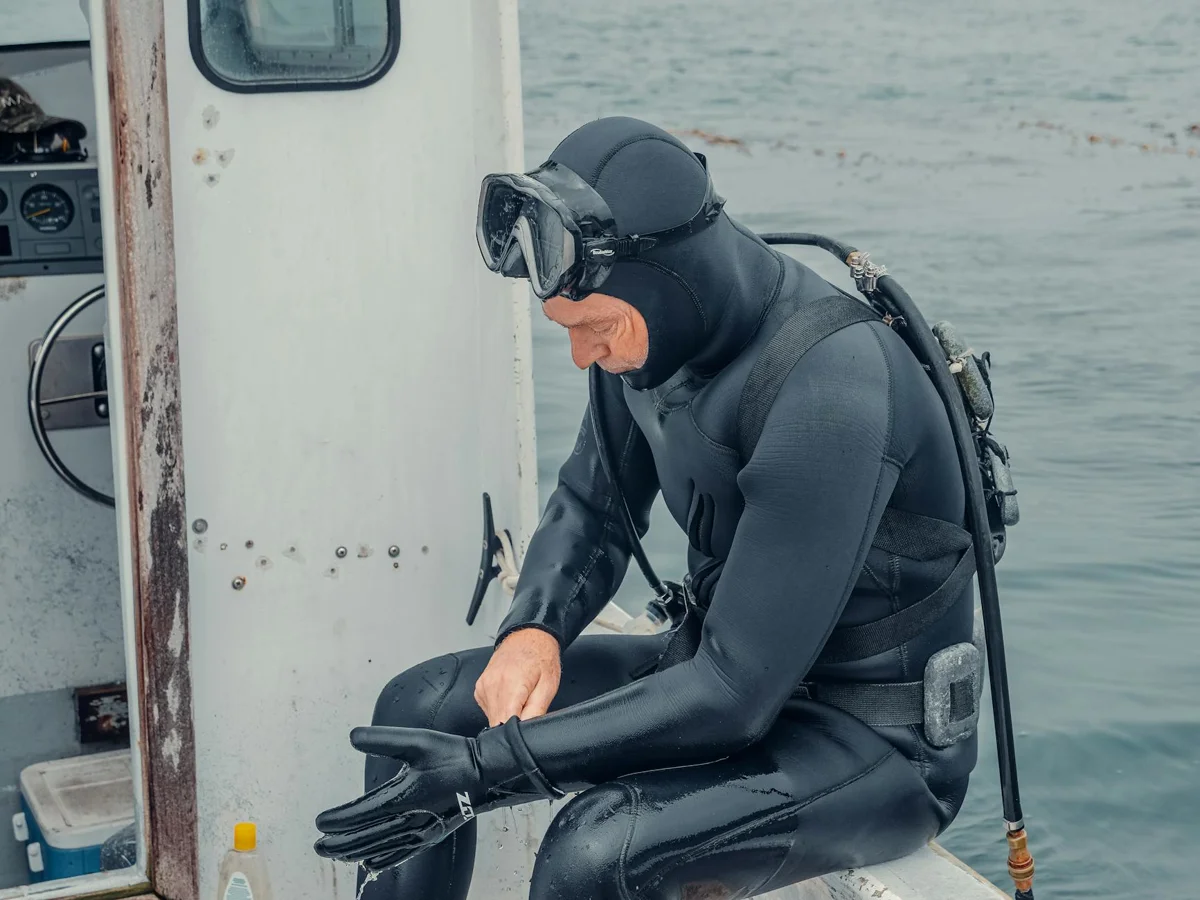
It's not bias or myth. People with less body mass and less subcutaneous fat lose heat faster underwater, full stop. It's physics, not a question of toughness. Knowing this helps you plan your gear, your dives, and understand why your buddy always wants to surface first — or why that buddy is you.
Surface area per unit of mass is the key. A lean person has more surface area relative to their mass than a heavier one. That means more skin exposed to heat loss for every kilogram of body that needs to stay warm. Subcutaneous fat, on top of that, is a natural insulator that slows thermal loss. Without that layer, heat bleeds into the water with nothing to stop it.
A number to put things in perspective: a 60 kg person with 12% body fat loses heat 40–50% faster in 14 °C water than a 90 kg person with 22% fat, in identical wetsuit and depth. That's not opinion — that's thermodynamics. It's why dive buddies with very different builds almost always end up running on different thermal clocks.
I'm lean. 1.78 m, 68 kg, not much fat. I've dived with 100 kg buddies who came out of 14 °C water saying they felt fine, while I surfaced from the same dive in the same wetsuit shaking like a leaf. It took me years to accept it wasn't a matter of toughness — it was pure physics. Accepting that changed my gear and my planning.
The answer isn't to eat more, obviously. The answer is equipment. If you're lean, a 7 mm wetsuit is the bare minimum for winter Mediterranean diving, and a drysuit with a decent thermal underlayer is the sensible choice below 14 °C. Layering matters too: a thin rash guard under the wetsuit improves insulation by 10–15%. A hood with an integrated collar — not a separate one — reduces water flushing between suit and neck every time you look around, and that adds up fast.
Weighting is another factor. Lean divers generally need less lead. But a well-inflated drysuit with thick underlayer needs more lead than a wetsuit. The combination of lean + drysuit + cold water + precise weighting is the sweet spot. Getting your lead right lowers your air consumption, your fatigue, and indirectly your heat loss — because you're working less.
Something few people mention: how you carry your lead matters. Weight distributed on a belt close to the kidneys insulates better than weight floating in jacket pockets. The technical approach of distributed integrated weighting — front and back — retains heat better than lead bunched at the waist.
Hydration and food count too. Starting a cold-water dive dehydrated is starting at a disadvantage. Drinking warm water an hour before helps maintain blood volume. Slow-release carbohydrates two hours before provide thermal fuel. It's not magic — it's basal metabolism with backup. A lean person has little tissue to metabolise, so every extra reserve counts.
My takeaway: being lean doesn't stop you diving well, but it forces you to be more careful about the whole thermal chain. Look after your suit, your nutrition, and your bottom time, and you'll be as comfortable as anyone. Neglect any of it and you'll have a miserable time. Physiology doesn't argue back — you work with it or you suffer.