
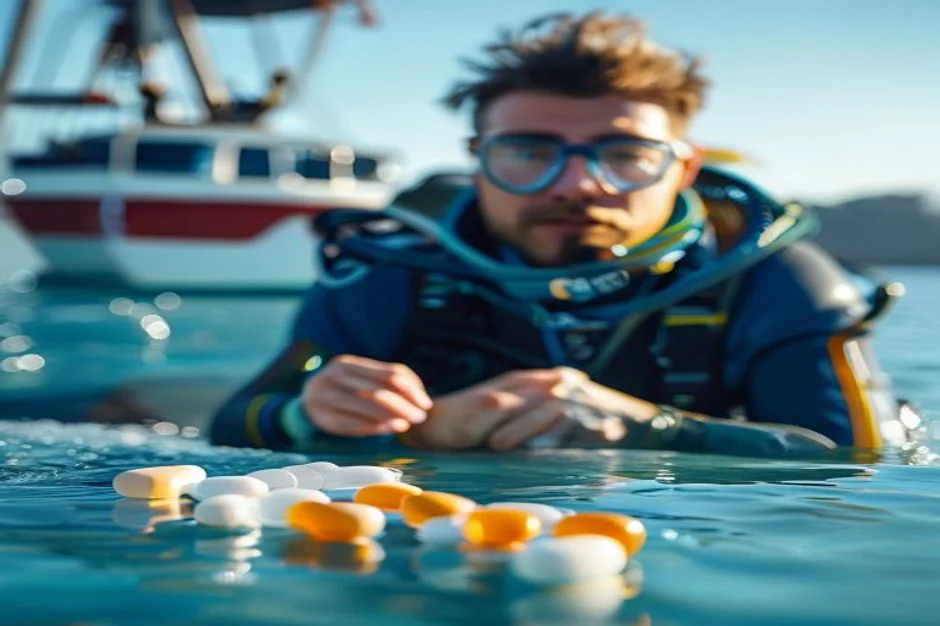
Allergy antihistamines like Reactine, Claritin, Aerius, and Zyrtec seem harmless, and plenty of divers pop one before getting in the water without a second thought. The reality is different: they can cause serious equalization problems, underwater drowsiness, and interact with pressure in ways that are hard to predict. This guide covers which OTC drugs are acceptable, which are not, and why only a hyperbaric medicine physician can make that call.
Modern antihistamines are safe for daily surface use, but their behavior changes under pressure. Three reasons matter here. First, rebound congestion: even though they dry out mucous membranes initially, within a few hours they can trigger swelling that blocks equalization on ascent. Second, sedation: despite second-generation drugs being marketed as non-drowsy, hydrostatic pressure amplifies sedative effects in ways that surface testing never reveals. Third, narcosis interaction: below 25 m, sedative properties stack directly on top of nitrogen narcosis.
The most problematic substances break down like this. Diphenhydramine (Benadryl) is heavily sedating and simply off the table for diving. Cetirizine (Reactine, Zyrtec) is second-generation and carries moderate sedation risk — enough to be dangerous underwater. Loratadine (Claritin) sedates less but the rebound congestion risk remains real. Pseudoephedrine (Sudafed) is not an antihistamine but a decongestant, and it brings its own cardiovascular stress under pressure. The practical rule: any OTC allergy or cold drug needs a dive physician's sign-off before you enter the water.
Here is why equalization fails: antihistamines dry the mucous membranes at first, which feels like a good thing for clearing the ears. But the decongestant window is only 4-6 hours. A dive lasting 60-80 minutes can eat through that window entirely. By the time ascent begins, the mucosa rebounds and swells right when air needs to vent from the ear. The result is an ear barotrauma from blockage. I have seen this happen to divers who took Reactine before their first dive of the day and bled from their ear during the second.
What actually works in some situations: skipping the dive entirely when allergy or cold symptoms are present is always the right answer. Nasal saline rinses before entering the water help without introducing any drug. If you have well-controlled chronic allergic rhinitis and your dive physician has specifically cleared you, a second-generation antihistamine like Claritin taken four hours before the dive may be tolerable — but that judgment belongs to the physician, not to you as a recreational diver.
Other problematic medications worth knowing about: aspirin and anticoagulants affect clotting and raise the bleeding risk from barotrauma. Sedatives like Valium or Xanax are completely off-limits. Cannabis in any form is completely off-limits. Alcohol is off-limits before diving, during surface intervals, and for a minimum of 8 hours after. Ibuprofen is generally considered safe but should still be confirmed with a physician. Antidepressants in the SSRI class are generally safe but require individual assessment.
What most dive centres never tell you: the majority of operators do not ask about medication at all. That makes it entirely your personal responsibility. Your general practitioner probably has no working knowledge of how drugs behave under hyperbaric conditions. What you need is a physician specialised in hyperbaric medicine — DAN maintains a worldwide directory of dive medicine specialists. A consultation runs 80-150 € and is the only reliable way to understand which medications are compatible with your specific medical profile.
If something goes wrong during a dive: any sign of poor equalization or unusual sedation after taking medication is a signal to ascend in a controlled manner and abort the dive. On the surface, confusion, abnormal drowsiness, or loss of coordination all warrant immediate medical evaluation. The interaction between medication, pressure, and narcosis is unpredictable and can require a hyperbaric chamber for treatment.
The bottom line is straightforward: no new medication before diving without clearance from a dive physician. Frequent allergies or colds are a reason for a full medical evaluation before continuing to dive, not a reason to self-medicate on the boat. Divers on chronic medication should schedule an annual review with a hyperbaric medicine specialist. The gap between taking Reactine and jumping in versus consulting a physician first can be the gap between a holiday and a hospital stay.