Discover everything about technical diving: wings and harnesses, sidemount, underwater scooters, OSTC computers and gases such as trimix.
Technical diving represents the frontier between recreational diving and a discipline that demands a different level of commitment, knowledge, and equipment. It is not simply a matter of going deeper or staying underwater longer: it is a different philosophy that involves meticulous planning, absolute mastery of equipment, and a mindset oriented toward risk management. Before taking this step, most training agencies require at least one hundred documented recreational dives. This threshold is not arbitrary: it ensures that the diver has developed precise buoyancy, breath control, and problem-solving ability in variable environments.
The first major change experienced by those who enter the technical world is the harness system. Dorsal wings — known as wing and backplate systems — replace the traditional buoyancy compensator device (BCD) jacket. This system offers a more hydrodynamic horizontal position in the water, facilitates modular cylinder configuration, and allows a more balanced weight distribution. The backplate, typically made of stainless steel or aluminum, is adjusted with precision and does not yield to pressure at depth as some synthetic materials can.
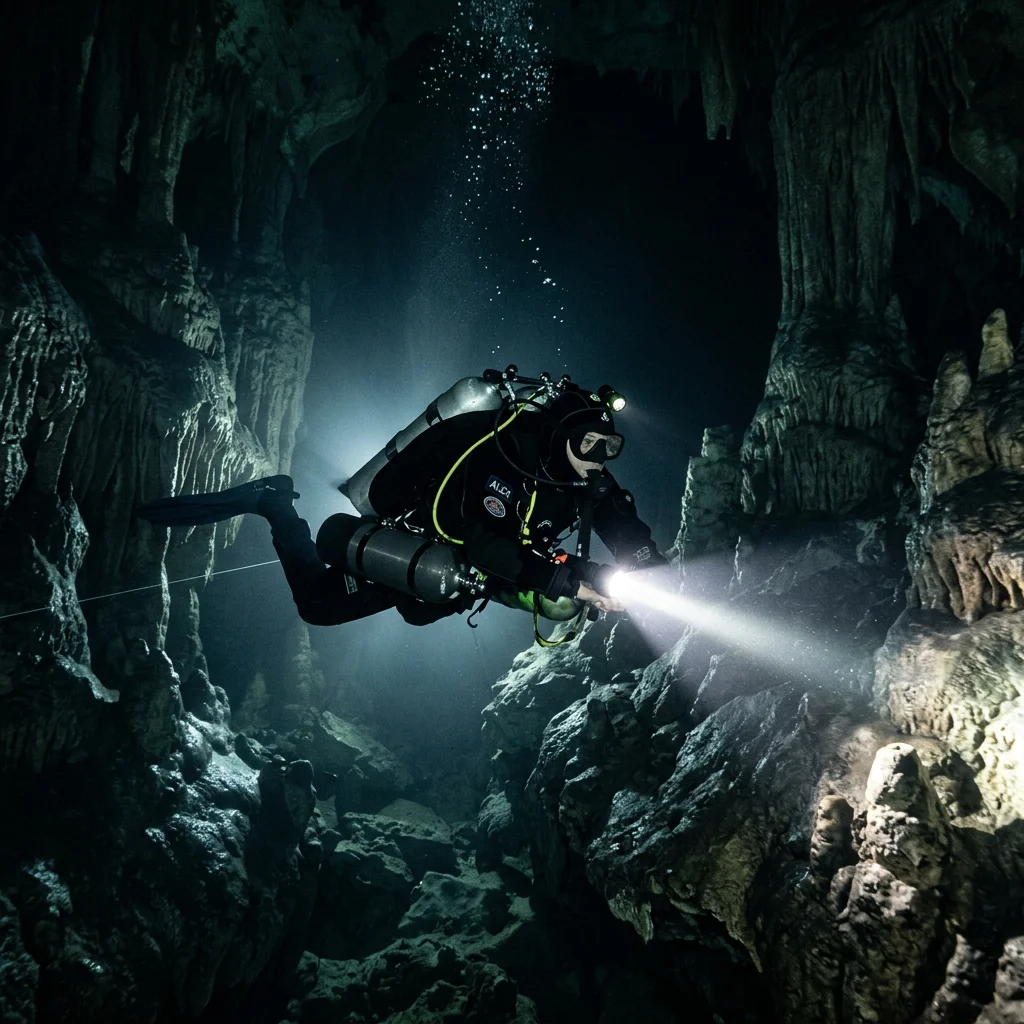
The sidemount configuration has gained enormous popularity in recent years, both in cave diving and in wreck dives with confined spaces. Instead of carrying cylinders on the back, they are positioned on each side of the body, attached to the harness via clips. This allows the diver to visually access the regulators during the dive, easily manage a faulty cylinder, and pass through passages where it would be impossible to enter with a back-mounted configuration. Sidemount also reduces spinal stress at the surface and makes gearing up from the water easier.
Underwater scooters, known as DPVs (Diver Propulsion Vehicles), are another common tool in the technical arsenal. They allow divers to cover large horizontal distances inside a cave, an extensive wreck, or a deep reef while conserving gas and energy. Their use requires specific training: handling a DPV at great depth demands more rigorous gas planning, since a scooter can carry the diver far from the entry point in a very short time.
The dive computer is the brain of any technical dive, and the OSTC is one of the most widely used in the European community. Originally developed as an open-source project, the OSTC allows programming of multiple gases including pure oxygen for decompression, adjusting algorithm parameters, connecting wireless pressure transmitters, and exporting dive profiles for later analysis.
Trimix — a mixture of oxygen, nitrogen, and helium — is the reference gas for deep dives in technical diving. The helium replaces part of the nitrogen, drastically reducing the risk of narcosis and allowing clear thinking at depths where a diver on compressed air would already be seriously impaired. Gas planning for a technical trimix dive can involve three or four different cylinders.
Cave diving in the Pozo Azul system in the province of Burgos is one of the most extreme examples a technical diver can find in Spain. This karst system has galleries explored for more than ten kilometers underground, with submerged sections at depths of tens of meters and access points that require sidemount configuration and DPV. The P-valve — a valve that allows urinating inside a drysuit without compromising its watertightness — is essential for multi-hour dives.
Approximately twenty percent of active technical divers have made the transition to closed-circuit rebreather (CCR) equipment. These devices recycle the exhaled gas, removing carbon dioxide via a scrubber and replenishing only the oxygen consumed. The result is a significantly greater autonomy with much smaller cylinders, the absence of bubbles, and a constant and optimal gas mix throughout the dive.