
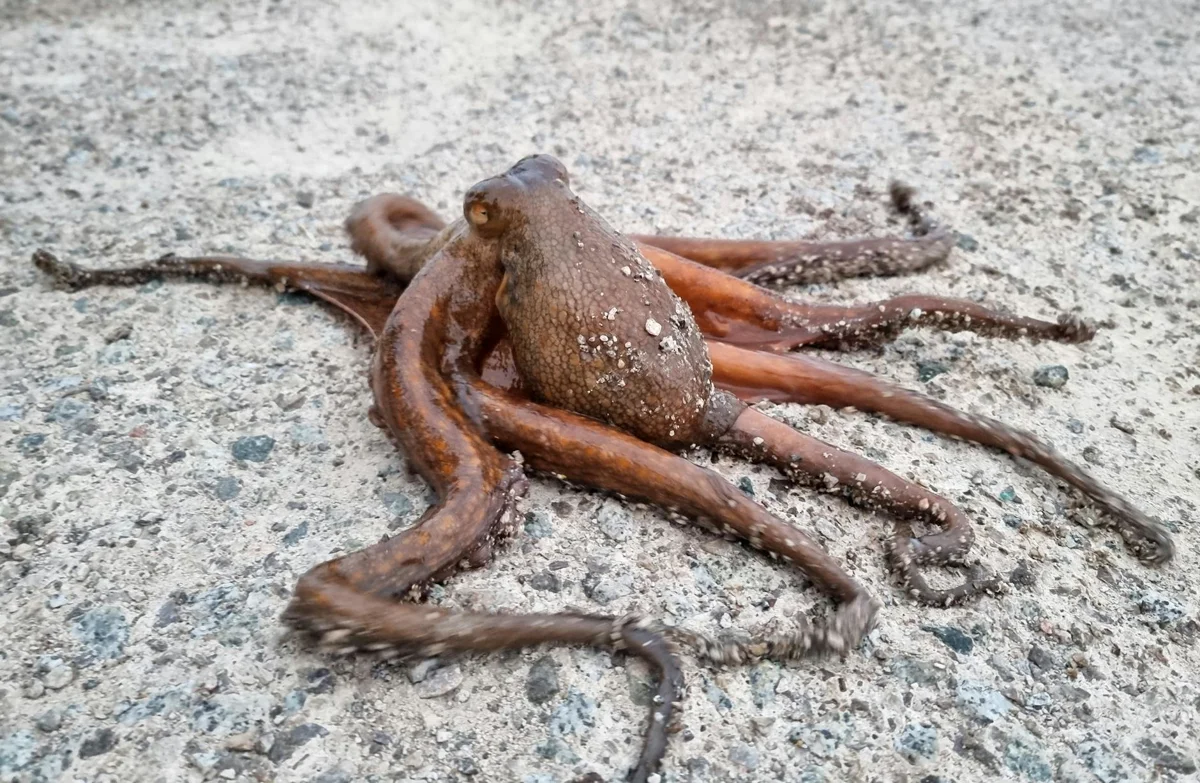
The common octopus is arguably the most photographed animal in the Mediterranean and one of the most underestimated in recreational diving. A cephalopod with a decentralised nervous system and cognitive abilities comparable to a dog, it can solve puzzles and recognise individual human faces. For attentive divers, spending 10–15 minutes with one is among the most rewarding encounters in the water.
*Octopus vulgaris* is the most widespread octopus in the eastern Atlantic and Mediterranean. It inhabits depths of 0–200 m, favours rocky seabeds with crevices for shelter, and lives alone except during reproduction. Adults weigh 2–10 kg with tentacles reaching 60–90 cm. Each animal carries 8 tentacles bearing 240 suckers apiece — 1,920 in total — along with 9 brains (one central, one per arm) and 3 hearts. By any measure of comparative physiology, this is a biological alien living alongside us.
The intelligence question: research by neurobiologists Peter Godfrey-Smith and Jennifer Mather demonstrates that octopuses open jars with screw lids, navigate mazes, remember individual human faces (distinguishing friendly handlers from hostile ones), and display what looks unmistakably like personality — some individuals bold, others shy, a few consistently aggressive. This cognition evolved entirely independently from vertebrate intelligence in mammals and birds, making the octopus a second, separate origin of complex thought on Earth.
Finding them: the common octopus is cryptic by design. It matches substrate colour and texture within fractions of a second. Trained divers look for three clues: 1) a scatter of crab shells, empty bivalves, and broken molluscs in front of a rock hole — this is the octopus's front door. 2) Sucker movement visible at a cave entrance. 3) Yellow eyes in deep shadow. Novice divers swim straight past occupied lairs; experienced divers read these micro-details.
The interaction: octopuses are not aggressive toward divers outside the reproductive season, when territorial males may posture. Approach slowly, neutralise your buoyancy, and hold still — a curious individual will typically emerge, extend one tentacle to probe your gear, and remain within arm's reach for 5–15 minutes. That proximity is exceptional for underwater macro work. Touching the animal is not recommended: handling causes stress and, in extreme cases, can trigger self-cannibalism of the arms.
Colour changes: chromatophores — pigment cells controlled directly by the nervous system, not by visual input — allow an octopus to shift colour in under one second. Red signals alertness; white signals relaxation; mottled brown signals camouflage against rock. Paradoxically, octopuses are colour-blind. Capturing a rapid chromatic transition with a calibrated flash is technically demanding but produces some of the most striking macro frames possible in temperate waters.
Range and best sites: the common octopus is abundant across the Mediterranean, Black Sea, eastern Atlantic from Marruecos to Galicia and southern Norway, and the western Caribbean (as *Octopus insularis*). In Spain, Galicia — Cíes, Cabo de Peñas — yields the largest specimens (5–6 kg), fattened on nutrient-rich cold upwellings. Mediterranean sites such as Medas and Cabo de Gata offer higher encounter frequency but smaller animals. Night dives increase sighting rates considerably.
Hunting behaviour: octopuses hunt at the day-night boundary, at dusk. Divers who time their entry accordingly may witness a full hunt: the animal stalks a crab, envelops it in a curtain of tentacles, transports it back to the den, and feeds. The simultaneous processing required — eight coordinated arms, decentralised tactile sensing, chemoreception, hydrodynamic detection — exceeds what most vertebrates handle in parallel.
Slow observation is the method: the common octopus rewards divers willing to forgo breadth for depth. No distant liveaboard is needed — any rocky European or Caribbean shoreline holds octopuses. What it demands is patience, a deliberate approach technique, and the decision to spend 15–20 minutes with a single animal rather than ticking species off a list. The payoff is contact with an intelligence that is genuinely alien to ours, arrived at by a completely separate evolutionary path, watching you back.