
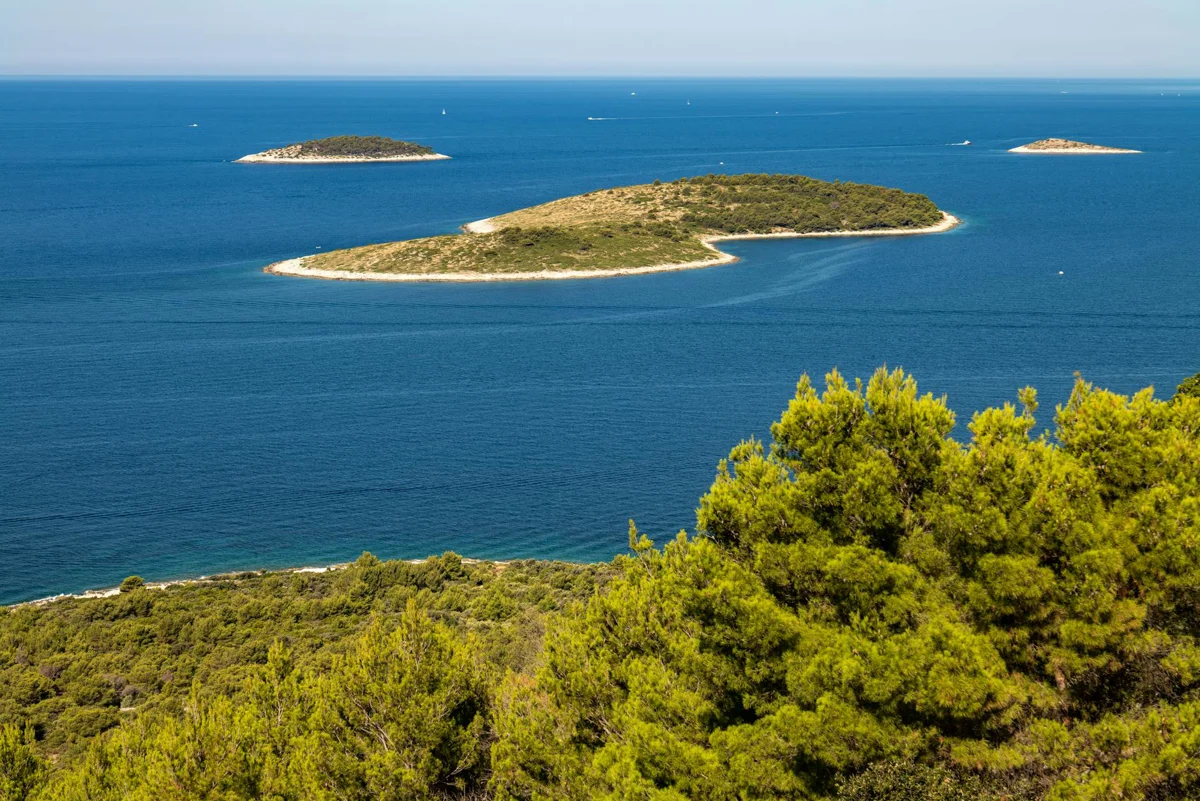
The Kornati archipelago — 89 islands in Croatia's Adriatic, protected as a National Park since 1980 — remains one of Europe's least-spoiled dive destinations. Warm, clear water, sheer limestone drop-offs, healthy Mediterranean reef life, and small family-run dive centres that haven't yet traded quality for volume. Against Italy or Spain, it feels like a different era.
The Kornati lie on Croatia's central coast between Zadar and Šibenik: 89 islands and islets packed into 35 km², nearly all uninhabited. The bedrock is limestone — similar to Malta or Mallorca — but many islands carry distinctive 'krune', vertical cliffs that plunge straight into the sea and keep dropping to 80–100 m below the surface. The result is that almost every dive here is a wall dive; sand or coralligene flats are the exception.
Visibility and water conditions: the Adriatic delivers 25–40 m of visibility for most of the year at this latitude. Water temperature ranges from 13 °C in February to 25 °C in August. May, June, September and October offer the best windows. Being a semi-enclosed sea, the Adriatic is more stable than the Tyrrhenian or Aegean, though that also means fewer pelagic encounters. What you find instead is rich benthic life: gorgonians, sponges, lobsters, grouper, conger eels, moray eels, nudibranchs.
Standout sites: the Mali Obručan wall drop-off (to −40 m), the wreck of the Francesca da Rimini (an Italian merchant vessel sunk in 1944, lying at 35–50 m — advanced or nitrox only), the cave at Ravni Žakan, and the Piškera cliffs. The site locals recommend most is the Klobučar kruna, where at 30 m the reef presents red gorgonians reaching 80 cm across — specimens that have largely vanished from other parts of the Mediterranean.
What sets Croatian diving apart: centres are small, mostly family-run, and cap groups at six to eight divers. That alone changes the feel of the day compared with Italy or Spain, where sixteen people on a boat is unremarkable. The guide learns your kit and comfort level on the first dive, adjusts the profile accordingly, and there is no sense of a conveyor belt. The trade-off is reduced flexibility: miss the 09:00 departure and you wait for the 14:00 slot.
Getting there: fly into Zadar or Split and hire a car — around 40 minutes to the departure harbours at Sali, Murter, or Žirje. Accommodation in the fishing villages runs 60–80 € per night for a double room in a pension. Diving prices: 35–50 € per guided dive, five-dive packages at around 180 €. National Park fees are charged separately at 8–12 € per day. Language: English is universal at dive centres; German is common; Italian works in the more touristed areas.
The first surprise: the marine fauna is noticeably better preserved than at comparable Mediterranean destinations. The reason is partly historical — during communist Yugoslavia, recreational fishing pressure in the Croatian Adriatic was low — and partly institutional: since independence in 1991, Croatia's National Parks have been managed with real budgets. Lobsters appear in dozens on a single dive, adult grouper don't bolt, and deep-water coral (*Dendrophyllia ramea*) still forms healthy colonies at 35–45 m.
The main disappointment: pelagics are largely absent. There are no reliable tuna migrations, no sharks, and rays are uncommon. If you arrive expecting barracuda schools like those off Cabo de Palos, Croacia will feel quiet. This is precise, detail-oriented benthic diving — wall life, macro photography, medium-field portraits. For open-water megafauna the Red Sea or Galápagos operate in a different league.
The bottom line: Kornati suits an experienced Mediterranean diver looking for something off the standard circuit. Exceptional visibility, well-preserved walls, professional small-group centres, sensible prices, and the rare feeling of diving a sea that hasn't been exhausted yet. A five- or six-day trip in September, given decent weather, stands up against any European diving destination. For a quick one- or two-day stop the logistics argue against it. Come properly equipped with time, or don't bother.